Bitcoin vs Ethereum: diferencias clave explicadas
Essential Points
- Bitcoin functions as a digital store of value; Ethereum is a programmable platform where applications are executed using smart contracts.
- The most technical difference between Bitcoin and Ethereum is in the consensus: Bitcoin uses Proof of Work and Ethereum migrated to Proof of Stake after "The Merge" in 2022.
- Bitcoin has a fixed maximum supply of 21 million; Ethereum has no fixed cap, but burns some of its fees since the EIP-1559 upgrade.
- Choosing between the two is not a question of "which is better", but of what problem you want to solve: storing value or building on a programmable infrastructure.
When someone starts to take an interest in digital assets, they almost always end up asking the same question: what are the real differences between Bitcoin and Ethereum? They constantly appear together in news stories, rankings, and conversations, and it's common to assume they're competing for the same position, as if one were simply an improved version of the other. The reality is different: they were created with different objectives, they solve different problems, and their technical design reflects that difference from the ground up.
This article compares Bitcoin and Ethereum in the aspects that truly matter for understanding the ecosystem: purpose, consensus mechanism, monetary policy, use cases, and transaction speed and cost. You'll also find a comparison table designed for quick reference, allowing you to draw your own conclusions without needing prior blockchain knowledge.
Within the European Union's regulatory framework, the MiCA (Markets in Crypto-Assets) Regulation, in force since 2024, establishes the conditions under which cryptocurrency service providers (CSPs) operate. BITCOINFORME, PSC, SL, which operates under the trade name of Bit2Me, is a crypto asset service provider authorized and regulated by the National Securities Market Commission (CNMV) in Spain, in accordance with Article 59 of Regulation (EU) MiCA.
Important noticeThis article is for educational and informational purposes only. The content does not constitute financial, legal, or tax advice. The acquisition of crypto assets is not fully regulated, may not be suitable for retail users due to their high volatility, and carries a risk of total loss of the amounts invested. Consult a qualified professional before making any acquisition decision.

Main Cryptocurrencies Course
Basic levelBit2Me Academy We bring you a new course where you will learn everything you need to know about the most important cryptocurrencies that exist today.
Empezar ahora ›Bitcoin and Ethereum: what they are and what purpose each serves
Bitcoin was born in 2009 as the first decentralized digital asset, with a specific goal: to allow value transfers between two people without the need for a bank or intermediary to authorize them. Its design is optimized for that and little else. Each block on the network confirms transactions, and the protocol prioritizes security and predictability over flexibility, which has solidified Bitcoin as a kind of "digital gold": an asset designed primarily to preserve value over time, not to execute complex logic on it.
Ethereum, launched in 2015, shares the underlying blockchain technology but pursues a different goal. Instead of simply moving an asset from one place to another, Ethereum incorporates a virtual machine capable of executing programs called smart contracts (smart contracts): code that runs automatically when certain conditions are met, without third-party intervention. This capability transforms Ethereum into a programmable platform on which other developers build applications, not just a digital asset to be bought and held.
This fundamental difference between Bitcoin and Ethereum explains almost all the others. Bitcoin was designed as a peer-to-peer digital currency system, deliberately simple and difficult to modify. Ethereum was designed as a general-purpose infrastructure, deliberately flexible so that third parties can build new things on top of it. Neither design is inherently superior: each optimizes for a different problem, and that distinction is crucial to understand before comparing any other technical aspects.
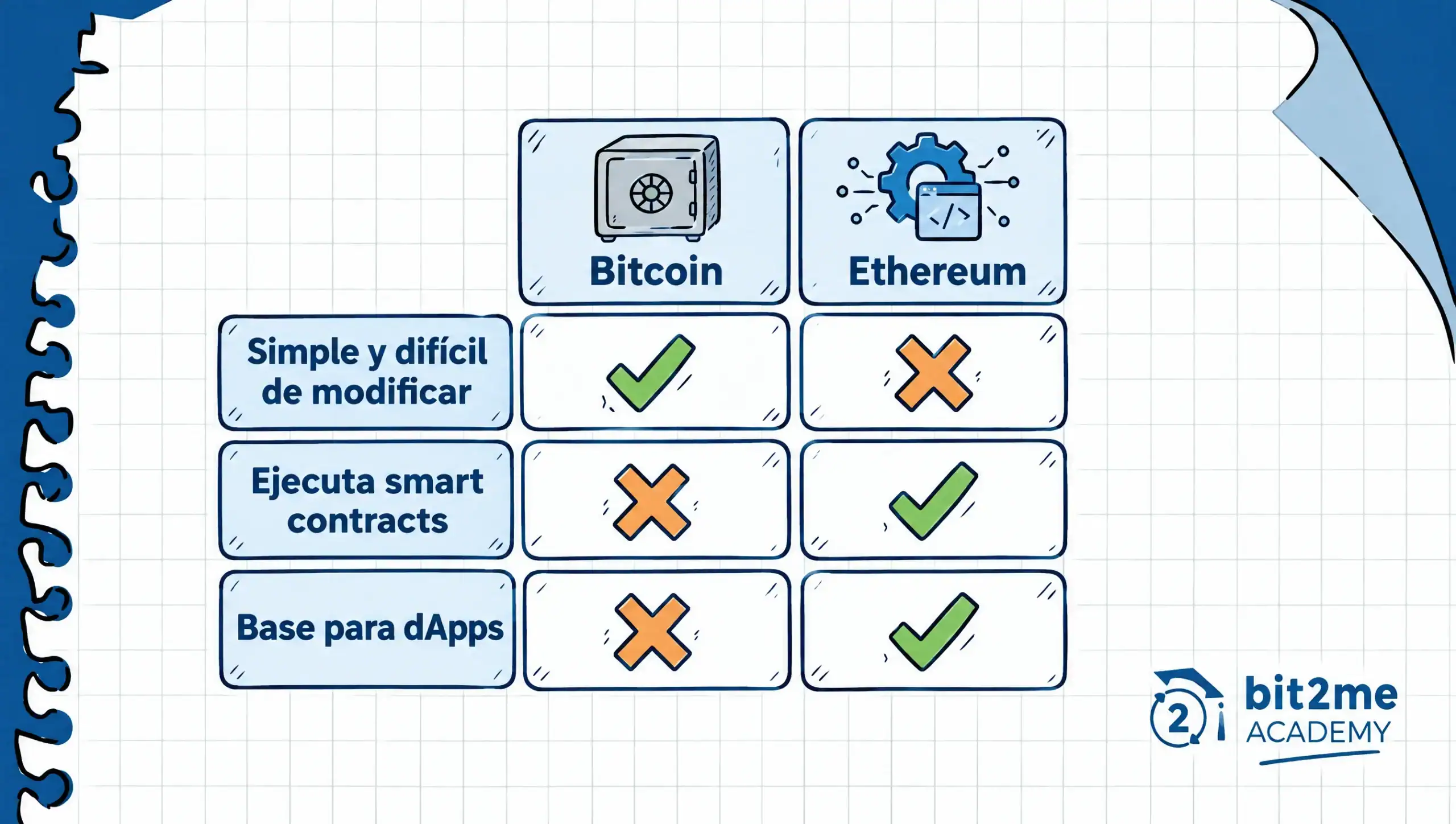
Bitcoin vs Ethereum: Comparison chart of key differences
Before going into the technical details of each aspect, this table summarizes the comparison of bitcoin vs ethereum in the five criteria that structure the rest of the article.
| Appearance | Bitcoin | Ethereum |
|---|---|---|
| Main purpose | Decentralized digital store of value asset | Programmable platform for smart contracts and decentralized applications |
| Consensus Mechanism | Proof of Work (PoW) | Proof of Stake (PoS), since «The Merge» (September 2022) |
| Monetary politics | Fixed maximum supply of 21 million BTC, with periodic halving | No fixed issuance limit; part of the commissions are burned since EIP-1559 |
| Primary use case | Storing value, peer-to-peer transfers | DeFi (Decentralized Finance), NFTs, dApps, tokenization |
| Approximate block time | ~10 minutes | ~12 seconds |
| Standard scaling layer | Lightning Network (second layer) | Rollups and Layer 2 (Arbitrum, Optimism, Base, among others) |
This table isn't meant to declare a winner, but rather to highlight that each network competes in a different league. Bitcoin prioritizes security, simplicity, and monetary predictability; Ethereum prioritizes flexibility, programmability, and speed of innovation. With this general overview in mind, it makes sense to delve into each criterion separately, starting with the one most often misunderstood: the consensus mechanism.
Consensus Mechanism: Proof of Work vs. Proof of Stake
The consensus mechanism is how a blockchain network agrees on which transactions are valid without relying on a central authority. Bitcoin uses Proof of Work (PoW): thousands of specialized teams compete to solve a complex mathematical calculationWhoever solves it first adds the next block to the chain and receives a reward in BTC. This computational effort, verifiable by the rest of the network, is what makes attempting to alter Bitcoin's transaction history extremely costly.
Ethereum operated under PoW during its early years, but in September 2022 it completed a historic transition known as "The Merge", switching to PoS Proof of Stake (PoS) is used as a consensus mechanism. According to Ethereum's official documentation (ethereum.org, accessed in 2026), in PoS, participants—called validators—lock ETH as collateral instead of performing calculations with hardware. The network periodically selects validators to propose and confirm blocks, and those who act improperly can lose some of their locked ETH, a penalty mechanism known as slashing.
This difference in consensus between Bitcoin and Ethereum has practical consequences beyond the purely technical. The switch to Proof-of-Stake (PoS) reduced Ethereum's energy consumption by more than 99%, according to estimates from the Ethereum Foundation itself published after the Merge, because it no longer depends on mining hardware operating continuously. Bitcoin, on the other hand, deliberately maintains Proof-of-Work (PoW): the community that supports the protocol believes that this energy expenditure is precisely what gives the network its level of security and immutability, and any change to this mechanism would alter one of the properties that have defined the asset since its inception.
Monetary policy: fixed maximum supply versus a model of issuance with burning
Each network's monetary policy defines how many units will exist and at what rate they are created, and this is where one of the most frequently cited differences between Bitcoin and Ethereum outside of the technical sphere arises. Bitcoin has a fixed maximum supply of 21 million BTC, a limit that has been part of the protocol's code since its inception and cannot be modified without near-unanimous consensus from the entire network. This supply is released in decreasing amounts. through the halving, a scheduled event that halves the block reward approximately every four years, slowing the issuance of new BTC until the peak is reached in the last decades of this century.
Ethereum operates under a different logic: there is no fixed maximum ETH supply in the protocol code. Instead, the issuance adjusts dynamically based on how many validators participate in the Proof-of-Stake (PoS) consensus. Since August 2021, it has incorporated an additional mechanism introduced by the Ethereum Improvement Proposal (EIP) 1559: a portion of each transaction fee, the so-called base fee, is destroyed or "burned" instead of being distributed to validators. When network activity is high, this burn can offset or even exceed new ETH issuance, leading to periods where the total supply decreases rather than increases.
The practical consequence is that Bitcoin offers a completely predictable and predetermined monetary policy, while Ethereum offers a dynamic monetary policy that responds to actual network usage. Neither offers guarantees about the future value of the asset: monetary policy explains how units are created or destroyed, not what their market price will be, and any projection on that point is beyond the scope of this article.
Use cases: value reserve versus programmable infrastructure
Bitcoin's primary use case remains the one that motivated its creation: to serve as a digital asset for transferring and storing value without relying on traditional financial intermediaries. Its deliberate simplicity—it doesn't run complex smart contracts or host applications—is part of its value proposition, not an accidental limitation. Those who allocate a portion of their digital assets to Bitcoin typically do so with a long-term perspective, treating it as a digital store of value comparable, albeit on a different scale, to the role that physical gold has historically played.
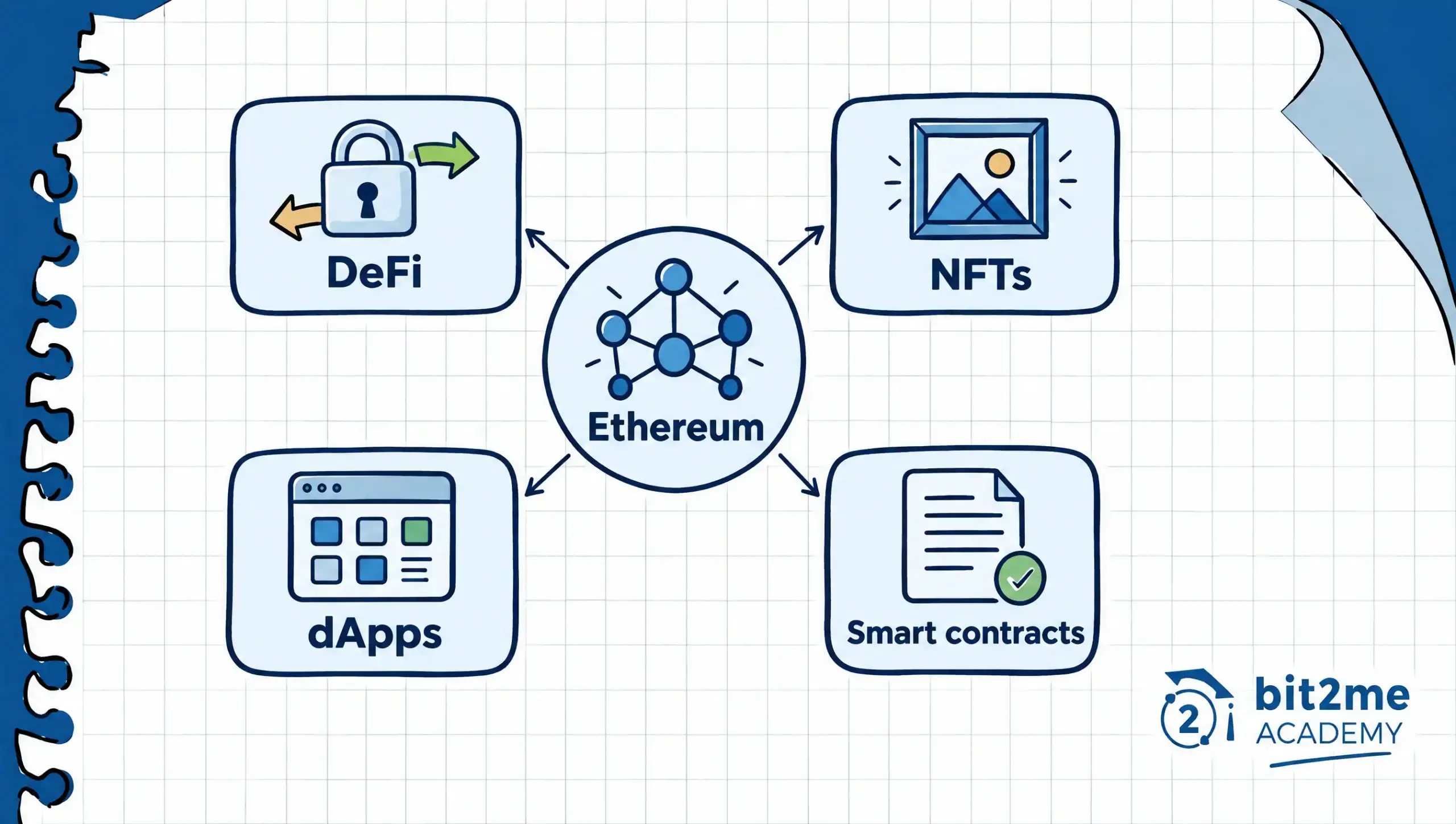
Ethereum, on the other hand, functions as the infrastructure upon which much of what is now known as Web3 is built. Regarding its blockchain DeFi protocols operate Decentralized finance (DFi) replicates financial services—loans, exchanges, markets—without banks; it issues and manages NFTs, non-fungible tokens that represent sole ownership of a digital asset; and it deploys thousands of decentralized applications (dApps) ranging from games to digital identity systems. This versatility is possible precisely because Ethereum sacrificed some of Bitcoin's simplicity in exchange for programmability.
This doesn't mean that both use cases are mutually exclusive for the same user. It's common for someone to hold Bitcoin as part of their long-term digital asset portfolio while using Ethereum to access DeFi protocols, acquire NFTs, or interact with specific applications. Anyone wanting to start with either path can consult the guide in Bit2Me Academy about how to buy bitcoin or the guide on how to buy Ethereum, both designed to help you take the first step with sound judgment before deciding how much to allocate to each asset.
Speed and transaction cost: what to expect on each network
Confirmation speed and transaction cost are, in practice, the first things anyone who starts using both networks notices. Bitcoin generates a new block approximately every 10 minutes, and its base layer processes a small number of transactions per second, which can result in higher fees and longer wait times when the network is congested. To expedite small and frequent payments, Lightning Network exists, a second-layer (Layer 2) solution that allows for near-instant transactions with minimal fees off the main chain, settling the final result in Bitcoin when appropriate.
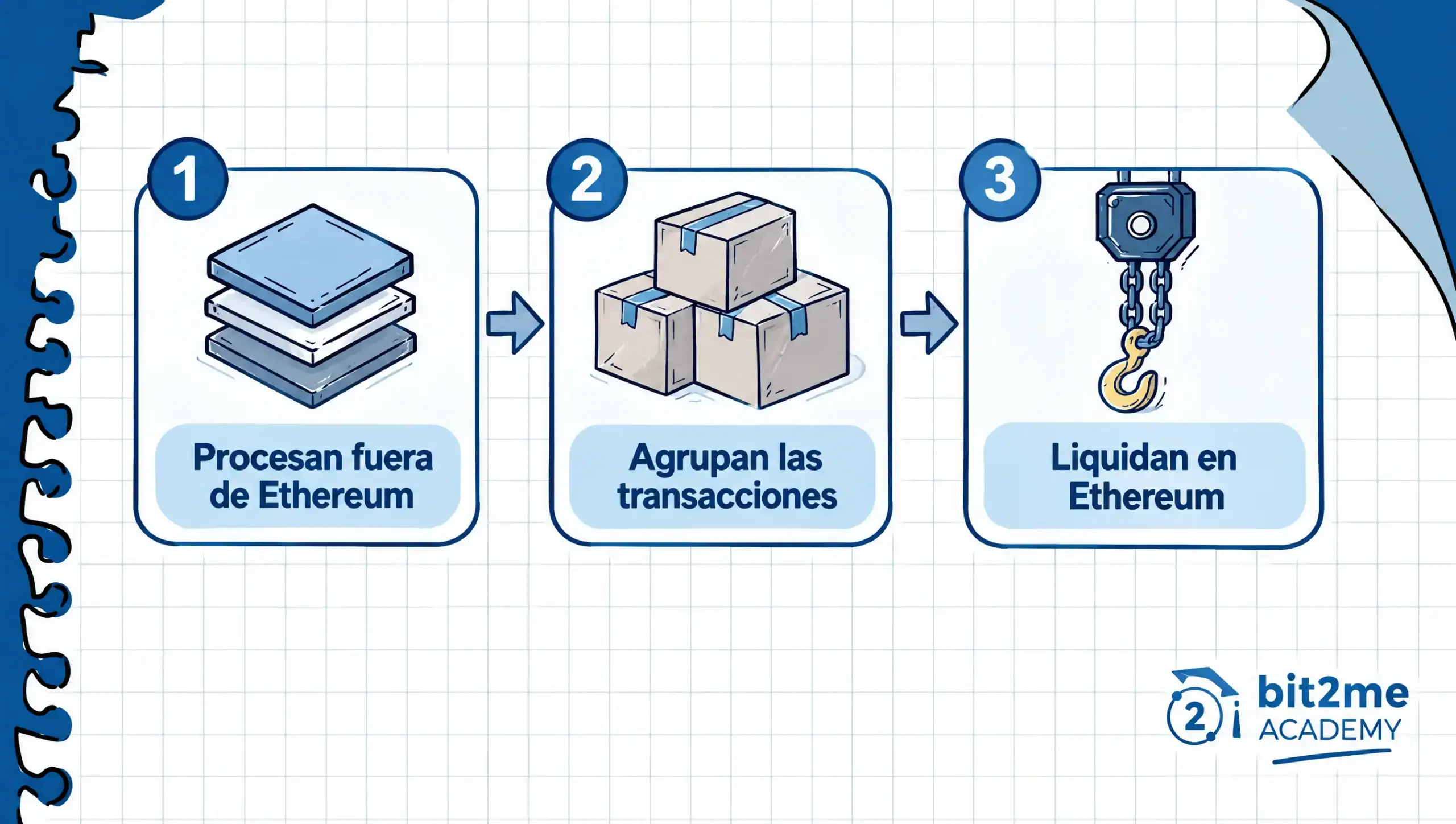
Ethereum confirms blocks approximately every 12 seconds, significantly faster than Bitcoin at its base layer, but this doesn't always translate to low fees. The cost of each transaction is paid in gas, denominated in Gwei, and fluctuates according to network demand: during periods of high congestion, executing a smart contract or a complex transaction can be expensive. To mitigate this, the Ethereum ecosystem increasingly relies on... Layer 2 solutions such as Arbitrum, Optimism, or Base, which process transactions outside the main layer and group them before settling them on Ethereum, drastically reducing the cost per individual transaction.
In both cases, the comparison between Bitcoin and Ethereum in terms of speed and cost depends on both the core protocol design and the scaling ecosystem built around it. Neither network solves the scalability problem solely at its core layer; both rely, to varying degrees, on additional infrastructure to deliver fast and inexpensive transactions at scale.
Current state: Bitcoin and Ethereum as of December 2026
As of December 2026, Bitcoin maintains its position as the digital asset with the largest market capitalization in the ecosystem, with virtually all of its 21 million BTC already in circulation following successive halvings, the last of which took place in April 2024 and reduced the block reward to 3,125 BTC. Ethereum, meanwhile, continues to operate under Proof-of-Stake (PoS) with several million ETH. locked in staking by validators across the network, according to public estimates from explorers such as beaconcha.in consulted at the end of 2026, and its Layer 2 ecosystem continues to absorb a growing proportion of total transaction activity.
Both networks continue to evolve under the supervision of the European regulatory framework: in the European Union, the MiCA Regulation governs cryptocurrency service providers that allow the purchase and custody of Bitcoin, Ethereum, and other digital assets, while the technical development of each protocol—new proposed improvements in Ethereum, adjustments to the Lightning Network in Bitcoin—continues to progress independently of the legal framework. It is advisable to periodically check official sources such as ethereum.org or bitcoin.org before considering specific figures as definitive, since both ecosystems change relatively frequently.
How to choose between Bitcoin and Ethereum based on your goal
You don't have to choose one exclusively to start familiarizing yourself with digital assets. If your goal is to have a digital asset designed as a long-term store of value, with a fixed and predictable monetary policy, Bitcoin is a better fit for that priority. If you're looking to interact with decentralized applications, participate in DeFi protocols, or explore NFTs, Ethereum is the natural entry point to that ecosystem.
Many people who have been in the industry for a while end up allocating part of their digital assets to each, precisely because they don't compete for the same objective. Before deciding how much to allocate to each asset, it makes sense to fully understand their differences—which is exactly what we've covered in this article—and, if you don't yet have either, to take the first step in an environment designed to guide you through that decision.
You can create an account at Bit2Me To begin familiarizing yourself with buying Bitcoin and Ethereum, always review the dedicated guides of Bit2Me Academy Before confirming any purchase, understanding Bitcoin vs. Ethereum isn't just an academic exercise: it's the first real criterion for deciding what role you want each digital asset to play in your own strategy, taking your time and having the information you need to do so calmly.
Frequently Asked Questions about Bitcoin vs Ethereum
What is Bitcoin and what is it used for?
Bitcoin is the first decentralized digital asset, created in 2009 to enable transfers of value between individuals without relying on banks or intermediaries. It functions primarily as a digital store of value, with a fixed maximum supply of 21 million units.
What is Ethereum and how is it different from Bitcoin?
Ethereum is a programmable blockchain platform capable of executing smart contracts, allowing decentralized applications to be built on top of its network. The fundamental difference between Bitcoin and Ethereum is that Bitcoin is designed to be a simple and secure asset, while Ethereum is designed to be flexible and programmable.
What is the most important technical difference between Bitcoin and Ethereum?
The most relevant technical difference lies in the consensus mechanism: Bitcoin uses Proof of Work, based on solving calculations with specialized hardware, while Ethereum has used Proof of Stake since 2022, based on validators that lock ETH as economic collateral.
How does the Proof of Stake used by Ethereum work?
Validators lock up ETH as collateral and are periodically selected to propose or confirm blocks on the chain. If they act correctly, they receive rewards; if they act incorrectly or remain inactive, they can lose some of that ETH through a mechanism called slashing.
Why does Bitcoin have a limit of 21 million and Ethereum doesn't?
Bitcoin incorporated this limit into its original design as a guarantee of predictable scarcity, reinforced by the periodic halving. Ethereum prioritized the flexibility of its monetary policy to adapt to the number of active validators, later incorporating fee burning via EIP-1559 as a compensatory mechanism.
Is Ethereum faster than Bitcoin?
At its base layer, Ethereum confirms blocks approximately every 12 seconds compared to Bitcoin's 10 minutes, meaning its main layer processes transactions more frequently. Both networks also utilize second-layer solutions (Lightning Network and Layer 2, respectively) to further accelerate everyday transactions.
Is Bitcoin or Ethereum safer?
Neither is "more secure" in absolute terms, because each manages security differently: Bitcoin bases it on the computational cost of Proof of Work, Ethereum on the economic capital locked in Proof of Stake. Both mechanisms have demonstrated operational resilience, although no protocol can be considered invulnerable or risk-free.
Can I use Bitcoin for DeFi or NFTs just like Ethereum?
Bitcoin wasn't designed to run complex smart contracts, so its native DeFi and NFT ecosystem is much more limited than Ethereum's. While bridge solutions exist that allow Bitcoin to be represented within Ethereum to participate in some protocols, the native functionality of the two networks is fundamentally different by design.
Should I buy Bitcoin, Ethereum, or both?
It depends on your goal: Bitcoin suits those seeking a store of value with a fixed monetary policy, while Ethereum suits those wanting access to decentralized applications, DeFi, or NFTs. Many people allocate a portion of their digital assets to each precisely because they fulfill different functions within the same portfolio.
What is the current state of Bitcoin and Ethereum in 2026?
At the end of 2026, Bitcoin will maintain almost all of its 21 million units in circulation following the April 2024 halving, while Ethereum will continue to operate under Proof of Stake with an increasingly active Layer 2 ecosystem. Both remain under the regulatory framework of the MiCA in the European Union, which regulates cryptocurrency service providers that facilitate the acquisition of both assets.


«Investment in cryptoassets is not fully regulated, may not be suitable for retail investors due to high volatility and there is a risk of losing all invested amounts»
Share this article!Continue learning

Ethereum Staking: A Practical Guide to Getting Started
Discover how Ethereum staking works, its slashing risks, and how to get started step by step: your own validator, platform, or liquid staking explained.
How to buy bitcoin in Spain safely: a step-by-step guide
Guide to buying bitcoin in Spain safely: identity verification (KYC), how to fund in euros, purchase steps and where to store it afterwards.

ETFs on Ethereum, scope and possibilities for DeFi
Ethereum ETFs are exchange-traded investment funds that track the price of Ethereum and allow investors to gain exposure to Ethereum.

WebAssembly on Ethereum: A Practical Guide to Developing with WASM
Learn to develop with WebAssembly on Ethereum: tools, installation, your first WASM contract, and how to deploy it step by step.