Errores comunes del inversor principiante (y cómo evitarlos)
- Most of the pitfalls of a novice investor do not come from the market, but from avoidable decisions before and during the investment.
- Defining the risk profile and setting a long time horizon are the two foundations that prevent most other mistakes when investing.
- Failing to diversify, ignoring fees, and chasing past returns erode capital silently, without being noticeable from one day to the next.
- Selling in a panic during a downturn often turns a temporary loss on paper into a real and permanent loss.
Every year, thousands of people take the plunge and invest in funds, stocks, or ETFs for the first time, almost always with the same goal: to make their savings work for them over the long term instead of losing value to inflation. However, experience in the financial sector reveals something that surprises many newcomers: a novice investor's disappointing results are rarely due to market behavior, but rather to a handful of investment mistakes that are repeated with almost predictable regularity.
In this article, we review the most common mistakes beginner investors make when starting to invest in funds, stocks, or ETFs, explaining the practical consequences of each and how to avoid them before they affect your capital. You'll see that several of these seven errors are interconnected, and understanding one helps prevent the others, starting with two decisions that should be made before buying your first asset: defining your risk profile and setting a realistic investment horizon.
Important noticeThis article is for educational and informational purposes only. The content does not constitute personalized investment advice or financial, legal, or tax advice. All investments in funds, stocks, or ETFs involve risk, including the possibility of losing some of your capital, and past performance is not indicative of future results. The investment services referred to in this article are provided through Bit2Me Stocks, SL, in collaboration with InbestMe, an entity authorized to manage and execute these transactions. Consult a qualified professional before making any investment decision.
Main Cryptocurrencies Course
Basic levelBit2Me Academy We bring you a new course where you will learn everything you need to know about the most important cryptocurrencies that exist today.
Empezar ahora ›The 7 most common mistakes beginner investors make, at a glance
Before going into detail, it's helpful to have the full picture in front of you. These are the most common pitfalls for those starting to invest, in the order in which they typically appear during the first year as an investor:
1. Not defining the risk profile before investing1. Choosing a portfolio blindly without knowing how much risk one can or wants to take. 2. Getting caught up in short-term market noiseReviewing the portfolio daily and reacting to headlines that do not affect a long-standing strategy. 3. not diversify4. Chasing past returns as if a good recent track record guaranteed future results. 5. Ignoring the effect of commissionswithout understanding how a seemingly small cost erodes capital in the long run. 6. Investing money that may be needed in the short term, without leaving a prior savings cushion. 7. Panic selling during downturnsturning a theoretical loss on paper into a real loss.
None of these seven mistakes are exclusive to beginners: even investors with years of experience make them when they let their guard down. What is true, however, is that when starting out, the lack of a frame of reference makes it much easier to fall into several of them at once, so it's worth reviewing them one by one carefully.
Error 1: Not defining the risk profile before investing
The first mistake when investing, and probably the one that influences all the others, is choosing a fund, a stock, or an ETF without first defining your risk profile. It's easy to understand why this happens: when someone starts out, the natural temptation is to directly search for "what to buy" instead of first asking themselves how much volatility they can tolerate, both financially and emotionally.
The practical consequence of this mistake almost always appears at the worst possible moment. If your portfolio is more aggressive than you can realistically sustain, the first significant drop will force you to sell out of fear, realizing a loss that until then only existed on paper. Conversely, if your portfolio is too conservative for your actual investment horizon, it simply won't grow enough to achieve the goal that led you to invest in the first place.
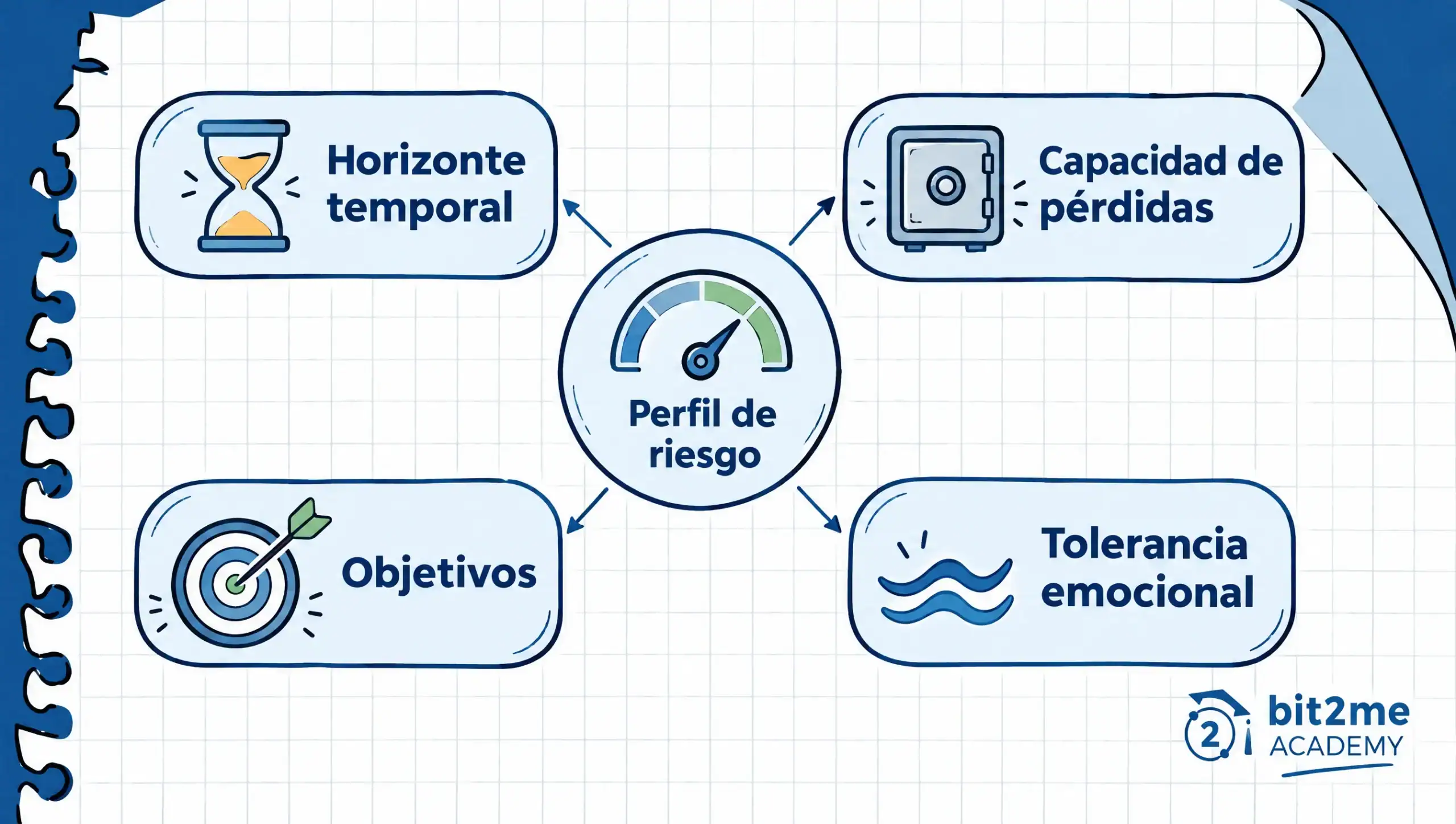
Avoiding this mistake is really more an exercise in honesty than technical expertise. Before looking at a single product, it's wise to understand what factors make up your risk profile (time horizon, capacity to absorb losses, objectives, and emotional tolerance for volatility) and how these translate into a specific type of portfolio. In the guide to Bit2Me Academy on how define your risk profile As an investor, this process is explained step by step, including how the suitability questionnaire works, which any regulated provider will apply to you before recommending a product.
Mistake 2: Getting carried away by short-term market noise
The second most common mistake when investing is treating every headline, every minor correction, or every viral opinion as an urgent signal demanding immediate action. Those starting out in investing often check their portfolio several times a day during the first few weeks, which is understandable given the novelty of it all, but in the medium term, this only fuels anxiety without providing any relevant information about a long-term strategy.
The consequence of being swept away by this noise is twofold. On the one hand, it generates reactive decisions: buying after a rise for fear of "missing out" or selling after a temporary drop out of sheer discomfort—both contrary to any premeditated plan. On the other hand, this constant level of attention makes any normal market fluctuation seem like a serious anomaly, when in reality it's part of the normal functioning of funds, stocks, and ETFs.
Avoiding this behavior involves regaining perspective on the long-term horizon before looking at today's price. The guide to Bit2Me Academy Regarding long-term investing, it elaborates in detail on why time, diversification Discipline is more important than timing your entry or exit points perfectly, and reviewing your portfolio regularly (monthly or quarterly, not daily) helps you stay on track. Setting a schedule for how often you'll review your portfolio is, in practice, an effective defense against this mistake.
Error 3: not diversifying the portfolio
Concentrating all your capital in a single fund, a single stock, or a single sector is one of the most direct mistakes: if that particular investment hits a rough patch, there's nothing else in your portfolio to cushion the blow. This is a common pattern among beginners, especially when the buying decision is driven by enthusiasm for a single company or sector that has been generating a lot of buzz lately.
The practical consequence of not diversifying is not only greater volatility, but also an excessive dependence on a single factor over which the novice investor has no real control. A single industry announcement, a regulatory change in a particular country, or even just a bad quarter for a company can disproportionately impact the entire portfolio when there is no diversification across different assets, sectors, and geographic regions.
Avoiding this concentration does not require buying dozens of separate assets. indexed funds and Diversified ETFs They allow capital to be spread across hundreds of companies, sectors, and countries with a single transaction, reducing reliance on a single successful investment. This principle directly connects to the time horizon explained earlier: the longer the target, the more sense it makes to build a diversified portfolio that can weather entire market cycles without depending on a single, concentrated investment.
Mistake 4: Chasing past returns as if they guaranteed the future
Another common mistake among beginners is choosing a fund, stock, or ETF simply because it has performed exceptionally well in recent months or years. This is an understandable human reaction: an attractive recent track record conveys a sense of security that an unknown asset doesn't offer, and platforms and media outlets tend to highlight precisely those products that have "performed best."
The practical consequence of this behavior is that investors often end up buying just when the asset's valuation already reflects all that past positive performance—that is, near a relative peak rather than at the beginning of a trend. Past performance is no guarantee of future results, and a fund or stock that has risen sharply may simply revert to its usual behavior, leaving the latecomer with a much worse experience than someone who invested before the rally.
Avoiding this mistake means evaluating any product based on how it fits your risk profile and time horizon, not on its recent performance. When historical returns are used as a selling point, it's important to check the exact timeframe and remember that this data alone offers no reliable predictions about future trends. In many ways, it's the flip side of the mistake of being swayed by market noise: here, the noise isn't a temporary dip, but rather past enthusiasm that prompts late purchases.
Error 5: Ignoring the effect of commissions
management feesCustody or intermediation fees may seem like a minor detail compared to the potential performance of a fund, stock, or ETF, and that's precisely why so many novice investors overlook them. It's one of the most insidious mistakes of all, because it doesn't become apparent overnight, but rather accumulates over the years.
The practical consequence is easy to illustrate with a simplified example: if two hypothetical portfolios performed identically before fees over twenty years, but one had a significantly higher total annual cost than the other, the final difference in accumulated capital could be considerable just by the compound effect of that cost repeated every year. The longer the investment horizon, the more any difference in fees weighs on the final result, precisely because that cost is discounted each year on an increasingly larger basis.
Avoiding this oversight starts with carefully reading what fees each product includes before signing up: management fees, custody fees, and, where applicable, subscription or redemption fees. It's not about always choosing the cheapest option without considering anything else, but about understanding that any recurring cost must be justified by the value it provides, and comparing that cost-to-service ratio before committing your capital long-term.
Mistake 6: Investing money that may be needed in the short term
One of the most immediate and consequential mistakes when investing is allocating money to funds, stocks, or ETFs that you might actually need in the coming months. Funds, stocks, and ETFs are instruments designed to remain invested over a reasonable time horizon, and their value can fluctuate significantly in short periods without indicating anything about their long-term performance.
The practical consequence of this decision becomes apparent when an unexpected event arises (a repair, a medical expense, a loss of income) and that money is only available by selling the investment, regardless of whether the market is performing well or poorly that day. In the worst-case scenario, the forced sale coincides with a temporary dip, turning a need for liquidity into a real loss that a longer investment horizon would likely have prevented.
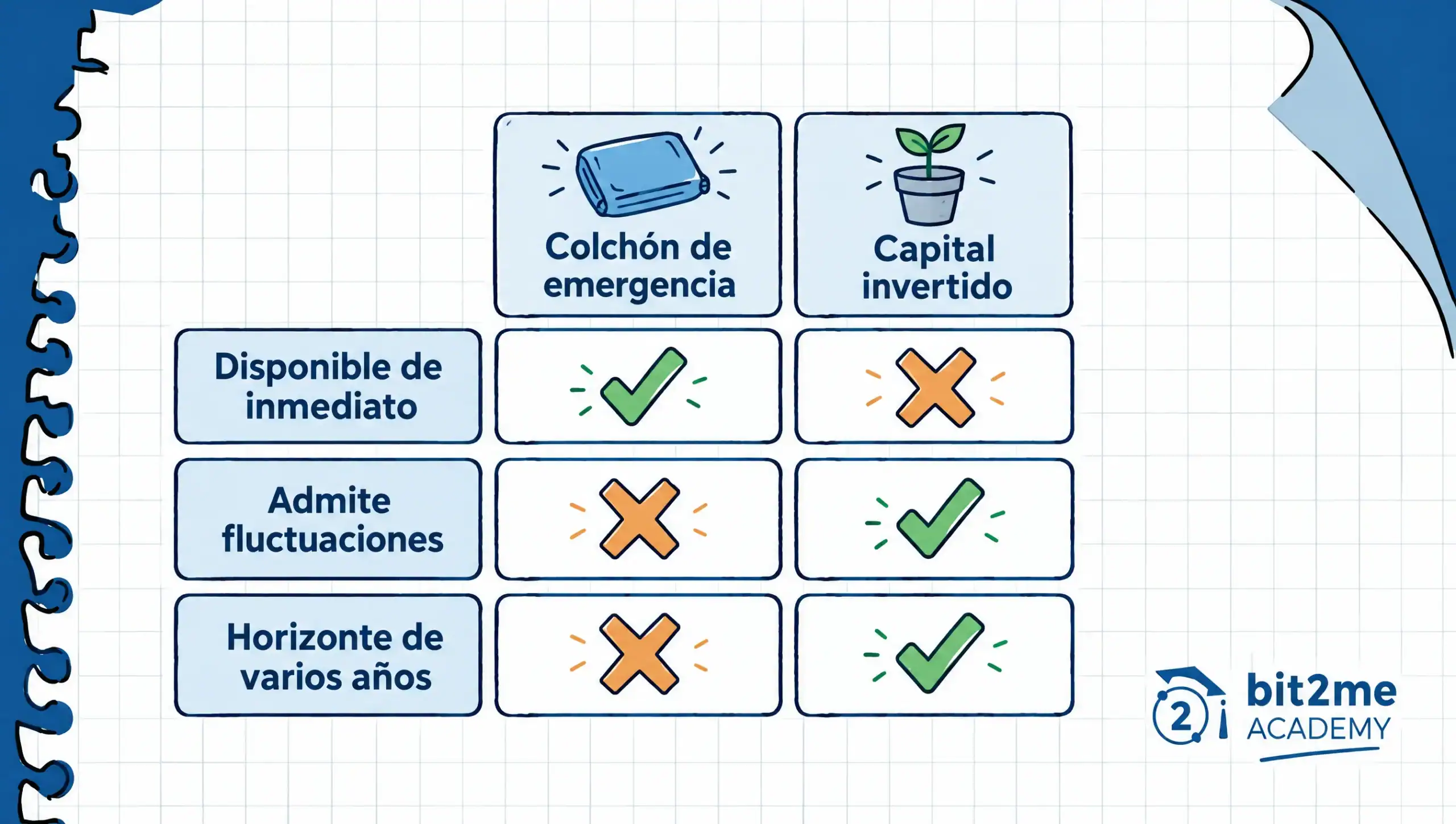
Avoiding this mistake involves clearly separating two layers of savings before investing a single euro: a emergency mattressLiquid and immediately accessible, and capital that you can realistically allocate to a multi-year horizon without compromising your financial stability. Only the second layer should be directed towards funds, stocks, or ETFs, following the same time horizon criterion already mentioned as the basis of a well-constructed long-term investment strategy.
Mistake 7: Panic selling during downturns
The seventh mistake when investing is, in many ways, the end result of several of the previous ones: selling hastily when the market is falling, driven by fear rather than a cool-headed analysis of the situation. It's the most human reaction of all, and also the one that most often turns a temporary loss into a permanent one.
The practical consequence of panic selling is twofold and particularly damaging. First, a loss that until then only existed on paper is realized; second, those who sell during a downturn often miss out on the market just as the recovery begins, because timing the re-entry is, in practice, as difficult as timing the exit. The combined result is usually much worse than having held the portfolio untouched.
Avoiding this reaction requires, above all, prevention: if the risk profile was correctly defined from the outset (error 1) and the time horizon is appropriate for the objective (error 2), a market downturn should feel like an expected event within the plan, not an emergency requiring immediate action. Before selling out of fear, it's wise to review whether something has actually changed in your situation or objective, or if the market is simply doing what markets do from time to time.
How to avoid these mistakes when investing from day one
Viewed individually, these seven mistakes share a common root cause: the lack of a defined plan before purchasing the first asset. Those who begin with a clear risk profile, a realistic time horizon, a diversified portfolio, and a separate savings cushion have already covered most of the ground where these pitfalls typically arise.
The rest is largely a matter of developing consistent habits over time. Reviewing your portfolio regularly rather than daily, being wary of any product marketed solely on past performance, understanding the true cost of fees, and remembering why every euro was invested are practices that, combined, significantly reduce the likelihood of repeating mistakes over time. None of these eliminates risk entirely, as all financial instruments carry inherent risks, but they do prevent that risk from being exacerbated by avoidable decisions.
If you want to take the next step with a more solid foundation than most beginners, you can learn Bit2Me Invest and see how a portfolio of funds, stocks, or ETFs is structured, taking into account your risk profile and time horizon from the outset. Investment services are provided through Bit2Me Stocks, SL, in collaboration with InbestMe, an entity authorized to manage and execute these operations, and any decision should be preceded by the corresponding suitability test.
No investor, however experienced, is completely immune to making these mistakes at some point, and the goal of understanding them beforehand is not to achieve perfection, but to reduce their frequency and, above all, their cost. Past performance is no guarantee of future results; the value of any investment can go up or down, and precisely for that reason, the best starting point is not to avoid risk altogether, but to understand it well enough to prevent an avoidable decision from making it worse.
Frequently asked questions about mistakes when investing
What is the most common mistake investors make?
Failing to define your risk profile before choosing a product is often the first mistake, as it determines many of the other errors a novice investor makes. Without this preliminary step, it's easy to end up with a portfolio that doesn't suit either your financial capacity or your emotional tolerance for market downturns.
Why is checking your wallet every day a mistake?
Reviewing your portfolio daily amplifies short-term market noise and encourages impulsive decisions in response to fluctuations that don't affect a long-term strategy. Spacing out reviews to a monthly or quarterly frequency helps maintain perspective over the long term.
How can I tell if my portfolio is sufficiently diversified?
A diversified portfolio spreads capital across different assets, sectors, and geographic regions, something that index funds and ETFs facilitate with a single transaction. If your return depends heavily on a single company, sector, or market, you likely lack diversification.
Is it safe to choose a fund just because it has had good recent returns?
It's not recommended, because past performance is no guarantee of future results, and that good track record might already reflect a demanding valuation at the time of purchase. It's best to evaluate any product based on how it fits your risk profile, not on its performance in the previous period.
What happens if I don't take fees into account when investing?
A seemingly small recurring cost is deducted each year from an ever-increasing amount of capital, so its cumulative effect can be considerable over a period of several decades. Ignoring it doesn't result in an immediate, visible loss, but it does reduce the final capital available at the end of the investment period.
How much money should I save before I start investing?
Before investing, it's wise to have a liquid savings cushion to cover unexpected expenses, so that the money allocated to funds, stocks, or ETFs is capital you won't need in the short term. Investing without this cushion increases the risk of having to sell at a bad time out of necessity, not by choice.
What should I do if my portfolio suddenly drops in value?
Before selling, it's wise to check if your time horizon and objective remain the same, because a single dip doesn't define the outcome of a strategy designed to last for years. Selling in a panic often results in a loss that, until then, was only theoretical.
How does a novice investor's mistake differ from a bad market performance?
A poor market performance is a price fluctuation beyond your control, while a beginner investor's mistake is an avoidable decision, such as failing to diversify or panic selling, that exacerbates the effect of that fluctuation. Distinguishing between the two helps avoid mistaking normal volatility for your own error.
Are these mistakes only made by those who are starting to invest?
Not exclusively, although they are more frequent at the beginning due to a lack of a clear frame of reference. More experienced investors also make them when they deviate from their own plan, especially during times of market euphoria or panic.
How can I start investing while avoiding these mistakes from the beginning?
First, define your risk profile and time horizon, build a diversified portfolio, and review fees before buying any product. You can learn Bit2Me Invest to explore how to structure a portfolio of funds, stocks or ETFs with these criteria from the beginning, always completing the corresponding suitability test.


«Investment in cryptoassets is not fully regulated, may not be suitable for retail investors due to high volatility and there is a risk of losing all invested amounts»
Share this article!Continue learning
Traspaso de fondos en España: la ventaja fiscal que debes conocer
Descubre cómo el traspaso de fondos en España te permite cambiar de fondo sin tributar, y por qué los ETFs casi nunca gozan de esta ventaja fiscal.
Cierre fiscal del año: compensar pérdidas y ganancias en tu cartera
Aprende a compensar pérdidas y ganancias antes del cierre fiscal: cómo funciona, la regla de los dos meses y qué revisar en tu cartera en diciembre.
ETF de acumulación o distribución: cuál elegir
ETF de acumulación o distribución: compara el tratamiento fiscal de sus dividendos en España y descubre cuál elegir para tu propia estrategia de inversión.
Trading spot vs trading avanzado: cuándo dar el salto a Pro
Trading spot vs trading avanzado: diferencias, riesgos reales del apalancamiento y cuándo tiene sentido dar el salto a herramientas profesionales.