Traspaso de fondos en España: la ventaja fiscal que debes conocer
Essential Points
- Transferring funds allows you to move your money from one investment fund to another without paying taxes at the time of the change.
- The key is in the deferral: the Treasury waits for the final refund to collect, not for each transfer between funds.
- It allows you to readjust your portfolio of funds without each adjustment costing you an immediate tax bill.
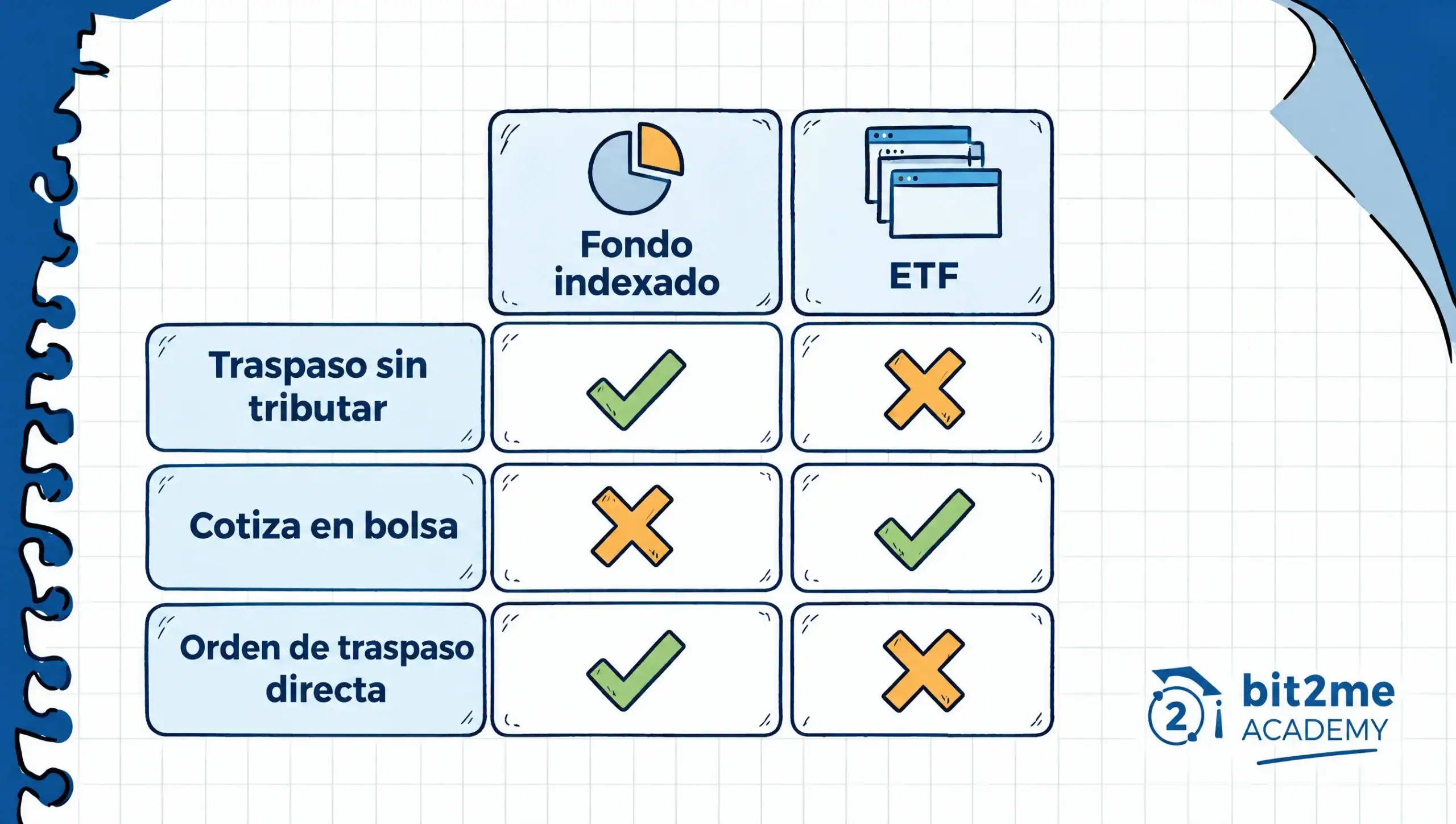
- ETFs, although they may seem like cousins of index funds, almost never enjoy this advantage: selling one to buy another is taxable.
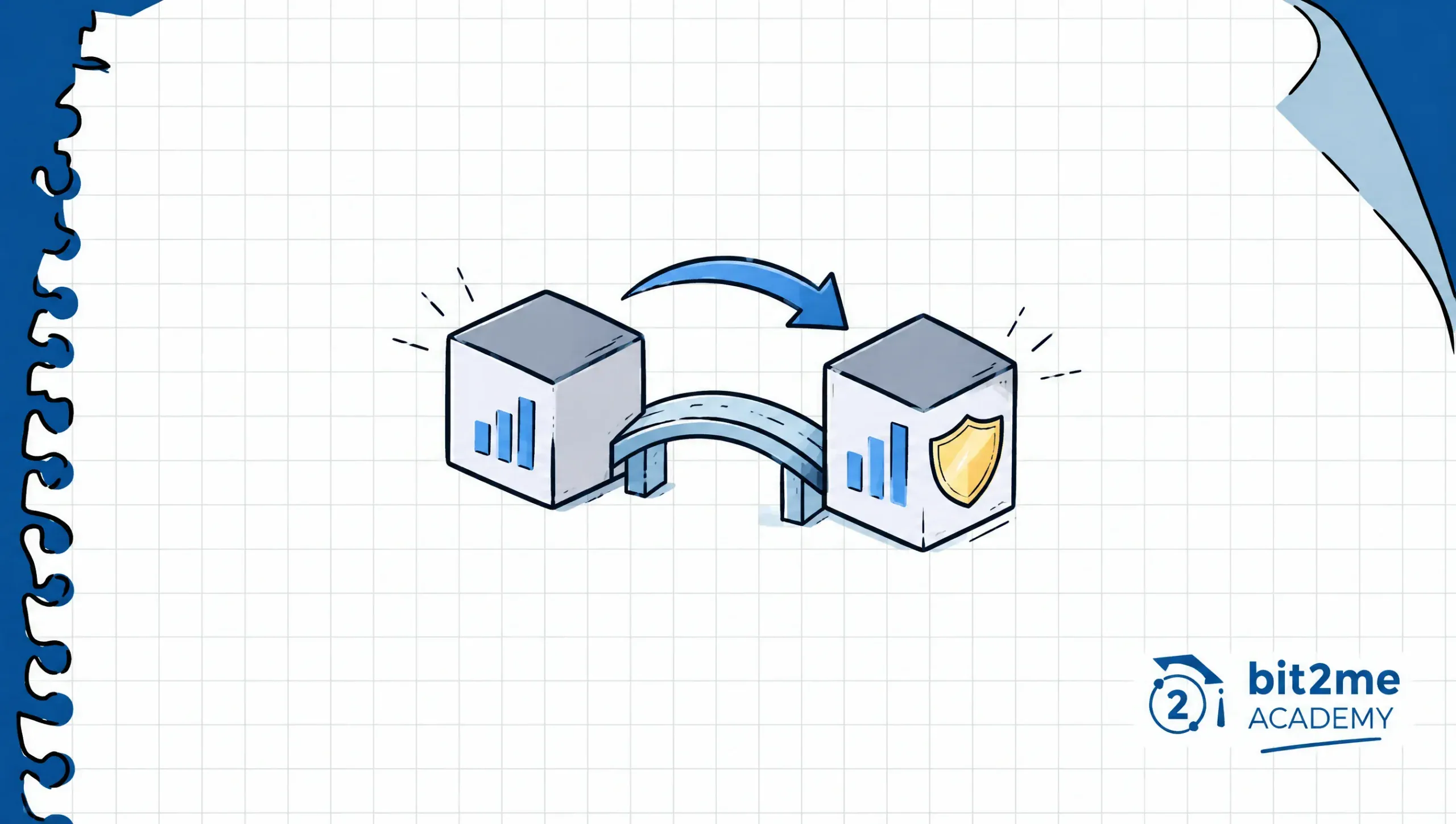
Fund transfers are the process of moving your money from one investment fund to another without incurring taxes at the time of the transfer. This is probably the least known—and most profitable in the long run—tax advantage of buying investment funds in Spain, and understanding it well can make the difference between optimizing your tax situation and paying taxes prematurely.
This article explains how the tax-free fund transfer system works, what general requirements the transaction must meet, and why this same advantage doesn't apply to ETFs, except in very specific cases. You'll also see how a transfer differs from a sale followed by a new purchase, what happens when you finally redeem your money, and what mistakes to avoid if you already invest in funds and want to start switching between them wisely.
This is not tax advice. This article is for educational and informational purposes only and does not constitute personalized tax, legal, or financial advice. The taxation of investment funds can vary depending on the regulations in force each year and the circumstances of each taxpayer, so it is advisable to confirm the details with the Tax Agency or a qualified tax advisor before making any decisions. If you invest through Bit2Me Invest, remember that this service is provided through Bit2Me Stocks, SL, in collaboration with InbestMe, the entity that acts as the regulated provider of the investment service, and that past performance does not guarantee future results.

Main Cryptocurrencies Course
Basic levelBit2Me Academy We bring you a new course where you will learn everything you need to know about the most important cryptocurrencies that exist today.
Empezar ahora ›What is the transfer of funds and why does this concept exist?
When you buy shares in a Investment fundYour money isn't stuck there forever. You can sell them and get your money back, or you can transfer that capital directly to a different fund without the money ever passing through your checking account. This second operation is called a transfer, and it's a mechanism specifically designed for investment funds, not for any similar financial product.
The reason for this mechanism is fiscal policy: the legislator wanted investors to be able to adjust their portfolios—changing strategy, management company, or risk level—without each adjustment triggering a tax bill. Without the transfer mechanism, any fund change would require selling, paying taxes on the gain, and then buying back with the now-depleted funds. With the transfer mechanism, this change is made from fund to fund, and taxation is deferred until a later date.
It's important to distinguish between a transfer and other similar transactions. Selling shares in a fund to buy stocks, cryptocurrencies, or any other asset is not a transfer, but rather a redemption followed by a separate purchase, and that redemption is taxable. A transfer only applies when the destination is, specifically, another investment fund that meets the requirements we'll discuss later.
The tax deferral regime: the key to switching funds without paying taxes
The mechanism that allows you to switch funds without paying taxes is technically known as the tax deferral regime, although many savers search for it simply as a tax-free fund transfer. In simple terms, the law considers that as long as your money remains within the universe of investment funds, there has not yet been a change in net worth that is subject to taxation. The gain or loss accumulated in the original fund does not disappear: it is simply transferred, along with the capital, to the destination fund.
This means that the original purchase price of your shares—what you paid initially, including fees—moves with you to the new fund. When you eventually redeem your shares, the capital gain or loss will be calculated by comparing that original purchase price with the final redemption price, as if there had never been any intermediate transfers. The transfer doesn't erase the accumulated gain; it simply postpones it.
This deferral can be repeated as many times as you like over the years. You can transfer from a global index fund to a fixed-income fund, then to a mixed fund, and finally to another index fund, and at none of these intermediate steps will you have to declare a capital gain simply for having changed funds. Only the final redemption, the one that converts your shares into available cash in your account, triggers the accumulated taxation of the entire process.
Full transfer or partial transfer
The deferral scheme doesn't require you to move all your capital at once. You can transfer your entire position in one fund to another, or you can transfer only a portion and leave the rest where it is, and both options enjoy the same tax advantage. This provides considerable flexibility for those who want to gradually rebalance their fund portfolio without completely liquidating a position all at once.
Why do ETFs not enjoy this regime, except in very specific cases?
Here comes the distinction that most confuses those who are already investing and starting to compare. traditional index funds with ETFs. An ETFAn exchange-traded fund (ETF), also known as a collective investment scheme, is strategically a type of investment vehicle: it tracks an index, diversifies risk, and typically has low fees, just like a conventional index fund. However, for the purposes of income tax transfers, the way in which shares are bought and sold matters more than the underlying investment strategy.
ETFs are traded on a secondary stock market, just like shares, with a price that fluctuates throughout the trading session and is executed through buy and sell orders. Personal Income Tax (IRPF) regulations governing the tax deferral regime require, among other conditions, that the source and destination funds cannot be collective investment schemes listed on secondary stock markets. In practice, this requirement excludes ETFs, as they are typically purchased in Spain, from the general transfer regime. Therefore, selling one ETF to buy another is treated for tax purposes as a sale of shares, not as a fund transfer.
There are very specific exceptions in the regulations for certain ETFs with particular characteristics, but these are limited cases that depend on technical details—such as the market in which they are listed or their distribution structure—and not a general rule applicable to any ETF you buy from a broker. Precisely because these nuances can change with regulatory updates, it's prudent not to take anything for granted and to confirm with a tax advisor whether the specific ETF you have in mind falls under any of these exceptions before trading it as if it will behave like a traditional fund. For the vast majority of investors, the practical rule is simple: tax-free transfers exist for investment funds, not for ETFs.
This difference is not a minor detail or a purely technical matter. It is, arguably, the most important tax distinction you need to understand if you combine index funds and ETFs in your portfolio, because treating them as interchangeable for transfer purposes is the most costly mistake you can make when filing your taxes.
General requirements for not paying taxes when transferring between funds
Personal income tax regulations do not allow the transfer of any product to any other and call it a tax transfer. For the deferral to apply, the transaction must, broadly speaking, meet a set of general conditions that should be understood, although the exact details of each requirement may vary depending on the type of fund and the regulations in force at any given time.
- The transfer must take place between investment funds of the same nature according to the IRPF regulation, that is, regulated collective investment institutions, not between a fund and any other financial product.
- The money must be transferred directly between the managing or marketing entities involved, without ever passing through the participant's current account.
- The source fund and the destination fund must not be collective investment institutions listed on a secondary securities market, which in practice excludes ETFs from the general regime.
- The transaction must be formalized as a proper transfer before the relevant entities, not as a separate refund and subscription managed independently.
These requirements are a general and indicative description of how the system works, intended to help you understand the mechanism before you operate, not an exhaustive or definitive checklist. The regulations governing collective investment schemes and their treatment under Personal Income Tax (IRPF) may introduce additional nuances depending on the type of fund, its domicile, or its marketing method, so it is always advisable to confirm with your fund manager or a tax advisor that the specific transfer you wish to make meets the conditions in force at that time.
Transferring versus selling and buying back: the difference that costs money
To understand why fund transfers are so important, it's helpful to compare the two possible paths when you decide to switch funds. The first is to redeem your shares in your current fund, receive the money in your account, and use it to buy shares in another fund. The second is to directly request a transfer between the two funds, without the money ever touching your bank account at any point in the process.
In the first route, the redemption immediately generates a capital gain or loss that you must declare in the tax year in which it occurs, and if there is a gain, you pay tax on it before you can reinvest the full amount. In the second route, that same fund change does not generate any capital gain or loss to be declared at that time, and the entire capital—including the portion that in the other route would have been used to pay tax—continues to work within the new fund. This difference, repeated over the years and several portfolio readjustmentsThis is what makes this figure a legitimate tax planning tool and not just a simple administrative technicality.
The transfer doesn't reduce the final tax you'll pay when you actually repay; it simply allows capital that would otherwise go toward tax to remain invested in the meantime. The longer the time between the interim transfers and the final repayment, the greater this cumulative effect.
How is a fund transferred in practice?
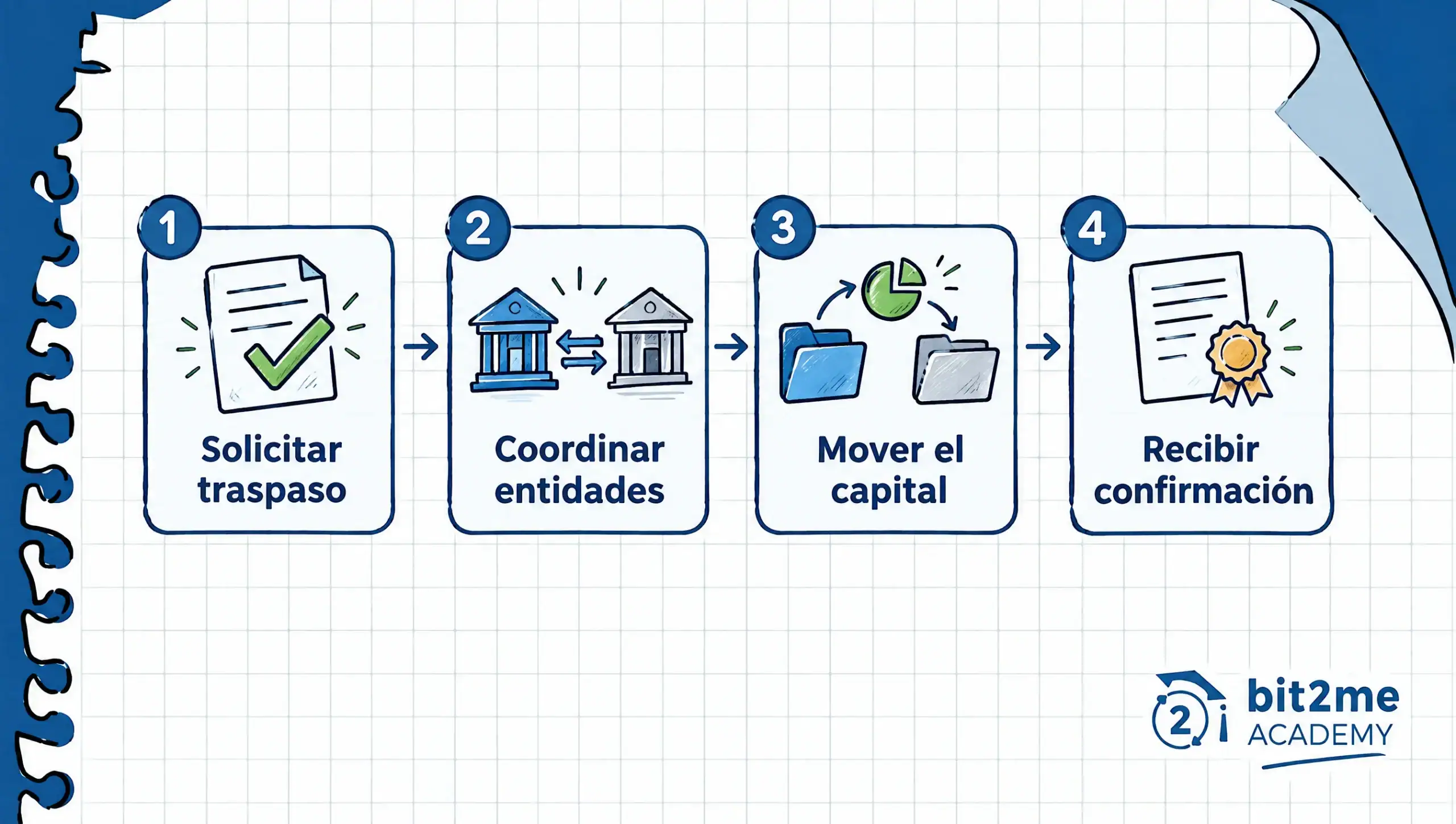
The operational procedure for transferring between funds is usually simpler than its tax implications might suggest, because most of the management is handled by the entities involved, not the investor. These are, in general terms, the usual steps of the process.
- You request the transfer to the marketing entity of the destination fund, indicating the source fund and the amount or percentage you want to move.
- The receiving entity processes the order and communicates directly with the originating entity to coordinate the capital outflow.
- The originating entity reimburses the shares internally and transfers the cash to the destination entity, without the money passing through your current account.
- The receiving entity subscribes to shares of the new fund for the amount received, and both managers inform the Tax Agency of the transaction for control purposes.
- You receive confirmation of the transfer with details of the shares transferred and the net asset value applied at each end of the transaction.
Although the transfer isn't taxed at the time it's made, it's still a good idea to keep the transaction confirmation, just as you would keep any purchase or sale receipt. This document will allow you to reconstruct the original acquisition value of your shares when you finally redeem them, especially if you've made several transfers between different fund managers over the years.
What happens when you finally make a refund: the deferred taxation is not eliminated?
It's crucial to understand that the tax deferral regime doesn't eliminate the tax on the accumulated gains in your funds; it only postpones it until you actually decide to redeem your investment and withdraw the money from the investment fund system. When that time comes, the tax authorities will calculate the capital gain or loss by comparing the original acquisition value of your initial shares—the price of the first purchase, not the value of the last fund you held—with the transfer value of the final redemption.
This means that if you've made several transfers over the years, the profit you declare in the final redemption includes all the accumulated appreciation during that entire period, not just the gain generated in the last fund. That's why it's so important to keep a record of each transfer: reconstructing that journey years later, without organized documentation, can become a complicated task if you've changed fund managers several times.
The resulting capital gain is included in the savings income tax base, just like any other gain from sale of financial assetsand is taxed according to the tax brackets in effect during the year of the refund. These brackets change from year to year, so it's advisable to check them on the Tax Agency's website or with a tax advisor when filing your tax return, rather than assuming that the rate from previous years will remain the same.
Common mistakes when transferring funds
The most common mistake, and also the most costly, is assuming that an ETF can be transferred in the same way as a traditional index fund simply because both "do the same thing" in terms of strategy. Selling one ETF to buy another generates an immediate capital gain or loss that must be reported, and discovering this after trading under the assumption that it didn't could result in an incorrect declaration.
Another common mistake is processing the transaction as a refund followed by a separate subscription, instead of explicitly requesting a transfer from the investment provider. If the money passes through your bank account at any point, even briefly, the transaction ceases to be classified as a transfer and is treated as a standard refund. It's also common not to keep the documentation for each transfer, which makes it difficult to reconstruct the original purchase price when the refund is due, especially after several years and multiple investment managers.
Finally, some people assume that any fund automatically meets the requirements for the deferral scheme, without verifying its domicile or structure. The regulations impose specific conditions, particularly for foreign funds or unusual structures, and this prior verification prevents surprises during tax season.
How do they fit together Bit2Me Invest and Bit2Me Tax in your transfer strategy?
If you already invest in funds and want to start moving between them taking advantage of the tax deferral regime, having a platform that gives you access to a wide range of funds makes the process of rebalancing the portfolio much easier without operational friction. DISCOVER Bit2Me Invest It's a good starting point if you want to explore how to invest in funds, stocks, and ETFs from the same environment, always keeping in mind the tax distinction between them that you've seen in this article.
Once you start transferring funds, keeping an organized record of each transaction becomes just as important as understanding the tax mechanism itself. If you already centralize your digital asset taxation with Bit2Me TAXApplying the same record-keeping discipline to your funds will save you time when the final redemption comes due. And if you want to delve deeper into how to declare funds and ETFs when redeeming, our guide on how to declare index funds and ETFs in Spain directly complements what you've learned here about transferring funds.
Understanding fund transfers doesn't force you to constantly switch funds or chase every market fluctuation. What it does give you is the peace of mind of knowing that if at any point you decide another fund better suits your strategy, that change doesn't necessarily have to result in an immediate tax bill, as long as you do it within the rules of the deferral regime and don't confuse it with the very different operation of ETFs.
Frequently asked questions about fund transfers
What exactly is a transfer of funds?
This is the process by which you transfer your capital from one investment fund to another directly between management companies, without the money passing through your bank account. Thanks to the tax deferral regime, this transfer does not generate a capital gain or loss that must be declared at the time it occurs.
Why is the transfer of funds not taxed?
Because personal income tax regulations consider that, as long as the capital remains within the universe of investment funds, there has been no definitive change in net worth. The taxation of the accumulated gain is deferred until the final redemption, not until each fund change.
Can I transfer funds without paying taxes at any time?
Yes, you can request transfers as many times as you like over time, provided the transaction meets the general requirements of the deferral regime. There is no limit on the number of transactions or a minimum holding period required by tax regulations to be able to transfer.
Can ETFs be transferred without incurring the same taxes as index funds?
In general, no. The regulations exclude from the deferral regime collective investment institutions that are listed on a secondary securities market, a category in which ETFs, as they are usually purchased, fall, except for very specific exceptions that should be verified on a case-by-case basis with a tax advisor.
What happens if I sell one ETF to buy another, thinking it's a transfer?
This transaction is treated for tax purposes as a standard sale of a listed asset, and generates a capital gain or loss that you must declare in that tax year. Confusing this transaction with a transfer of funds is one of the most costly mistakes that can be made by someone who invests in both products.
What general requirements must a transfer of funds meet in order to be tax-free?
Generally, transfers must occur between regulated investment funds of the same type, with the money transferred directly between fund managers and formalized as a transfer, not as a separate redemption and subscription. These requirements may vary depending on the type of fund, so it's advisable to confirm them with your fund manager before making a transaction.
Does transferring funds eliminate the tax I will have to pay in the future?
No, the transfer only postpones the tax liability; it does not eliminate the tax obligation on the accumulated gain. When you finally make the repayment, you will declare the gain or loss calculated from the original acquisition value to the final transfer value of the repayment.
How does a transfer differ from selling and buying another fund?
Selling and reselling involves repaying the initial investment, paying taxes immediately on the profit, and reinvesting the amount already reduced by tax. Transferring the funds moves the entire capital directly to the new fund, without taxation taking place until the final repayment.
What documentation should be kept after a transfer of funds?
Confirmation of each transfer, detailing the shares moved and the net asset value applied at the source and destination. This record is essential for accurately reconstructing the original acquisition value when the final redemption arrives, especially if you have made several transfers between different asset managers.
¿Bit2Me Does Invest allow investment in funds by taking advantage of the transfer system?
Bit2Me Invest provides access to a range of funds, stocks, and ETFs within a single environment, although the tax treatment of each specific transfer always depends on current regulations and the nature of the product involved. Learn more Bit2Me Invest is a good starting point, and it should be combined with professional tax advice before planning any specific transfers.


«Investment in cryptoassets is not fully regulated, may not be suitable for retail investors due to high volatility and there is a risk of losing all invested amounts»
Share this article!Continue learning
Cierre fiscal del año: compensar pérdidas y ganancias en tu cartera
Aprende a compensar pérdidas y ganancias antes del cierre fiscal: cómo funciona, la regla de los dos meses y qué revisar en tu cartera en diciembre.

Cómo elegir proveedor cripto B2B: checklist para tu RFP
Checklist objetivo para tu RFP: cómo evaluar un proveedor cripto empresas por licencia CASP, custodia, SLA, API, comisiones y trayectoria antes de firmar.

Cierre contable de fin de año con criptoactivos en balance
Cierre contable criptomonedas paso a paso: valoración, deterioro y documentación para el fin de ejercicio de tu empresa con criptoactivos en el balance.
Errores comunes del inversor principiante (y cómo evitarlos)
Descubre los errores al invertir más comunes del inversor principiante en fondos, acciones y ETFs, su consecuencia práctica y cómo evitar cada uno de ellos.