ETFs to generate income: fixed income and dividends
Essential Points
- There are two main ways to generate regular income with ETFs: bond coupons (fixed income ETFs) and profits distributed by companies (dividend ETFs).
- Both share the same fundamental decision: to collect that income now (distribution) or to let it be reinvested on its own (accumulation), with very different consequences in taxation and compound interest.
- No fixed income or dividend ETF is a risk-free haven: one depends on interest rates, the other on companies maintaining their payouts.
- Combining both approaches, in the appropriate proportion to your time horizon, usually yields a more robust result than betting everything on a single source of income.
More and more individual investors want their portfolios not only to grow, but also to generate returns. This quest to "live off investments" is gaining momentum every year, and ETFs have become one of the most accessible gateways to achieving this goal, precisely because they consolidate hundreds of securities or companies into a single, liquid product.
There are two main ways to achieve this, and it's worth understanding them together because they have more in common than meets the eye. Fixed-income ETFs generate income through the coupons of the bonds they hold; dividend ETFs, through the profits distributed by the companies in which they invest. In this article, we'll see how each method works, the different types within each, and a common decision that applies to both: collecting that income now or letting it be reinvested.
Fixed income ETFs: income via bond coupons
A fixed-income ETF is an exchange-traded fund that tracks a bond index. This index groups debt issued by governments (sovereign debt) or by companies (corporate debt), and the ETF replicates its performance by buying a representative basket of those same issues. By buying a single share, you gain exposure to dozens or even hundreds of different bonds, as easily as buying a stock on the stock exchange.
Here's the key difference between buying a bond and buying an individual bond. An individual bond has a maturity date: on that day, the issuer repays the principal and the bond ceases to exist. A fixed-income ETF, on the other hand, never matures: as the bonds that make up the index mature, the fund sells those positions and buys new issues to maintain the duration profile it promises to replicate. If you buy a 10-year bond and hold it until maturity, you know exactly how much you'll receive at the end (barring default by the issuer); if you buy a 10-year bond ETF with an average duration, that duration remains constant over time because the fund continuously replenishes its portfolio.
Main Cryptocurrencies Course
Basic levelBit2Me Academy We bring you a new course where you will learn everything you need to know about the most important cryptocurrencies that exist today.
Empezar ahora ›Types of fixed income ETFs
Not all fixed-income ETFs are created equal, and the differences between them determine both the risk and potential return you can expect. It's helpful to look at them from three perspectives: who issues the debt, its maturity, and in which region of the world.
Sovereign bonds are debt issued by governments—the US Treasury, the German Bund, and Spanish public debt are common examples—and are generally the lowest credit risk within the fixed-income market. Corporate bonds, on the other hand, are debt issued by companies, and here it's useful to distinguish between two categories: investment-grade bonds, from companies with recognized creditworthiness, and high-yield bonds, which pay more because the issuer's default risk is also higher.
In terms of duration, the short-term, medium-term, and long-term classification is probably the most important factor in understanding the true risk of a bond ETF, because it measures the price sensitivity to interest rate movements (we'll look at this in detail in the next section). Geographically, emerging market debt generally offers a higher yield than that of developed economies, in exchange for currency risk, political risk, and, in some cases, greater issuer solvency risk; it's usually a better fit as a satellite position than as the core of a portfolio.
Advantages compared to buying bonds directly
If you already know that fixed income interests you, the next logical question is why not buy individual bonds directly. There are four specific reasons why, for the individual investor, ETFs are often the most practical option.
- Accessibility. Buying a government bond directly can require minimums of €1.000 or more per issue; the ETF is bought from the price of a single share, which is much lower.
- Diversification. A single ETF groups hundreds of different issues, which significantly reduces the impact of a specific issuer defaulting on its payments.
- Intraday liquidity. Individual bonds are traded in markets that are illiquid for the retail investor, with wide spreads; the ETF is traded on the stock exchange in real time, with the same liquidity as any stock.
- Transparency. The index it replicates is public and its exact composition is known at all times, without depending on the word of an intermediary.
Achieving that same level of diversification by buying bonds one by one would require considerable capital and a lot of management time, so this combination of accessibility, diversification and liquidity is the strongest argument in favor of investing in bonds via ETFs.
Interest rate risk: what you should understand before you buy
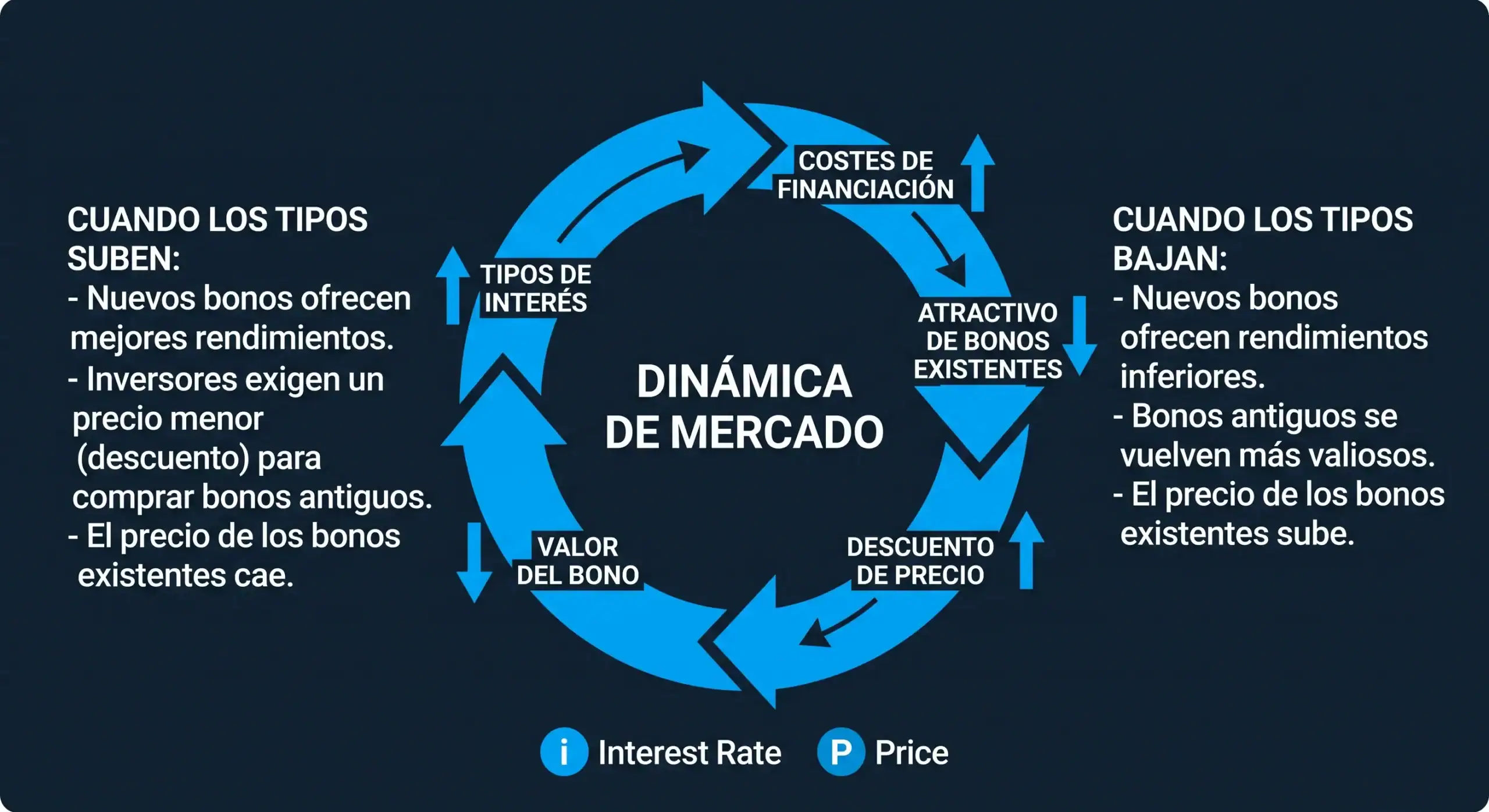
Here comes the most important, and also the most uncomfortable, part of this first approach: fixed-income ETFs are not risk-free. They have their own inherent risk, called interest rate risk. The relationship is inverse: when interest rates rise, the price of existing bonds falls.
The logic is simple if you think of it like a loan. Imagine a bank lent you money at 2% interest, and shortly after, interest rates rise and the bank could lend that same money at 4%. That old 2% loan is worth less because there's now a better alternative on the market. The same thing happens with a bond: if you pay a fixed coupon of 2% and the market starts demanding 4% for similar debt, your bond loses market value, even if the issuer continues to pay you as usual until maturity.
The longer the duration of a bond ETF, the greater this impact: during the interest rate hikes experienced by the US and Europe in 2022, longer-duration fixed-income ETFs suffered significant price declines, some of the steepest in their recent history. This was not a product failure or issuer default, but rather the duration mechanism functioning as expected.
TER and costs in fixed income ETFs
The TER (Total Expense Ratio) is the annual percentage a fund charges to cover its management, custody, audit, and operational costs, and is automatically deducted from the fund's value. As a general rule, fixed-income ETFs tend to have a lower TER than equity ETFs, especially when they track sovereign debt indices of developed economies through passive management; those focused on high yield or emerging markets tend to cost more because constructing and maintaining the index requires more management effort.
We don't include exact TER figures here because they vary depending on the provider, currency, and timing: always check the updated KID/DFI information before buying. Compared to buying bonds directly, ETFs also typically offer better overall costs, as they replace the spread across multiple OTC spreads and custody fees with a single, transparent, and predetermined annual fee.
Dividend ETFs: income via corporate profits
A dividend ETF is an exchange-traded fund that selects companies based on their dividend payout policies. Some prioritize companies with a high current dividend yield—the high dividend yield strategy—while others select companies with a track record of increasing their dividends year after year—the dividend growth strategy.
Everyone, regardless of their strategy, invests in companies that already distribute part of their profits to their shareholders; the important difference is not whether the companies pay dividends, but what the ETF does with that money once it receives it, something we will see in detail in the cross-section of this article.
High dividend or growing dividend: they are not the same thing
Not all dividend ETFs pursue the same objective, and confusing "high dividend" with "good dividend" is one of the most common mistakes when entering this strategy. A very high dividend yield—for example, 8% or 10%—may seem like an opportunity, but it should be viewed with caution: when a company's stock price falls sharply, its dividend yield (calculated as dividend divided by price) automatically rises, even if the company hasn't changed anything in its payout policy. In many cases, that high yield reflects the market's anticipation of a dividend cut, not a sign of strength.
Growing dividend ETFs follow a different logic: they select companies with a track record of steadily increasing their dividends for several consecutive years, which requires generating increasing profits and sound financial management.
This filter implies that companies that have been increasing their dividends for years tend to have more predictable and less leveraged businesses, and dividend growth strategies have historically shown lower volatility than pure high-dividend strategies, although this is not a guarantee and varies depending on the period analyzed. No dividend strategy is risk-free: past performance is no guarantee of future results, and the value of any ETF can go up or down.
Accumulation vs. distribution: the same decision in both worlds
Whether the income comes from a bond coupon or a company dividend, every income-generating ETF presents you with the same fundamental decision: collect that money now or let it reinvest on its own. It doesn't change what the fund earns; it changes what you receive and when you pay taxes on it.
In an accumulating ETF, the coupon or dividend received by the portfolio's assets doesn't go into your account: the ETF itself receives it and automatically reinvests it, buying more shares of the assets it already holds. You don't see that money as cash; you see it reflected in the ETF's price rising slightly more than it would solely from the appreciation of the underlying assets. The advantage is that compound interest works without tax friction as long as you don't sell: every euro reinvested generates, in turn, new future income, and this snowball effect becomes more powerful the longer it goes on.
In a distributing ETF, on the other hand, that money is paid directly into your account on a defined schedule—quarterly, semi-annually, or annually, depending on the fund—and you receive real cash that you can spend, manually reinvest, or leave as available liquidity. Dividend ETFs introduce a specific nuance that doesn't have an exact equivalent in fixed income: the ex-dividend date. On the payment date, the ETF's price drops by approximately the amount distributed because a portion of the fund's value has been transferred as cash to your account; this drop isn't a loss of value, it's simply a change in how you hold that money—in the fund or in your account.
When to use each method (or combine them) according to your profile
Fixed income plays a specific role within a diversified portfolio: acting as a counterweight to equities. In environments of falling stock markets accompanied by interest rate cuts, quality bonds have historically tended to outperform equities, although this is not a fixed or guaranteed rule, but rather a trend observed in past cycles. If your portfolio is composed entirely of equities, incorporating a fixed income ETF typically reduces its overall volatility, something that tends to be particularly beneficial for investment horizons of less than 10 years or for any investor who values greater peace of mind in the face of sharp market declines.
The practical rule for choosing between accumulation and distribution, in both fixed income and dividends, has to do with the stage you're at, not which of the two options is objectively better. If you have a long-term horizon—more than ten years—and don't need the income now, you're in the wealth accumulation phase, and in this case, tax deferral and frictionless compound interest work in your favor. If you're nearing retirement or in a gradual divestment process, distribution makes more practical sense: you receive the income without having to sell shares, which simplifies your cash management.
This transition doesn't have to be a sudden, overnight change: many investors gradually shift their portfolio from accumulation to distribution as they approach the point where they'll need that cash flow, combining fixed income and dividends in varying proportions based on that same criterion. There's no single ratio that works for everyone: it depends on your investment horizon, your risk profile, and your goals. "Living off investments" is a legitimate and achievable goal, but it's wise to be realistic about the timeframe: building a truly substantial income requires accumulated capital and time; it's not a shortcut.

Frequently asked questions about ETFs for generating income
What is the difference between a fixed income ETF and a dividend ETF for generating income?
A fixed-income ETF generates income through the coupons paid by the government or corporate bonds it holds; a dividend ETF, through the profits distributed by the companies in which it invests. Both can be configured as distributing (paying dividends) or accumulating (reinvesting dividends).
How does the duration of a bond ETF work?
Duration measures how much an ETF's price moves in response to changes in interest rates. The longer the duration, the more sensitive its price is: it rises more when rates fall and falls more when they rise.
What is the difference between accumulating and distributing ETFs?
The accumulation plan reinvests the coupon or dividend back into the fund without you receiving any cash; the distribution plan pays it out periodically into your account. The choice depends on whether you need that money now or prefer to maximize compound interest over the long term.
Do I need a minimum amount of capital to start investing in these ETFs?
There's no need to meet the minimum investment requirements for individual bonds, which often exceed €1.000 per issue. Both the fixed-income and dividend ETFs can be purchased for the price of a single share.
Is it safe to invest in fixed income or dividend ETFs with very high returns?
No financial product is risk-free. A fixed-income ETF carries interest rate and credit risk, and a very high dividend yield may indicate that the market anticipates a cut, not an exceptional opportunity.
What happens to my bond ETF if interest rates rise?
Its price tends to fall, and the longer the duration of the ETF, the more pronounced the decline. This is the same mechanism that caused long-duration bond ETFs to fall during the 2022 interest rate hike cycle in the US and Europe.
What happens if a distributing ETF's price falls on the day it pays its dividend?
It's the ex-dividend date: the price drops by approximately the amount distributed because that money has left the fund and gone into your account. It's not an actual loss, but rather a change in how you hold that asset—in the fund or as cash.
How are the returns from these ETFs taxed in Spain?
The distributed amount is taxed as investment income when received, with withholdings ranging from 19% to 28% depending on the tax bracket in effect in 2026. Accumulation defers this payment until you sell; this article is for guidance only, so consult a tax advisor for your specific situation.
What is the difference between a high-dividend ETF and a growing-dividend ETF?
The high-dividend category prioritizes current dividend yield, which may be high but less sustainable. The growing-dividend category selects companies with a history of consistently increasing their dividends, which usually indicates greater financial strength.
Is accumulation or distribution better for my portfolio?
It depends on your time horizon: if you don't need the income now, accumulating funds is usually more tax-efficient; if you're looking for regular income, distributing funds is more practical. There's no single answer that works for everyone, and many investors combine both approaches.


«Investment in cryptoassets is not fully regulated, may not be suitable for retail investors due to high volatility and there is a risk of losing all invested amounts»
Share this article!Continue learning
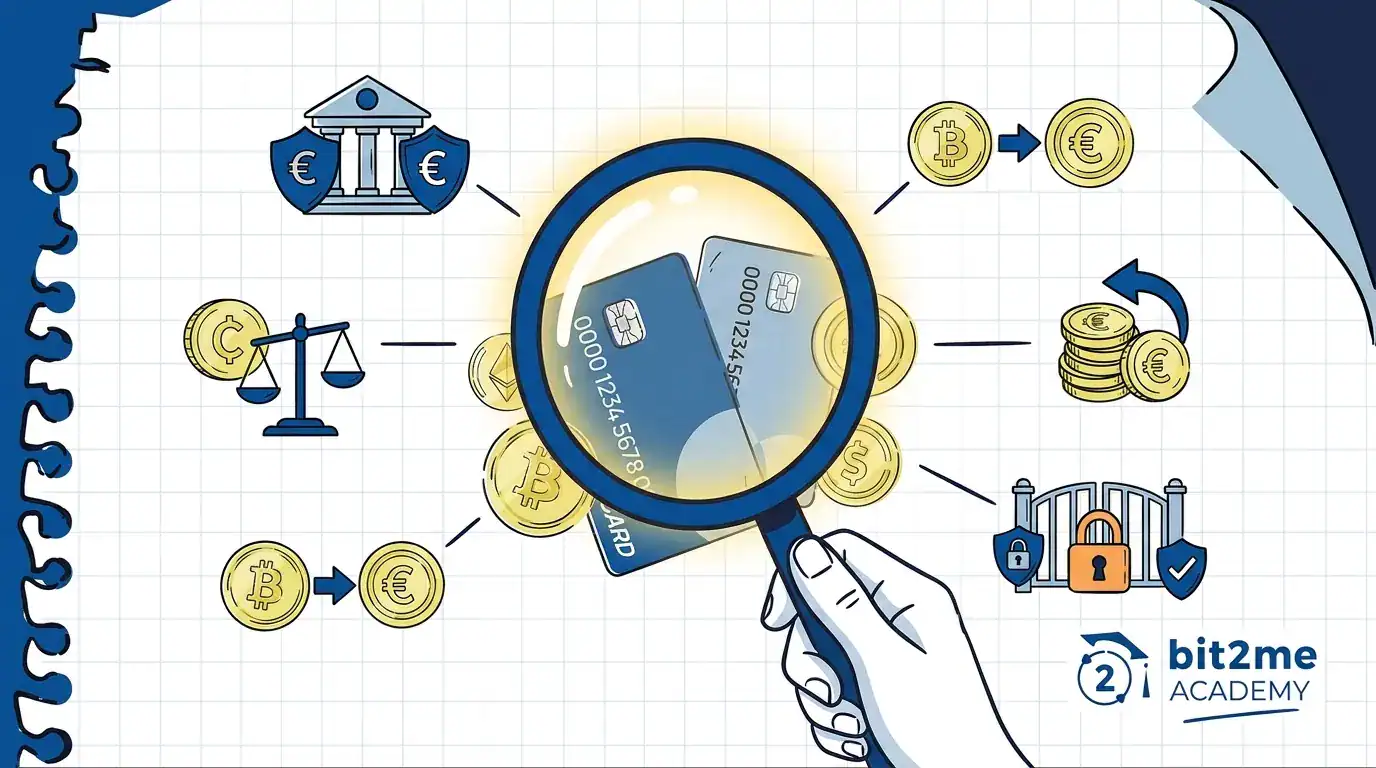
Best crypto card in Spain: what to look for before choosing one
What to look for when choosing a crypto card in Spain: regulated issuer, conversion, fees, cashback, limits and security, without comparing brands or rankings.
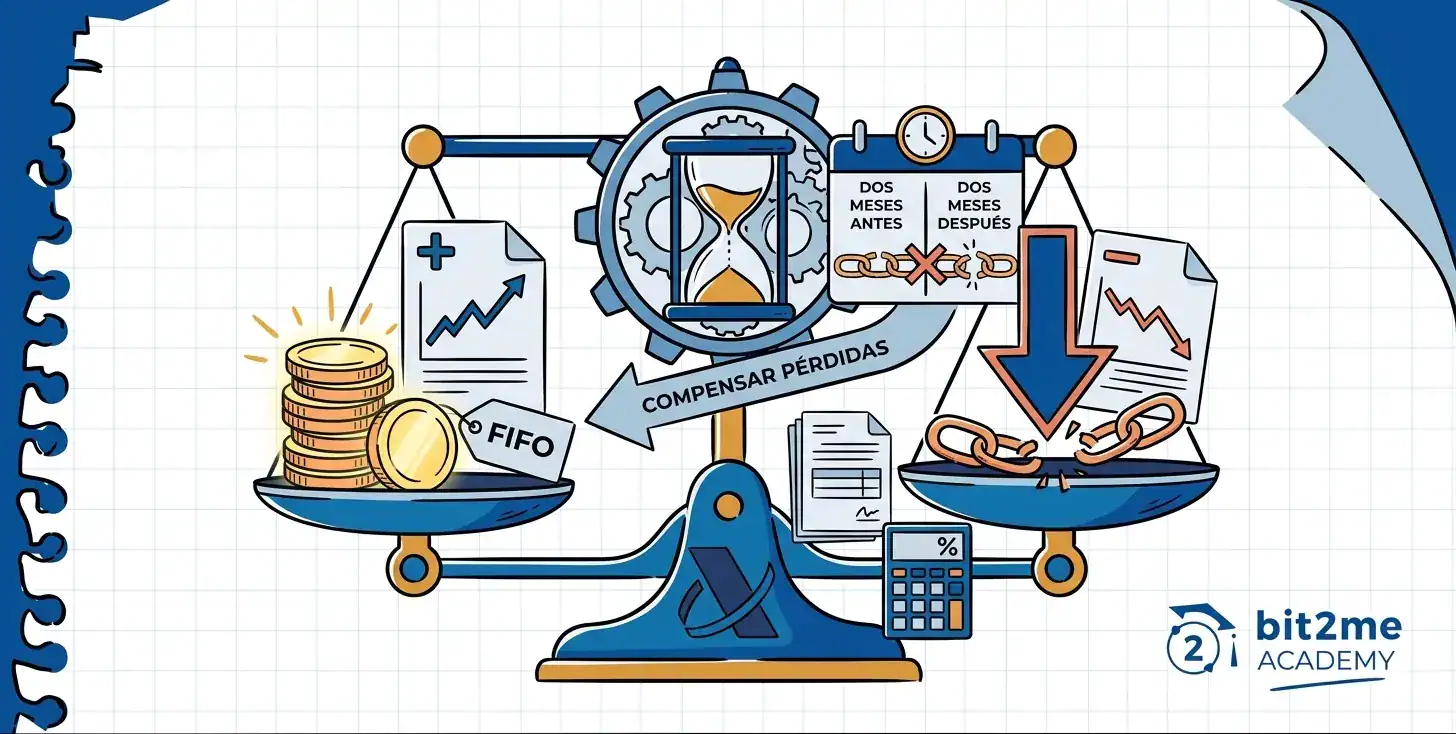
Taxation of shares in Spain: taxation and the two-month rule
Taxation of shares in Spain: savings base, personal income tax brackets and the two-month rule (art. 33.5 LIRPF) explained step by step, with examples.
ETF vs. investment fund: key differences and which one to choose depending on your situation
ETF vs investment fund: key differences and which one to choose depending on your situation and how to get the most out of both.
ETFs vs stocks: advantages of instant diversification
ETFs or individual stocks? Discover the key differences, when each option is right for you, and how the instant diversification of ETFs changes the game.