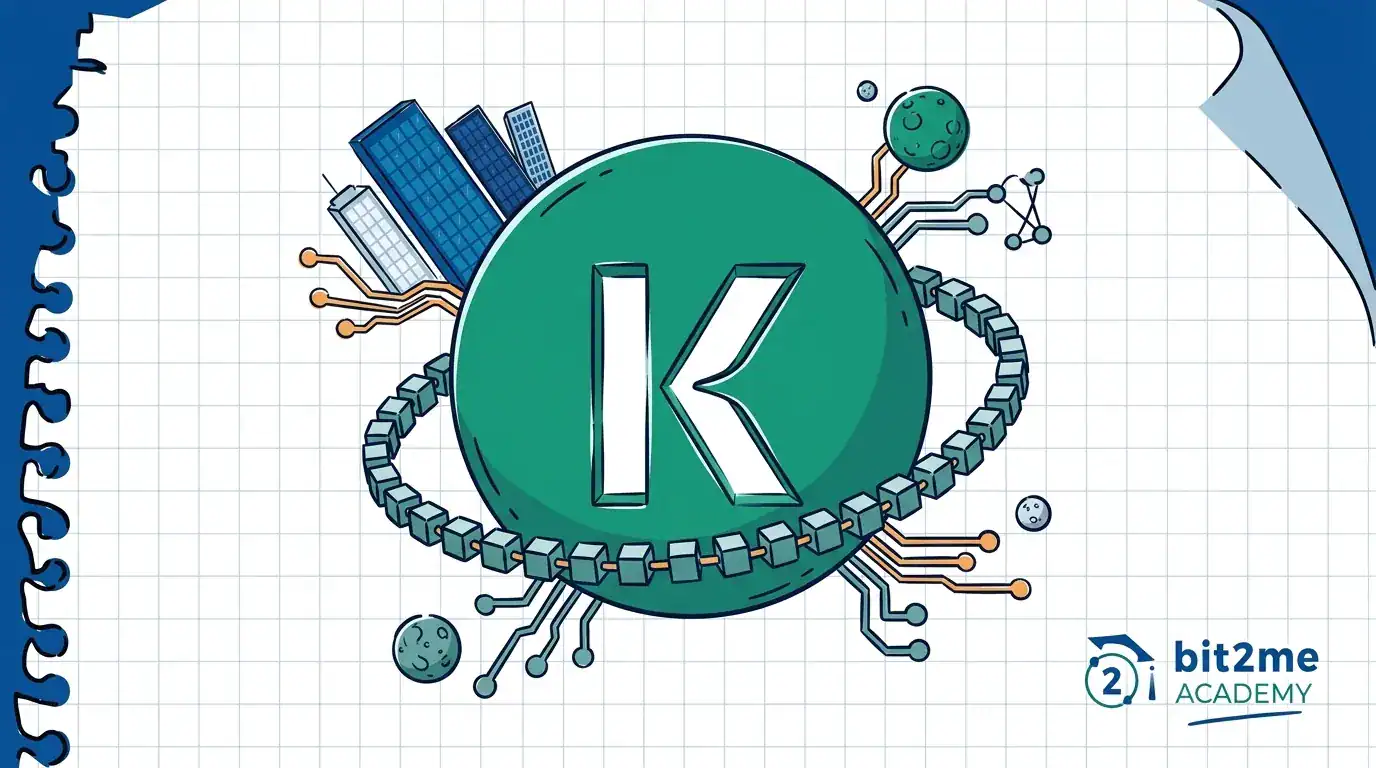
What is $KULA?
Essential Points
- KULA is the governance token of KulaDAO, a project that converts land, mines, or hydroelectric dams into digital assets that can be voted on by its community.
- Its appeal lies in the quadratic voting system within RegionalDAOs: whoever holds the token decides, without large positions dominating the vote.
- It serves to give a real voice to communities in Kenya, Nepal, Zambia or Malaysia regarding infrastructure that is normally managed by distant third parties.
- It is an ambitious, still young experiment: it does not promise economic rewards and its trading volume, still low, demands caution before making a move.
Real-world assets, known in the industry as RWA (Real World Assets)These narratives have become one of the most discussed in the digital asset ecosystem over the past two years. The promise is simple to state but complex to execute: Bringing tangible assets—land, raw materials, infrastructure—to the blockchain to make their management more transparent and accessible. Kula is one of the projects that has decided to apply that idea not to bonds or real estate in developed countries, but to natural resources and infrastructure projects in emerging markets.
This article explains what the $KULA token is, who is behind the project and why it was created, how its governance mechanism works through RegionalDAOs, and the complete structure of its tokenomics. We also review where the cryptocurrency is currently used, what external sources say about its model, and what aspects to consider before becoming interested in it.

Basic Bitcoin Course
Basic levelStart from scratch in Bitcoin in a clear, easy, safe and quick way. This course is specially designed for beginners practically know nothing about Bitcoin.
Empezar ahora ›What is KULA and why is it being discussed in the RWA sector?
KULA is the governance crypto asset of KulaDAO, an ecosystem built on the Avalanche network that defines itself as a decentralized impact staking platform. Instead of focusing on corporate bonds or urban real estate—the usual ground for other tokenization projects—Kula targets natural resources and infrastructure projects in regions that often fall outside the radar of traditional finance, such as Zambia, Nepal, Kenya, and Malaysia.
The project's thesis is based on a contextual fact that should be acknowledged: Around 70% of the $1,6 trillion that impact capital moves globally is concentrated in high-income countries. KulaDAO proposes to reverse this concentration by tokenizing underutilized assets —land, water, timber, agriculture or minerals— so that local communities can participate directly in their management through the $KULA token.
What distinguishes KULA from much of the digital asset ecosystem is its explicit rejection of speculative narratives. The project itself describes itself as something that is not “a meme currency, a speculative trading asset, nor part of the get-rich-quick culture”, and instead proposes to leverage the transparency and decentralized governance of blockchain to solve real-world financing problems.
This position is not just marketing rhetoric: its own whitepaper under the European MiCA regulation It formally classifies $KULA as a utility token for exclusive governance use, without any associated ownership rights, benefits, or refunds. This classification directly conditions its tokenomics, as discussed below.
The origins of KulaDAO: who is behind it and how they got here
The project was co-founded by three complementary profiles. Samuel Chen brings experience in hedge funds and in connecting blockchain technology with real-world applications; Chris Turner is an expert in governance and international development, with experience managing global projects; and Micah Yeackley specializes in financial design and blockchain, with particular knowledge of tokenomics.
The legal structure that supports the project today is precisely documented in its official whitepaper under the MiCA (Markets in Crypto-Assets) regulation, notified to the Central Bank of Ireland on December 8, 2025. According to that document, the issuer of $KULA is KulaDAO Foundation Limited, a non-profit foundation established in the Cayman Islands on November 1, 2024, whose administrators are Christopher Kenneth Turner and Paul Alan Jackson.
The functions of regulatory compliance, identity verification and operations with virtual assets are handled by a second entity within the group. Kula VASP Limited, a virtual asset service provider authorized in Mauritius under the law VAITOS (Virtual Asset and Initial Token Offering Services Act).
The milestone marking the project's public launch occurred between March 17 and April 15, 2025, the period in which $KULA was listed through an initial exchange offering (IEO) on centralized platforms. By then, KulaDAO had already signed contracts and memoranda of understanding in several countries and had raised $25 million from partners aligned with its community governance mission.
How does KULA work? Asset tokenization and RegionalDAO governance
KulaDAO's mechanism relies on two components that should be understood separately: the technical infrastructure that supports the token and the proposal and voting system that translates that infrastructure into real decisions about the treasury's capital. Both are designed to work together, not as independent modules.
The token: an ERC-20 governance asset on Avalanche
According to its official whitepaper under the MiCA regulations, $KULA is an ERC-20 token deployed as an auxiliary asset of the network Avalanche, specifically on its Contract Chain (C-Chain), compatible with the Ethereum virtual machine.
The token does not participate in the network consensus or its staking mechanismThat function belongs exclusively to Avalanche validators, who do block AVAX to produce and validate blocks. KulaDAO's treasury assets, on the other hand, are held in custody using Fireblocks, an institutional-grade custody infrastructure based on multi-party computing and multi-signature authorization.
The proposal system: PIPs, KIPs and quadratic voting
Those who own $KULA can submit proposals of two types defined in the Kula Constitution, the document that governs the entire system: PIPs (Protocol Improvement Proposals), focused on protocol changes, and the KIPs (KulaDAO Improvement Proposals), focused on ecosystem management decisions.
The voting does not follow the usual "one token, one vote" scheme: KulaDAO applies quadratic voting, a mechanism that moderates the weight of the largest positions and seeks a less concentrated distribution of influence than linear governance.
The entire process follows a defined sequence: a snapshot of the token balances is taken at the beginning of each voting period to establish voting power, the community deliberates and votes within a published timeframe, and the implementation of approved proposals is subject to a mechanism of time lock which delays its implementation to allow for review and the detection of anomalous activity. If a dispute or escalation arises, the Court intervenes, an oversight body provided for in Kula's Constitution to resolve governance conflicts.
RegionalDAOs: local governance over tokenized capital
This governance is organized through RegionalDAOs, decentralized structures dedicated to a specific project or territory. Each RegionalDAO brings together stakeholders in that specific initiative—from local communities to capital contributors—and channels treasury funds approved by community vote toward it, with transparent execution through smart contracts.
When KulaDAO identifies an asset with potential—a mining concession, a waterfall for a hydroelectric dam, an agricultural plot—it negotiates an agreement with local parties and structures that asset as an ecosystem-backed project, with its milestones and capital allocation reflected on the blockchain.
$KULA Tokenomics: Full Token Distribution and Utility
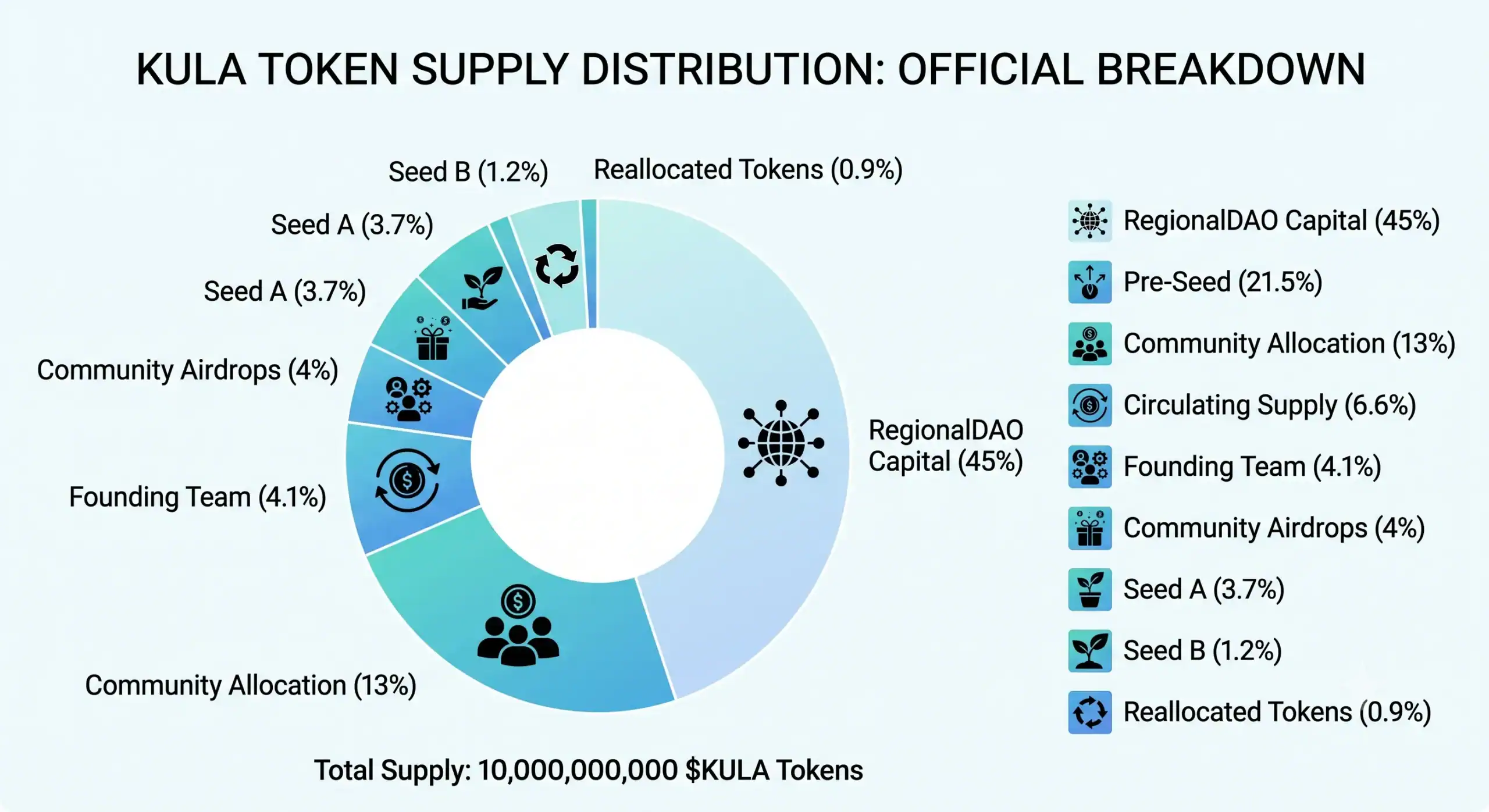
The total supply of $KULA is fixed at 10.000 billion tokens, with no staking or burning mechanisms to alter that number over time. The MiCA whitepaper itself explicitly confirms this: there are no supply adjustment protocols, no token value protection schemes, and no compensation schemes for its holders. This design decision is deliberate: the project wants $KULA to be perceived as a stable governance tool, not as an asset whose supply changes based on performance incentives.
The official whitepaper (dated October 14, 2025) details the full distribution of those 10.000 billion tokens by category, along with their lock-up and vesting conditions:

This structure is noteworthy for what it excludes as much as what it includes. $KULA is formally classified as a governance utility token: it does not represent ownership, it does not distribute periodic profits to its holders, and it does not grant financial rights typical of equity or debt instruments. Its sole function is to provide access to the ecosystem's governance tools—proposal submission, quadratic voting, and oversight of capital allocations to RegionalDAOs—and its "repurchase" is only possible by selling it on the open market, as the issuer offers no redemption or redemption mechanism.
The $KULA contract operates on the Avalanche network and can be viewed on block explorers such as Snowscan. As of May 2026, its fully diluted market capitalization (FDV) was around $576 million. It's worth noting that, according to the official whitepaper, the issuer does not set the token's price at any time; it is determined solely by supply and demand on the exchanges where it is listed.
Where KULA is used: active projects supported by the ecosystem
KULA is not yet a token widely used for everyday payments; its primary function, as we've seen, is governance over specific projects. But these projects already exist and have their own names, allowing us to assess the ecosystem's actual progress beyond its initial design promises.
Among the active or contract-phase initiatives, the following stand out: a limestone concession in Zambia, with a 14% stake secured since July 2023; a hydroelectric project in the Tsum Valley, Nepal, formalized in June 2024; a regenerative forestry initiative in Sarawak, Malaysia, through a memorandum of understanding signed in October 2024; and a regenerative agriculture program covering 3.000 hectares in Ukwimi, Zambia, initiated in March 2024. These are in addition to WaterDAO, a smart water management project in Lusangazi, also in Zambia.
The most recent and visible case is Enzi MotorsKulaDAO, an electric mobility initiative in Nairobi, Kenya, received $3,5 million in capital as of October 2025. According to cumulative figures up to December 2025, the KulaDAO ecosystem reports nine memoranda of understanding, five signed contracts and fifteen strategic partnerships, with $17,5 million mobilized in pre-token launch phases.
The roadmap outlined in the official MiCA whitepaper details the actual order of this expansion: the first treasury allocations to RegionalDAOs were deployed in the second quarter of 2025 in Malaysia, Nepal, and Zambia, while Kenya was added as an institutional expansion market in the second half of 2025, along with a greater presence in Nepal during the same phase. This same document also foreshadows a further development for the ecosystem: the commercial launch of “Kula Services,” a white-label governance software offering designed to enable third-party organizations to adopt the KulaDAO infrastructure in their own projects.
Basic mining guide
FREEWhat better way to get bitcoins than creating them yourself. In this simple guide we show you how to do it. Do not lose this chance!
Download
×Download the basic guide on Mining for free
Receive in your email the PDF with the basic information.
Frequently Asked Questions about KULA
What is KULA (KulaDAO)?
KULA is the governance token of the KulaDAO ecosystem, a project built on the Avalanche network that tokenizes real-world assets—land, water, minerals, infrastructure—so that local communities can vote on their management. It is not designed as a speculative trading asset, but as a tool for participating in capital decisions.
How does real-world asset tokenization work in KulaDAO?
KulaDAO identifies an underutilized asset, negotiates agreements with local stakeholders, and structures the project chain so that its milestones and capital allocation are publicly recorded. This layer of transparency then enables governance voting on the project.
Who founded KulaDAO and when?
The project was co-founded in 2021 by Samuel Chen, Chris Turner, and Micah Yeackley, with backgrounds in blockchain technology, international governance, and financial design, respectively. Its issuing entity, KulaDAO Foundation Limited, was formally registered in the Cayman Islands on November 1, 2024, and the $KULA token was not publicly offered until March-April 2025.
How can I participate in KULA's governance?
Those who hold $KULA can submit proposals (PIPs or KIPs) and vote on them using quadratic voting, through the governance platform that KulaDAO fully opened on May 15, 2025. Participation requires holding the token in a wallet compatible with the Avalanche network and passing the required identity checks.
Is it safe to participate in the KulaDAO ecosystem?
No cryptocurrency can be considered risk-free, and KULA is no exception: its own regulatory whitepaper acknowledges market, issuer, smart contract, and execution risks for the projects it funds. The issuing foundation has an associated entity authorized by the Mauritius Financial Services Commission for compliance functions, but this license does not eliminate market or operational risk.
What happens if a KULA-backed project fails to meet its objectives?
The governance model allows the community to vote on capital adjustments or priorities, but that doesn't guarantee that a physical project—a mine, a dam, an agricultural initiative—will achieve its goals. The regulatory, environmental, and political risks of each territory remain, regardless of the blockchain layer.
How does KULA differ from other real-world asset tokenization projects?
Most RWA projects tokenize traditional financial instruments—bonds, money market funds, urban real estate—and offer some form of reward tied to the asset's performance. KulaDAO, on the other hand, tokenizes natural resources and infrastructure in emerging markets and uses the token exclusively for governance, without periodic profit distribution.
Does KULA have any token staking or burning mechanism?
No. The $KULA supply of 10.000 billion is fixed, with no staking mechanisms that generate rewards or burning mechanisms that reduce the supply over time. This design decision reinforces the project's position as a governance tool rather than a performance asset.
What is the current state of KulaDAO's expansion?
By mid-2026, KulaDAO reported active projects in Malaysia, Nepal, Zambia, and Kenya, with an institutional growth phase and the launch of “Kula Services” for third parties planned in its official roadmap. Access to the offering may be restricted in certain jurisdictions, so it is advisable to check the conditions in your country of residence before expressing interest in the project.
«Investment in cryptoassets is not fully regulated, may not be suitable for retail investors due to high volatility and there is a risk of losing all invested amounts»
Share this article!Continue learning
Ethereum Staking: A Practical Guide to Getting Started
Discover how Ethereum staking works, its slashing risks, and how to get started step by step: your own validator, platform, or liquid staking explained.
How to buy bitcoin in Spain safely: a step-by-step guide
Guide to buying bitcoin in Spain safely: identity verification (KYC), how to fund in euros, purchase steps and where to store it afterwards.
Cryptocurrency exchange regulated in Spain: complete guide 2026
Discover what it means for a cryptocurrency exchange in Spain to be regulated under MiCA, how to verify this with the CNMV, and what to compare before choosing one.
What is $SPAIN?
Discover what the $SPAIN Fan Token of the Royal Spanish Football Federation is, what it's for, how it works on the blockchain, and how to acquire it. Bit2Me.