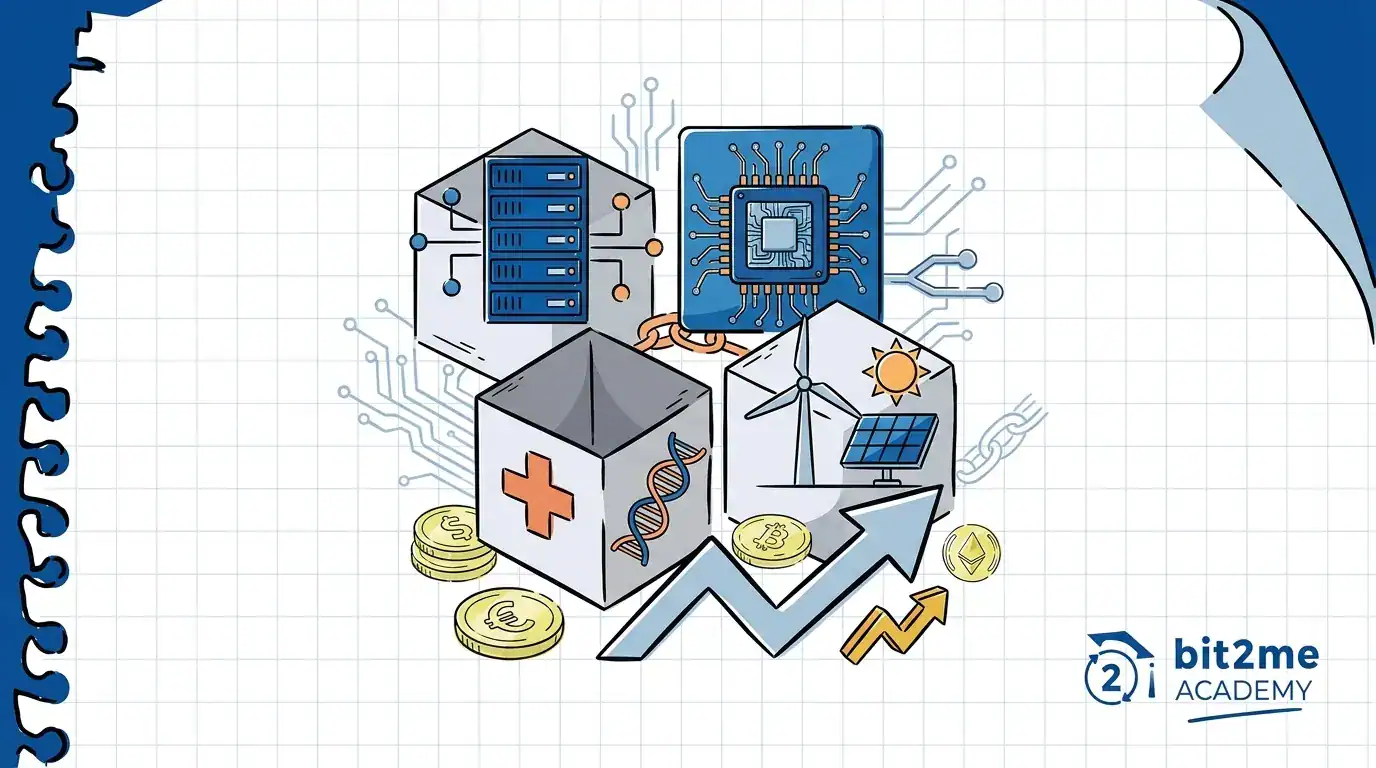
Sector and thematic ETFs: technology, healthcare, energy, AI and semiconductors
Essential Points
- A sector ETF groups companies from one industry (technology, health, energy); a thematic ETF crosses several sectors around a trend, such as AI.
- Both concentrate more conviction and more risk than a global ETF: if the sector or theme rises, you gain more; if they fall, you lose more.
- They serve as satellites of a diversified portfolio to reinforce a specific idea, never as a substitute for the core.
- The biggest danger is not choosing badly, but confusing a passing fad with a real trend and concentrating your entire wallet on it.
Artificial intelligence, semiconductors, renewable energy: it's hard to go a day without seeing one of these headlines in the business news. This media coverage has a direct impact on financial products, and more and more investors are looking for sector ETFs or thematic ETFs that give them direct exposure to a specific industry or trend, rather than spreading their investment across the entire market. The question of whether it's worthwhile doesn't have a single answer: it depends on which product you choose, whether you really know what's inside, and what weight you give it within your portfolio.
In this article, we unify two categories that are often confused, although they are not the same. We explain what a sector ETF is and what a thematic ETF is, how they differ from each other, and how they compare to a broad index ETF, such as one that tracks the MSCI WorldWe'll take a detailed look at the sectors and themes most in demand among Spanish investors: technology, healthcare, energy, artificial intelligence, and semiconductors. You'll also see the real risks of concentrating your investment in a single sector or trend, when it might make sense to add one to your portfolio, and what practical criteria to apply before deciding on any of them.
What is a sector ETF and what is a thematic ETF?
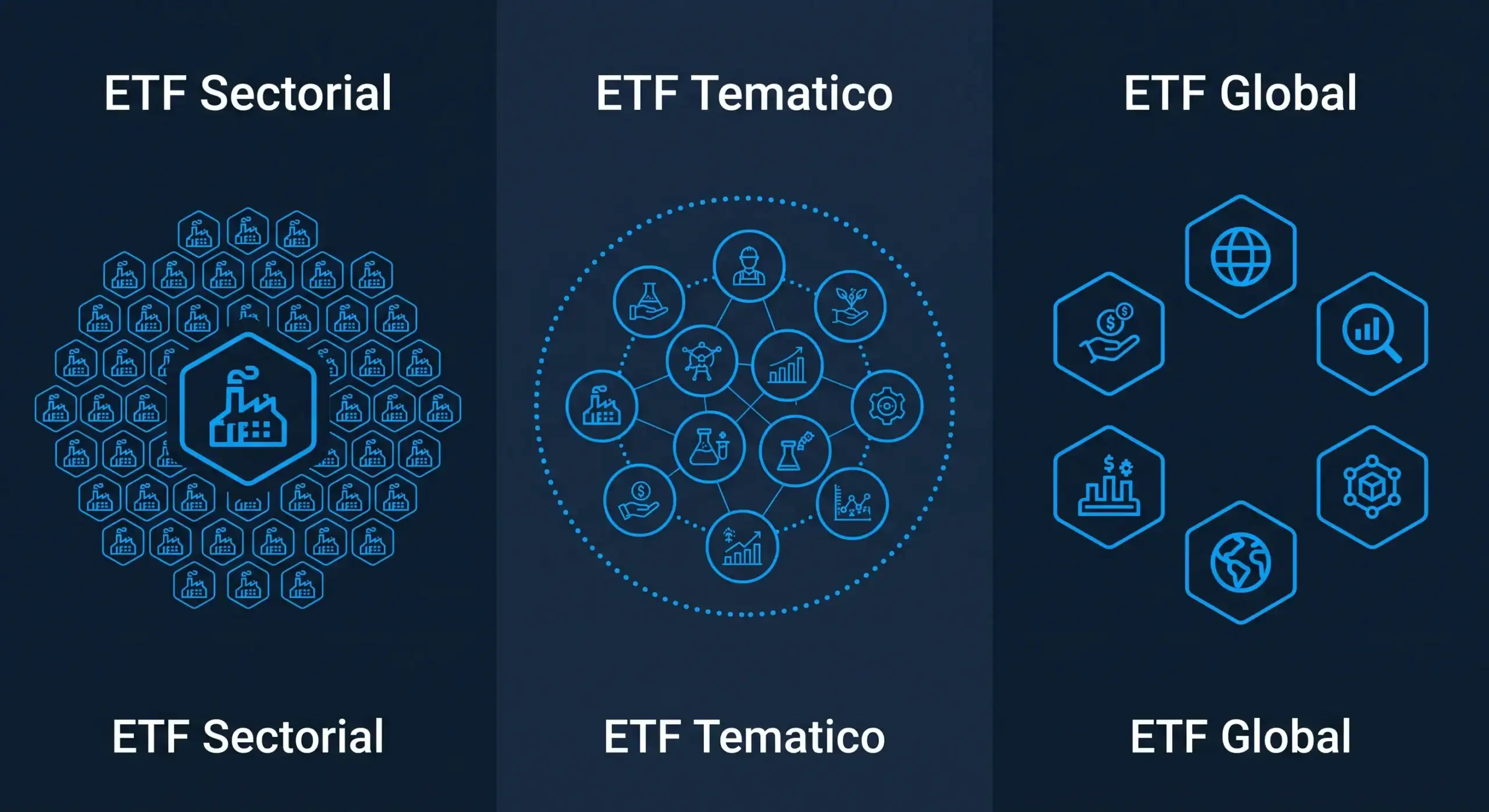
A sector ETF is an exchange-traded fund that groups companies from a single industry or economic sector, regardless of their country of origin. If you buy a technology ETF, you'll have exposure to technology companies in the United States, Europe, or Asia, but not to healthcare, energy, or consumer goods companies. The selection criterion is simple: whether or not a company belongs to that sector according to the standard market classification.
A thematic ETF works differently. Instead of tracking a specific industry, it groups companies around a cross-cutting trend—such as artificial intelligence or the energy transition—that can span multiple sectors simultaneously because it doesn't adhere to industry boundaries. An artificial intelligence ETF, for example, might include chip manufacturers, cloud computing providers, software developers, and even energy companies that supply data centers. Its selection criteria are more subjective: which companies are sufficiently exposed to the trend to be included in the index, as defined by the provider.
In contrast to both of these, there's the broad-based index ETF, such as the one that tracks the MSCI World—which we analyzed in detail in our article on the MSCI World ETF as a global portfolio in a single asset. This type of product includes virtually all sectors and more than 20 developed countries, weighted by market capitalization, without any active selection by industry or trend. If you want to review all the available variations beyond sector, theme, or region, you'll find the complete overview in our guide to ETF types: by geography, sector, index, and more.
The fundamental difference in all three cases is concentration versus diversification. The more concentrated the product—whether by sector or theme—the more its performance depends on the performance of that specific market segment. This can work for or against you depending on the timing, your investment horizon, and, above all, what proportion of your portfolio you allocate to it: it's not a question of whether sector or thematic ETFs are good or bad, but rather how they are used.
The sectors and topics with the highest demand
Within the universe of concentrated ETFs, five categories garner the most interest from Spanish investors: technology, healthcare, energy, artificial intelligence, and semiconductors. The first three are sectors in the classic sense; the last two function both as a specific sector (semiconductors) and as a cross-cutting theme (AI). We will review each one with its nuances, bearing in mind that any example we cite is for illustrative purposes only and should never be considered a buy recommendation.
Technology, semiconductors and artificial intelligence: three layers of the same industry
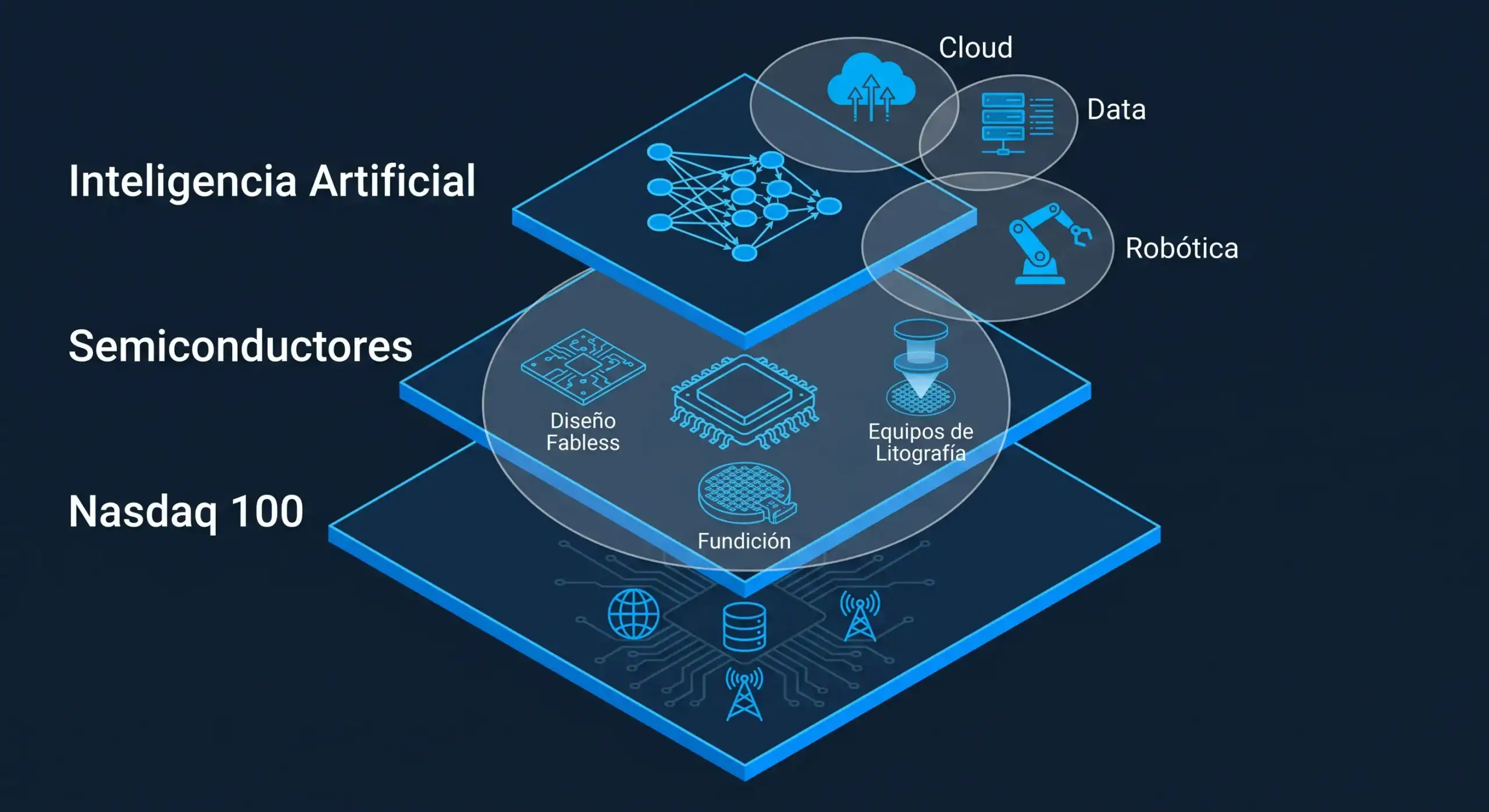
When someone talks about investing in technology through an ETF, they almost always mean, directly or indirectly, the Nasdaq 100 ETF. Technically, it's not a pure sector ETF: it tracks an index that tracks the 100 largest non-financial companies listed on the Nasdaq, across all sectors. In practice, however, it acts as a proxy for the technology sector, because most of those companies are in the technology, communications, or digital consumer sectors.
A step further down the list are semiconductor ETFs, such as the VanEck Semiconductor UCITS ETFThis fund exclusively includes chip manufacturers and related equipment. Semiconductors are the invisible infrastructure of the digital economy—they're in every mobile phone, every electric car, and every data center—and their ecosystem has three segments with very different business dynamics. First, there are the fabless companies, which design the chip architecture but outsource its manufacturing; second, the foundries, the factories that physically produce these chips using extremely capital-intensive processes; and third, the manufacturers of lithography equipment and design tools, without which neither design nor manufacturing would be possible. Two semiconductor ETFs can perform very differently depending on the weighting they give to each segment, so reviewing this internal composition is just as important as looking at the total number of companies in the portfolio.
Taking it a step further, we find artificial intelligence ETFs, which are no longer a sector but a theme that spans several sectors simultaneously. They rarely invest solely in "AI companies" in the strictest sense, because that category practically doesn't exist as an independent sector. They typically combine semiconductor manufacturers specializing in processing chips, cloud computing providers, AI software developers, data management companies, and, to a lesser extent, robotics companies.
This mix explains what we might call the thematic promiscuity trap: because artificial intelligence cuts across so many sectors, the same two or three dozen large tech companies end up appearing in almost every AI, semiconductor, and general technology ETF. The result is a concentration that isn't always immediately apparent: you can have three different ETFs in your portfolio thinking you're diversified, when in reality you have repeated exposure to the same companies. The total expense ratio (TER) of these types of products—technology, semiconductor, or AI—is usually higher than that of a broad global ETF, precisely because they track more specialized indices with lower trading volume.
Main Cryptocurrencies Course
Basic levelBit2Me Academy We bring you a new course where you will learn everything you need to know about the most important cryptocurrencies that exist today.
Empezar ahora ›Health and pharmaceuticals: a sector with its own volatility
The healthcare sector encompasses pharmaceutical companies, biotechnology firms, medical equipment manufacturers, and health insurers. It is one of the sectors with its own unique volatility: its movements depend largely on regulatory approvals from agencies such as the US FDA or the European EMA, and on each company's research and development cycles.
Unlike the technology sector, healthcare is generally less correlated with the overall economic cycle. Demand for medicines or healthcare services is less dependent on whether the economy is growing or contracting, which means a healthcare and pharmaceutical ETF can act as a partial safe haven during slowdowns. That doesn't mean it's risk-free, however: dependence on specific regulatory decisions can lead to sharp price movements that a global ETF is better able to mitigate.
Energy: traditional, renewables and the narrative cycle
Under the umbrella of “energy” several distinct realities coexist, depending on whether the ETF is organized by sector or by theme. On the one hand, there are traditional energy ETFs, focused on oil and gas, whose performance is linked to the commodity cycle and geopolitics. On the other hand, there are clean energy ETFs, which group companies in the solar, wind, green hydrogen, and battery storage sectors, and which function both as a renewable energy sector and as an energy transition theme.
Their behaviors are not parallel. Traditional energy is markedly cyclical and reacts to crude oil prices. Renewables, on the other hand, depend heavily on interest rates—because many of their projects are financed with long-term debt—and on regulatory frameworks such as the Inflation Reduction Act in the United States or the European Green Deal.
The 2020-2024 cycle is a useful historical example for understanding the difference between a real trend and a market narrative. During 2020 and 2021, enthusiasm for the energy transition led clean energy ETFs to rise sharply, pricing in a few months growth that was actually expected over several decades. When interest rates rose from 2022 onward, those same ETFs corrected sharply, not because the energy transition had ceased to be real, but because the market had overestimated the speed at which it would occur; traditional energy, meanwhile, behaved differently because it depended on other variables.
The risk they share: concentration and the narrative trap
The real risk of sector and thematic ETFs is not abstract: there are recent examples. The technology sector suffered a significant decline during 2022, in a context of rising interest rates that particularly penalized companies with more demanding valuations, and the clean energy sector underwent a sharp correction between 2022 and 2024 for the same macroeconomic reason.
It's important to distinguish between two types of risk. Market risk is systematic: it affects the entire economy and cannot be completely eliminated, even with maximum diversification. Concentration risk, on the other hand, can be reduced by investing in a global ETF instead of a sectoral or thematic one, precisely because it spreads exposure across many different industries. This concentration risk manifests itself in two distinct ways: in a sectoral ETF, it's evident from the product's name, while in a thematic ETF, it can be hidden behind a composition that crosses several sectors and gives the impression of diversification without actually being so, as we saw with the promiscuity among AI, semiconductor, and technology ETFs.
Added to this risk is another specific to products that follow a trendy theme: the narrative trap. When a topic is in vogue, enthusiasm drives investors to buy just as the ETF has already risen sharply, and at that moment, they are not buying the underlying trend but the narrative surrounding it, which often trades well ahead of the fundamentals. Structural technological trends—the adoption of AI, the energy transition, the demand for semiconductors—may be real and long-term, but the price of an ETF can discount in months what that trend would take decades to materialize, as illustrated by the clean energy cycle between 2020 and 2024. The stock market narrative moves in cycles of two to four years, while the structural trend it claims to represent takes years or decades to unfold, and this disconnect between narrative and price is precisely what goes most unnoticed by those who buy solely based on the product's name.
Core and satellites: how to incorporate these ETFs without unbalancing your portfolio
If you have a genuine conviction about a sector or theme—whether through professional knowledge, monitoring its fundamentals, or simply because you want to reinforce a specific idea—a sector or thematic ETF can make sense. The key is how you incorporate it into your portfolio, not whether you incorporate it at all.
The most common strategy for this is called core and satellites. The core of the portfolio is a diversified global ETF, such as one that tracks the MSCI World or the S&P 500, and it holds the majority of the portfolio's assets. Satellites are smaller, more specific positions—including sector and thematic ETFs—that add specific investment choices without jeopardizing the overall portfolio. If you'd like to see how this logic is applied according to your risk profile, we explain it in our article on portfolios by risk profile: conservative, moderate, and aggressive.
The reasonable weighting of the satellite portion is not identical in all cases, because not all concentrated products have the same level of volatility. As a general guideline, a sector exposure (technology, healthcare, or energy) of no more than 15-20% of the total portfolio is usually reasonable, while thematic exposure (AI, semiconductors as a trend, or clean energy) should be limited somewhat more, to around 10-15%, precisely because in addition to its concentration risk, there is also the risk of buying at the peak of a trend. This is not a personalized investment recommendation, but rather a benchmark that each investor should adapt to their own situation and time horizon.
To enter any of these products, the strategy of periodic contributions—known as DCA (Dollar Cost Averaging)—reduces the risk of buying right at the peak of a narrative, whether sectoral or thematic. It's the same principle we apply in Bogleheads portfolio: investing like John Boglewhere DCA is combined with a long-term investment horizon instead of trying to pinpoint the exact entry point. The profile that best suits these products is that of an investor with knowledge or conviction about the sector or trend, a long time horizon to withstand bear markets without being forced to sell at the worst possible moment, and who uses them as a complement, never as a substitute for their diversified portfolio.
How to evaluate a sector or thematic ETF before investing?
Beyond choosing a sector or theme, the important thing is knowing how to evaluate the specific ETF you're considering. These are the criteria we recommend you review before investing, applicable to any ETF you find, whether sector-based or thematic:
- Which index it replicates and who constructs it: MSCI, S&P, STOXX and other providers have different methodologies for selecting and weighting companies.
- How many companies does it include: below 30 companies is considered high concentration, and below 15, very high.
- How much do the first five or ten positions weigh: exceeding 40-50% of the total is a sign of high concentration, even within the sector or theme itself.
- The TER: Sector and thematic ETFs usually have a higher cost than broad indices because they replicate smaller and more specialized universes, typically between 0,40% and 0,75%.
- The type of replication: full physical, by sampling, or synthetic, each with a different level of transparency regarding how the index is tracked.
- Historical volatility compared to a broad index ETF: if it is significantly higher than expected, it is worth reviewing why.
- Daily trading volume: the greater the liquidity, the easier it is to buy and sell without the price moving against you.
None of these criteria tell you whether you'll be right about a particular sector or theme, because no one can reliably predict that. What they do give you is an honest snapshot of what you're actually buying: how much concentration you're assuming, how much more you're paying compared to a broad-track index ETF, and how much the product fluctuates compared to a diversified portfolio.
Access to sector and thematic ETFs from Bit2Me Invest
If after all of the above you decide that you want to incorporate sector or thematic exposure into your portfolio, with Bit2Me Invest You can access portfolios tailored to your profile with this type of controlled exposure, without having to piece it all together yourself. The process begins with an included MiFID II suitability test, which adjusts the type of exposure—sector, thematic, or both—to your actual risk tolerance.
Bit2Me Stocks SL acts as a tied agent for InbestMe, an entity supervised by the CNMV under MiFID II. This means that InbestMe is the entity that manages and supervises the investment operations, while Bit2Me It provides easy access through its own app. It's not a closed catalog of specific sector or thematic ETFs, but rather portfolios built according to your profile, which may include that type of exposure when it aligns with your objectives; the available catalog grows progressively, so it's always advisable to consult each product's information sheet within the app before making a decision.
Sector and thematic ETFs are neither good nor bad: they are instruments with a specific use. Used as satellites of a diversified portfolio, they reflect genuine convictions about where a sector or trend might evolve. Used as the core of the portfolio, however, they concentrate a risk that you may not always be aware of, exacerbated if you also buy at the peak of a trendy narrative.
The key, as you've seen throughout this article, lies in the proportion and the criteria: how much weight you give to the sector or theme relative to the rest of your portfolio, and whether that decision is based on informed conviction or simply a current trend. If you want to take the next step, the order matters: first, review your investor profile; then, decide what percentage of sector or theme exposure makes sense for you; and finally, evaluate any specific ETF using the seven criteria we've covered in this article.

Frequently asked questions about sector and thematic ETFs
What is a sector ETF?
It's a product that concentrates your investment in companies within a single industry—for example, only technology or only healthcare—regardless of the country in which they are listed. Its performance is almost entirely tied to the performance of that specific sector, for better or for worse.
What is a thematic ETF and how does it differ from a sector ETF?
A thematic ETF groups companies around a cross-cutting trend, such as artificial intelligence, which can span several sectors at once. A sector ETF, on the other hand, follows the traditional economic classification—technology, healthcare, energy—within a single, closed sector.
How do they both differ from a broad index ETF like the MSCI World?
A broad index includes virtually the entire global market weighted by market capitalization, without active selection by sector or trend. Sector and thematic ETFs, on the other hand, actively select which companies are included based on their industry or their exposure to a specific trend.
Is the Nasdaq 100 a technology sector ETF?
Not exactly: the Nasdaq 100 is an index of the 100 largest non-financial companies listed on the Nasdaq, across all sectors. In practice, it functions as a proxy for the technology sector because most of those companies are in technology or communications.
How can I tell if a sector or thematic ETF is highly concentrated?
Check how many companies are included and the weight of the top five or ten holdings in the total portfolio. If it includes fewer than 30 companies or those holdings represent more than 40-50% of the portfolio, the concentration is high, even if the product name suggests diversification.
What percentage of my portfolio should I allocate to these ETFs?
There's no single figure that works for everyone, but a common guideline is to keep sector exposure to 15-20% and further limit thematic exposure to 10-15% due to its greater volatility. This allows you to maintain a diversified core portfolio while adding specific convictions.
Is it safe to invest in sector or thematic ETFs?
Like any equity product, they carry market risk and, in addition, an extra concentration risk due to their focus on a specific sector or trend. They are no more or less safe than other ETFs by definition: it depends on how you use them within your portfolio.
What happens if the sector or theme I invest in goes into crisis?
If the ETF represents a small portion of your portfolio, the impact is limited to that portion, and the rest of your diversified assets can partially offset it. If you concentrate all your investment in that sector or theme, the impact of a downturn is total.
What is the difference between a traditional energy ETF and a renewable or clean energy ETF?
The traditional energy ETF tracks oil and gas companies, exhibiting cyclical behavior tied to commodity prices. The renewable energy ETF includes solar, wind, and hydrogen companies, whose performance is more dependent on interest rates and climate regulations, as demonstrated by the 2020-2024 cycle.
How can I invest in sector and thematic ETFs from Bit2Me Invest?
Through Bit2Me With Invest, you gain access to portfolios tailored to your profile, defined through a MiFID II suitability test, which may include sector or thematic exposure when it is consistent with your objectives. Bit2Me Stocks SL acts as a tied agent of InbestMe, an entity supervised by the CNMV under MiFID II.


«Investment in cryptoassets is not fully regulated, may not be suitable for retail investors due to high volatility and there is a risk of losing all invested amounts»
Share this article!Continue learning
Best crypto card in Spain: what to look for before choosing one
What to look for when choosing a crypto card in Spain: regulated issuer, conversion, fees, cashback, limits and security, without comparing brands or rankings.
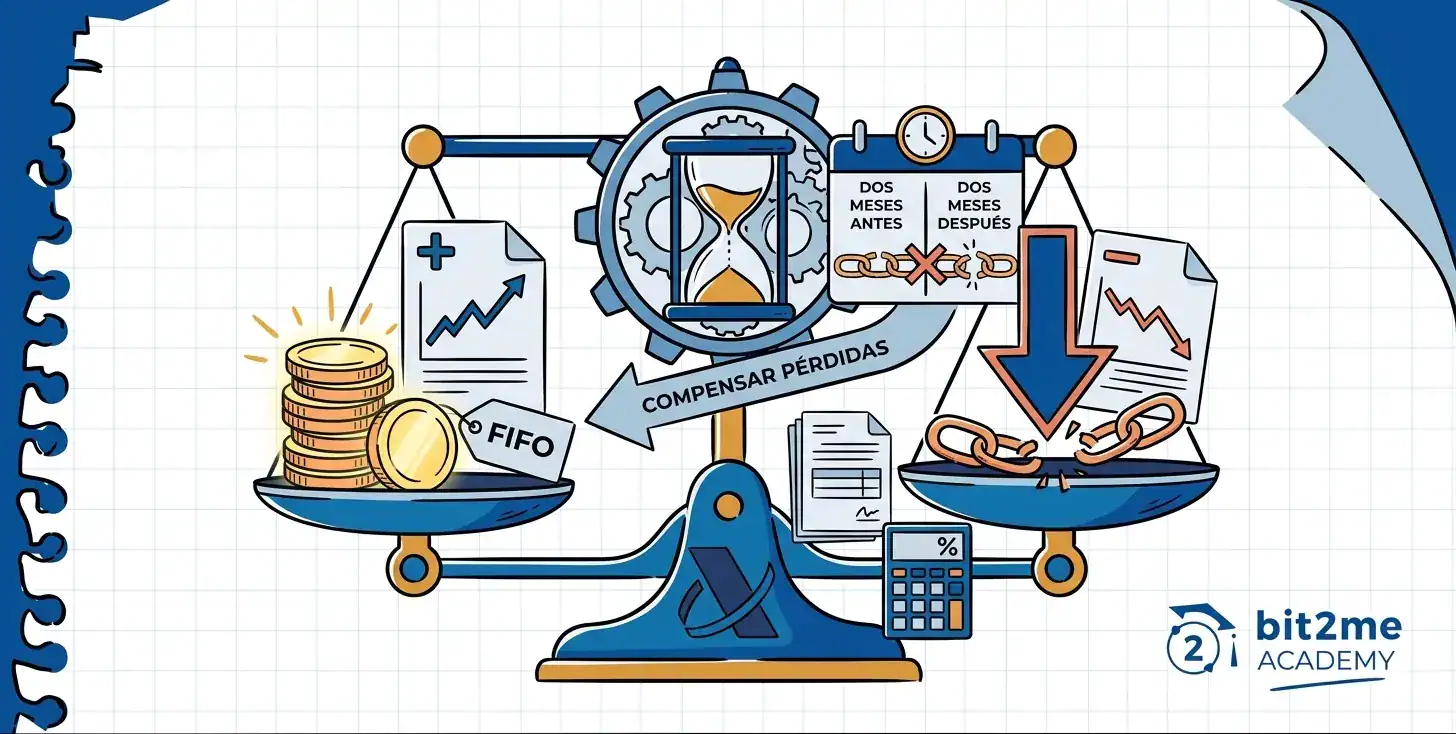
Taxation of shares in Spain: taxation and the two-month rule
Taxation of shares in Spain: savings base, personal income tax brackets and the two-month rule (art. 33.5 LIRPF) explained step by step, with examples.
ETFs to generate income: fixed income and dividends
Fixed income ETFs and dividend ETFs: two ways to generate regular income. Compare risks, taxation, and accumulation vs. distribution before choosing.
ETF vs. investment fund: key differences and which one to choose depending on your situation
ETF vs investment fund: key differences and which one to choose depending on your situation and how to get the most out of both.