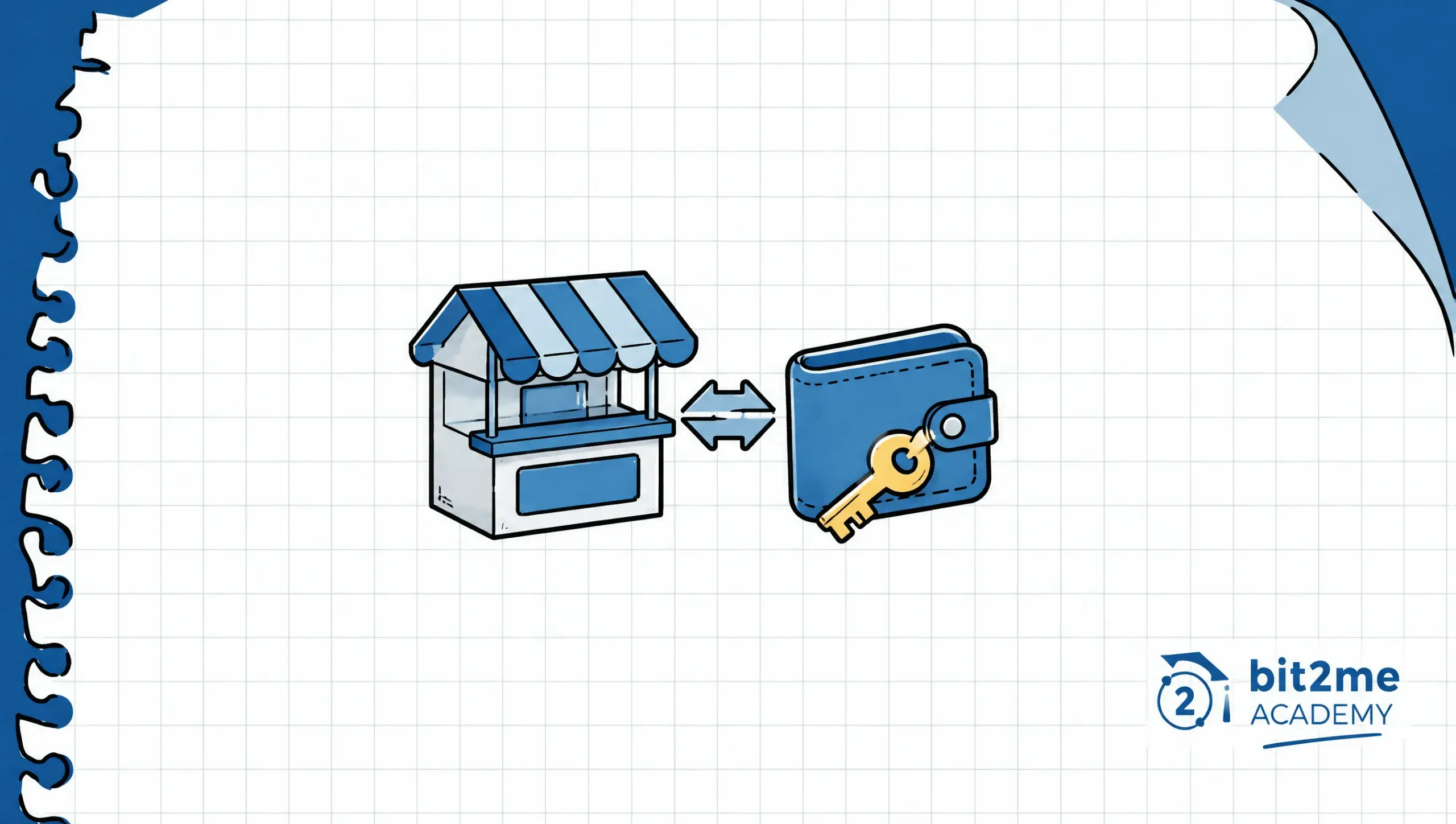
Exchange vs wallet: diferencias y cuándo usar cada uno
- An exchange is used to buy, sell, and trade crypto assets; a wallet is used to store the keys that give access to them.
- The difference between an exchange wallet and a non-custodial wallet lies in the custody: the exchange usually manages it through the platform, while the wallet can be custodial or non-custodial.
- Use the exchange to trade with agility and your own wallet, especially a non-custodial one, to hold it long-term with full control.
- Combining both —buying on the exchange and withdrawing to your own wallet— spreads the risk better than relying on a single option.
Almost everyone who starts getting interested in cryptocurrencies soon encounters the same confusion: they're not sure if they need an exchange, a wallet, or both. The two terms appear mixed together in tutorials, videos, and conversations, and it's common to think they're different ways of referring to the same thing when, in reality, they serve very different functions within the same process.
In this article, you'll clearly understand the difference between an exchange and a wallet, the role each plays when you buy, store, or move your crypto assets, and when it makes sense to use one, the other, or both simultaneously. You'll also see a comparison table that summarizes the differences between exchanges and wallets at a glance, practical examples of how both tools work together, and what security aspects to consider before deciding where to store your digital assets.
Important noticeThe acquisition of crypto assets is not fully regulated, may not be suitable for retail users due to their high volatility, and carries the risk of total loss of the funds invested. It is important to read and understand the risks before making any decisions, as outlined in the Markets in Crypto Assets Regulation (EU) (MiCA). This article is for educational and informational purposes only and does not constitute financial, legal, or tax advice.
Main Cryptocurrencies Course
Basic levelBit2Me Academy We bring you a new course where you will learn everything you need to know about the most important cryptocurrencies that exist today.
Empezar ahora ›What is an exchange and what is it used for?
An exchange is a exchange platform where a person can buy, sell, or exchange cryptocurrencies using euros, dollars, or other cryptocurrencies as a price reference. It works similarly to a digital currency exchange: you decide what you want to buy or sell, the platform finds the counterparty for that transaction, and executes the exchange in a matter of seconds.
Most exchanges also assume custody of cryptocurrencies while they remain on the platform. This means that, while your assets are there, the exchange itself manages the technical keys that grant access to them, similar to how a bank manages the money in your user account. You log in with your username and password, see your updated balance, and can trade without worrying about the underlying technical details.
This ease of use is precisely what makes an exchange attractive to beginners: you don't need to understand cryptographic keys or addresses to buy your first digital asset. Simply fund your user account, choose the cryptocurrency you're interested in, and confirm the transaction. Bit2MeFor example, it functions as an exchange platform designed to make that first step simple, without you having to manage anything technical on your own.
What is a wallet and what is it used for?
A wallet, or digital walletA wallet is a different tool, not primarily designed for buying or selling, but for storing and managing the keys that grant access to your crypto assets. It's important to understand that a wallet doesn't "store" your coins in the literal sense, just as a physical wallet doesn't create the money you carry inside: what it stores are the keys that prove those assets, registered in [the relevant database/system], are held by you. The blockchainThey belong to you.
There are two main types of wallets, and understanding the difference between them is just as important as understanding the difference between an exchange wallet and one of the other. In a custodial wallet, a platform manages your keys on your behalf, similar to how an exchange works; you log in with your regular credentials and delegate the technical aspects. In a non-custodial wallet, however, you are the one who receives and directly controls these keys, usually represented by a recovery phrase, and no third party can access them or recover them for you if you lose them.
This autonomy is the great advantage of a non-custodial wallet, but it also entails a responsibility that doesn't exist when you operate exclusively within an exchange. If you lose access to your non-custodial wallet and don't have your recovery phrase, there's no support service that can restore access to those crypto assets for you.
Exchange vs wallet: comparison table
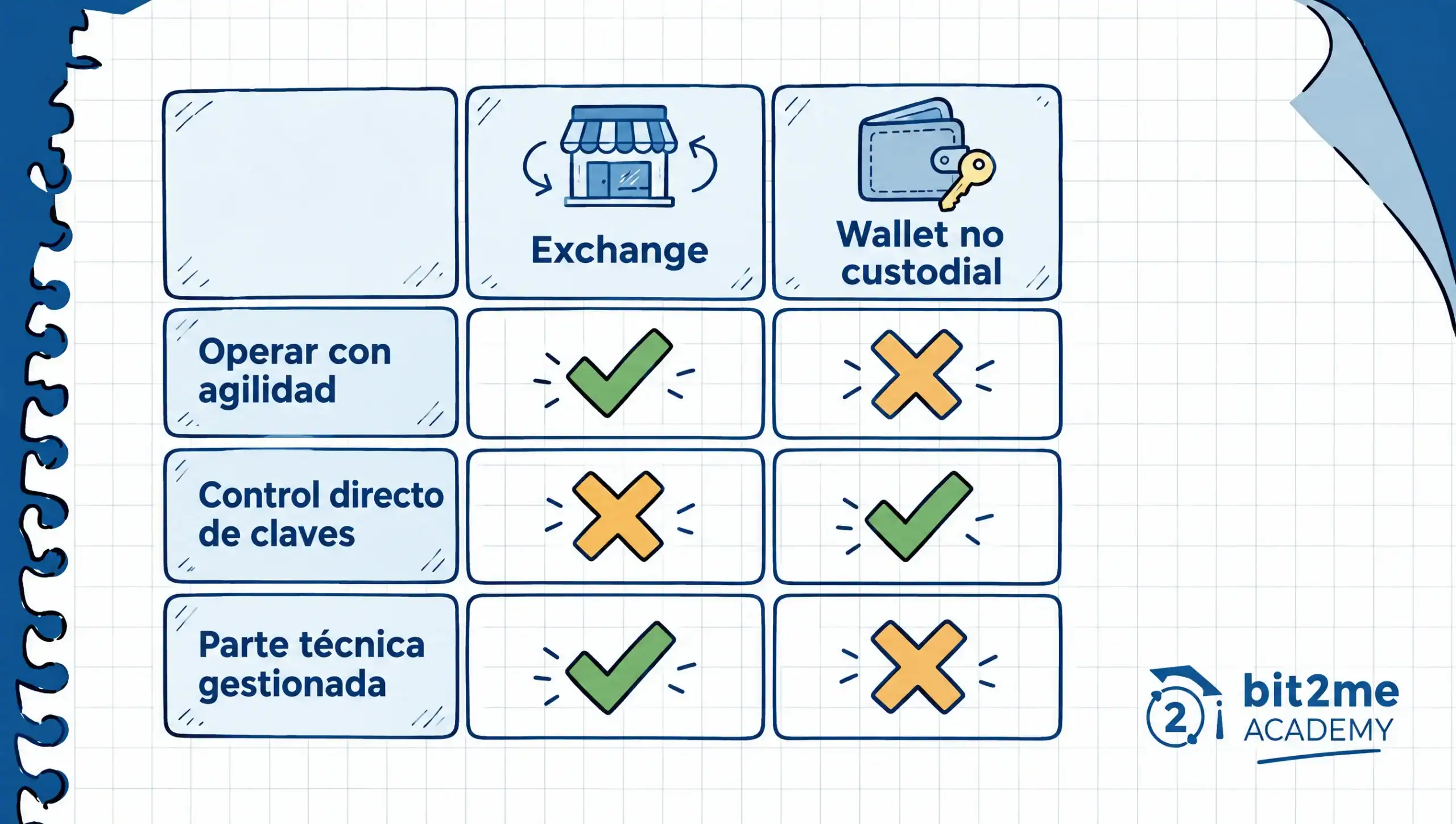
Before deciding when to use each tool, it's helpful to see at a glance how they are similar and how they differ. This table summarizes the differences between exchange wallets in the aspects that matter most to beginners.
| Appearance | Exchange | Wallet |
|---|---|---|
| Principal function | Buy, sell and exchange crypto assets | Storing and managing access keys to crypto assets |
| Custody | Generally managed by the platform itself | Custodial (managed by a third party) or non-custodial (managed by you) |
| Access | Username and password, like a user account | Platform credentials or your own recovery phrase |
| Recommended use | Actively trade: buy, sell, convert | Long-term storage with direct control of the keys |
| User Responsibility | Baja: the platform manages the technical aspects | Sign up for the non-custodial model: you are responsible for your own backup |
| Typical example | Exchange platform like Bit2Me | Non-custodial wallet application linked to a seed phrase |
This comparison makes one idea clear that should be understood from the beginning: an exchange and a wallet don't compete with each other, but rather address different needs within the same process. Choosing between an exchange or a wallet shouldn't be seen as an mutually exclusive choice, but rather as a decision about which tool to use at each stage of the process.
When is it convenient to use an exchange?
An exchange makes sense when your priority is active trading: buying a cryptocurrency for the first time, selling part of your position, converting one digital asset into another, or simply funding your user account to start familiarizing yourself with the ecosystem. The speed and simplicity of the interface make it the natural entry point for those who have never acquired cryptocurrencies before.
It's also beneficial to use an exchange when you need immediate liquidity, meaning you want to be able to sell quickly and have euros available in your user account without additional technical steps. If your activity focuses on frequent trading, comparing prices, or taking advantage of specific market movements, keeping your funds within the exchange reduces friction because you don't need to withdraw and refund your account every time you want to trade.
An exchange is especially useful for those who are learning. Starting by buying small amounts directly on an exchange platform, without yet having to manage their own redemption phrase, allows them to understand how the market works without suddenly adding the extra responsibility of self-custody. Over time, many people naturally take the next step once they feel comfortable with the basics.
When is it advisable to use your own wallet?
A personal wallet, and particularly a non-custodial one, makes sense when the focus shifts from trading to storage. If you already have a significant amount of cryptocurrency that you don't plan to move in the short term, keeping it in a wallet under your direct control reduces your reliance on a third party to manage those keys for you on an ongoing basis.
Full control of your keys is the underlying reason why many people are switching to a non-custodial wallet. You decide how, when, and where your crypto assets move, without depending on whether a platform is operational at any given moment. This independence is especially valued by those who plan to hold their digital assets for a long time, more as a long-term reserve which as a balance to operate daily.
Choosing your own wallet also means accepting the trade-off of that independence: the responsibility for properly protecting your recovery phrase rests solely with you. There's no support department that can restore access if you lose that backup, so anyone who chooses this route must be prepared to follow basic security rules from day one.
How exchange and wallet are combined in practice
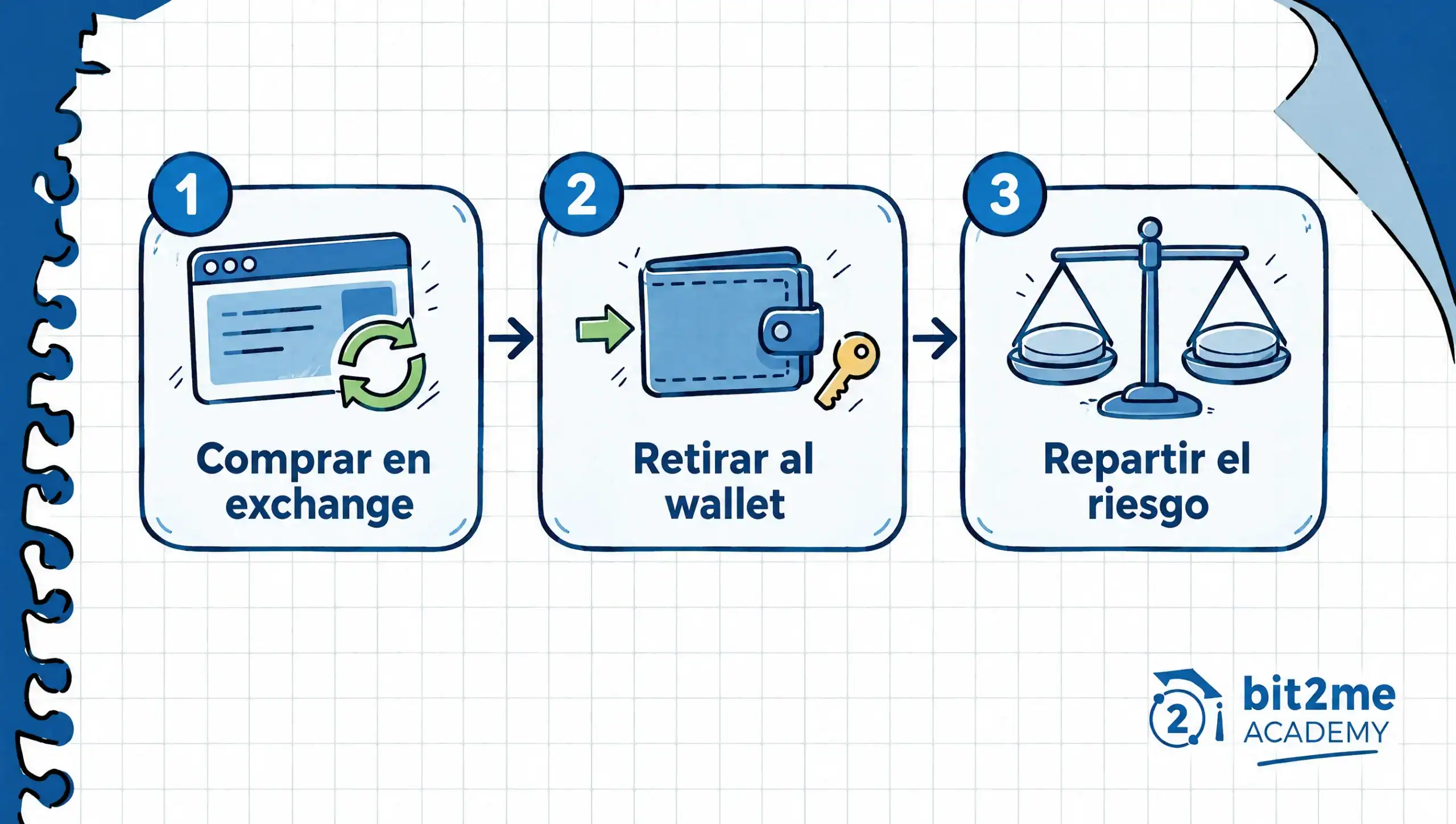
In practice, most people who have been in the ecosystem for a while don't definitively choose between an exchange or a wallet, but rather combine both tools depending on the situation. The most common pattern is simple: buy the cryptocurrency on the exchange, taking advantage of its speed and its interface geared towards buying and selling, and then withdraw that amount towards a personal wallet when the goal shifts from trading to preserving.
This withdrawal move has a clear security rationale. Holding large amounts of cryptocurrencies indefinitely on an exchange means remaining dependent on that platform to manage custody correctly all that time. Moving a portion to a non-custodial wallet spreads that risk: part of your assets remains under the direct control of your own keys, while another part stays on the exchange for when you need to trade quickly.
A practical example helps to visualize this. Imagine you buy a cryptocurrency on the exchange of Bit2Me To begin familiarizing yourself with the process, while you learn and decide on your strategy, that amount can remain safely on the platform. If later you decide to hold a portion for months or years without planning to sell it in the short term, withdrawing it to a non-custodial wallet gives you complete control over those keys, while you keep another portion on the exchange to continue trading as usual.
This combination isn't exclusive to advanced users. Anyone starting out can gradually adopt this approach: using the exchange as an entry point and, as they gain confidence, learning to manage their own wallet for the portion of their assets they want to keep more independently.
Custodial vs. non-custodial wallets: what you should know before withdrawing
Before taking the step of withdrawing your crypto assets from the exchange to your own wallet, it's important to be clear about what type of wallet you're going to use, because not all wallets work the same way once the funds leave the platform. As the guide explains in detail... Bit2Me Academy about custodial vs non-custodial walletThe difference between the two models is not only technical: it completely changes who assumes responsibility for protecting access to those assets.
If you choose a custodial wallet outside the exchange, you're still relying on a third party to manage your keys, even if it's a different platform than the one you used to buy. If you opt for a non-custodial wallet, you'll receive a recovery phrase You must keep it safe yourself, never sharing it with anyone or entering it on untrusted sites. This phrase is, in practice, the only way to regain access to your wallet if you change devices or need to restore it in the future.
Making this decision with information, rather than automatically, avoids unpleasant surprises later on. Many people withdraw their crypto assets to a non-custodial wallet without realizing that the recovery phrase doesn't have a "recover password" button, and this lack of awareness is the cause of many access loss cases seen in the ecosystem.
Common mistakes when choosing between an exchange and a wallet
One of the most common mistakes is keeping all cryptocurrencies indefinitely on an exchange, without ever considering the option of a personal wallet, simply out of convenience or lack of knowledge. This decision isn't inherently wrong for small amounts or for active use, but it ceases to make sense when the stored volume grows and the person doesn't trade with those funds for months.
The opposite mistake is also common: someone who is just starting out decides to move their crypto assets to a non-custodial wallet before fully understanding how a recovery phrase works, and ends up losing access due to a simple transcription error or by storing that phrase in a unsafe placeTaking that step without proper preparation usually generates more risk than it was intended to avoid.
It's also common to confuse the security of a user account within an exchange, protected by a password and 2FA (two-factor authentication), with the security of a non-custodial wallet, which depends solely on how you protect your recovery phrase. These are distinct layers of security and do not replace one another: enabling 2FA on your exchange does not protect a non-custodial wallet, and keeping your recovery phrase secure does not replace the security measures of your user account on the platform.
Current status: exchanges and wallets under MiCA (December 2026)
The European Union's regulatory framework, the MiCA Regulation The Regulation on Markets in Crypto-Assets (LMCA), in force since 2024, establishes authorization and supervision requirements for cryptocurrency exchange platforms operating in Europe. In Spain, the National Stock Market Commission (CNMV) is the competent authority to authorize and supervise crypto asset service providers, including exchanges.
As of December 2026, this framework does not impose equivalent regulatory requirements on non-custodial wallets themselves, since these do not provide an authorization-based custody service when the user directly controls their own keys. This regulatory difference, in fact, reinforces the difference between exchange wallets and non-custodial wallets in practice: while the exchange operates within a specific supervisory framework, the responsibility for a non-custodial wallet rests entirely with the user.
This situation may evolve as the MiCA framework develops with additional technical regulations, so it is always advisable to consult the latest information before making important decisions about where to store your crypto assets.
Taking the step to buy your first cryptocurrency or learn how to manage your own wallet doesn't have to be done all at once or under pressure. You can create an account at Bit2Me To begin trading on an exchange designed to guide beginners, familiarize yourself with the buying process and, when you feel ready, take the next step towards self-custody with the necessary information to do it right. The important thing is not to choose between an exchange or a wallet once and for all, but to understand the role each tool plays and use them in combination depending on your needs at any given time.
Frequently asked questions about exchange vs wallet
What is the difference between an exchange and a wallet in a nutshell?
An exchange is a platform for buying, selling, or converting cryptocurrencies, while a wallet is the tool that stores and manages the access keys to those assets. The exchange is designed for trading; the wallet, for storage.
How does custody work within an exchange?
On most exchanges, the platform itself manages the technical keys for your crypto assets while they remain in your user account. You log in with your username and password, without needing to manage any recovery phrase directly.
Do I need a wallet if I already have an account on an exchange?
It's not mandatory, but it's worth considering if you plan to hold cryptocurrencies for an extended period without trading them. A personal wallet gives you direct control over your keys, which isn't the case when your assets remain on an exchange.
What do I need to withdraw my crypto assets from the exchange to my own wallet?
You need to have a compatible wallet set up, obtain its public address, and use the exchange's withdrawal option, carefully entering that address. If the wallet is non-custodial, you must also have your recovery phrase saved correctly before moving any significant funds.
Is a wallet safer than an exchange?
It's not that one is more secure than the other in absolute terms, but rather that each manages different risks. An exchange depends on the security of the platform and your user account; a non-custodial wallet depends entirely on how you protect your recovery phrase.
What happens if I lose access to my non-custodial wallet?
If you don't keep your recovery phrase, there's no way to regain access to those crypto assets, because no platform holds it for you. That's why it's recommended to store it on a secure physical medium from the moment you create the wallet.
Can I buy cryptocurrencies directly from a non-custodial wallet?
Some non-custodial wallets offer built-in buying features, but they typically rely on external services to process the transaction. For most beginners, buying on an exchange and withdrawing later remains the easiest approach to understand.
What is the difference between a custodial wallet and a non-custodial wallet?
In a custodial wallet, a third party manages your keys, and you access it with conventional credentials, similar to an exchange. In a non-custodial wallet, you receive and directly control those keys using a recovery phrase, also assuming full responsibility for protecting them.
When does it make sense to use an exchange or a wallet depending on my profile?
If you're just starting out or trade frequently, an exchange is usually the most practical option due to its simplicity. If you already have experience and want to hold a portion of your crypto assets long-term with full control, a non-custodial wallet is a better fit for that goal.
What is the current state of exchange and wallet regulation in the European Union?
Exchanges operate under the MiCA framework, which requires authorization and supervision by authorities such as the CNMV in Spain. Non-custodial wallets, since they do not provide custody services managed by a third party, are not subject to this same authorization regime, although the regulatory framework may continue to evolve over time.


«Investment in cryptoassets is not fully regulated, may not be suitable for retail investors due to high volatility and there is a risk of losing all invested amounts»
Share this article!Continue learning

Qué es el slashing y cómo te protege un CASP regulado
Qué es el slashing en staking, por qué penaliza a los validadores y cómo un CASP regulado bajo MiCA reduce el riesgo de errores operativos que lo provocan.
Staking institucional y nodos: infraestructura para empresas
Staking institucional para empresas: infraestructura HSM/MPC, riesgo de slashing y autorización CASP bajo MiCA para decidir externalizar o gestionar nodos.
Qué es el KYC y por qué lo pide un exchange regulado
Descubre qué es el KYC, por qué te lo exige todo exchange regulado bajo MiCA y qué documentos necesitas para completar tu propia verificación de identidad.
ETF vs. investment fund: key differences and which one to choose depending on your situation
ETF vs investment fund: key differences and which one to choose depending on your situation and how to get the most out of both.