Qué es el slashing y cómo te protege un CASP regulado
Essential Points
- Slashing is the penalty that a Proof of Stake protocol applies to a validator for double signing or prolonged inactivity, not a user failure.
- It exists to incentivize validators to maintain high availability and behave honestly, protecting the economic security of the network.
- Operating through a regulated CASP under MiCA, with professional infrastructure and 24/7 monitoring, can reduce the likelihood of operational errors that cause slashing.
- No regulation eliminates the risk of slashing completely: it remains a technical risk of the protocol itself, not something that the oversight of a CASP can guarantee will never happen.
Slashing is the automatic penalty that a Proof of Stake protocol applies to a validator who acts improperly, deducting part of their stake. Whenever someone delegates digital assets to a validator for staking, this penalty ceases to be an abstract detail and becomes a real condition of the activity. As staking through regulated providers gains ground over self-managed staking, understanding the actual role of a Crypto Asset Service Provider (CASP) in mitigating this risk has become a recurring question among users. Bit2Me Earn.
This article explains the slashing mechanism with technical precision: what causes it, why the economic design of Proof of Stake networks requires it, and how the likelihood of experiencing it is reduced by operating through a professional infrastructure supervised under the (EU) MiCA Regulation. It also clarifies, unambiguously, what a regulated CASP cannot offer in the face of this risk. If you are already familiar with the other staking risks—liquidity, counterparty, protocol, and volatility—this guide complements that foundation by focusing on the most cited and least understood penalty mechanism in the industry.
Within the European Union's regulatory framework, Regulation (EU) MiCA (Markets in Crypto-Assets), in force since 2024, establishes the authorization and supervision obligations that Crypto-Asset Service Providers (CASPs) offering staking services to their users must comply with. BITCOINFORME, PSC, SL, which operates under the trade name of Bit2Me, is a crypto asset service provider authorized and regulated by the National Securities Market Commission (CNMV) in Spain, in accordance with Article 59 of the MiCA Regulation.
Important noticeThis article is for educational and informational purposes only. The content does not constitute financial, legal, or tax advice. Services related to reward generation carry specific risks, including liquidity risk, counterparty risk, collateral risk, and the terms and conditions of each protocol, which you should carefully review before participating. Past rewards are not a reliable indicator of future rewards.
Main Cryptocurrencies Course
Basic levelBit2Me Academy We bring you a new course where you will learn everything you need to know about the most important cryptocurrencies that exist today.
Empezar ahora ›What is slashing on a Proof of Stake network?
Slashing is a mechanism coded directly into the consensus rules of a network Proof of Stake (PoS)When a validator violates these rules—usually by double-signing blocks or remaining offline for an extended period—the protocol itself automatically reduces part of the stake locked as collateral. There is no individual or committee deciding on a case-by-case basis: the software detects the violation and applies the penalty according to predefined and publicly available rules.
This penalty directly affects the validator, but it can also impact those who have delegated digital assets to it, as the delegated stake can be reduced accordingly. This makes the choice of validator or provider a decision with real economic consequences. The magnitude varies: some networks apply minimal penalties for minor infractions, while others impose severe reductions for clear malicious behavior.
It's important to distinguish slashing from other mechanisms that sound similar but aren't. The unbonding period is simply the waiting period for withdrawing funds and doesn't imply a loss of stake, and the management fee charged by a provider isn't a staking penalty either: it's the cost of the service, agreed upon beforehand and unrelated to the validator's behavior.
The two most common technical causes of slashing
Double signing
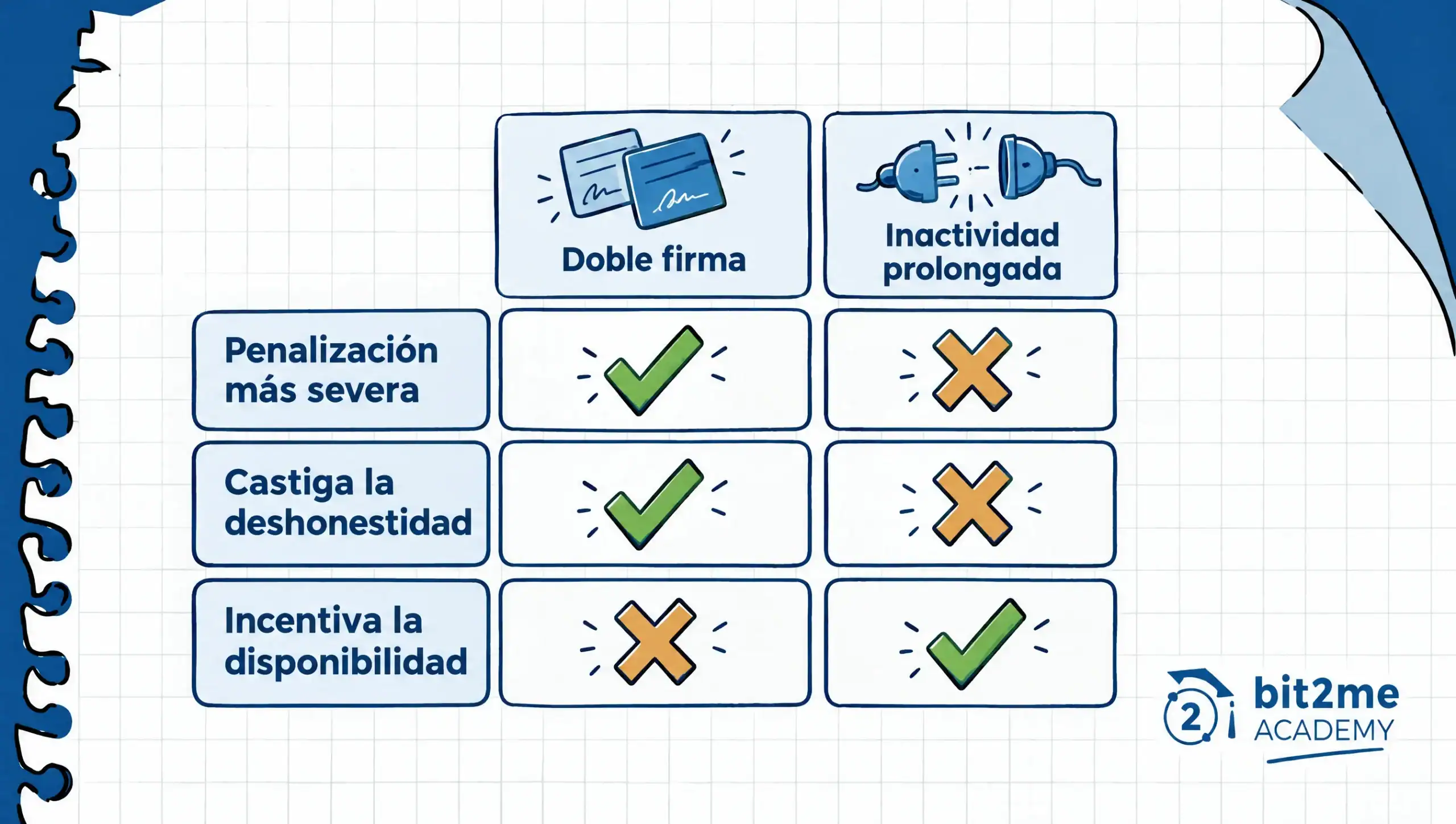
Double signing occurs when a validator signs two different blocks for the same position in the chain. Consensus rules interpret this as an attempt to manipulate the network history or, at the very least, a serious misconfiguration. While it can be malicious, in practice it's more often caused by operational errors: running the same validator on two machines simultaneously during an infrastructure migration is a common cause of accidental double signing. The penalty for this violation is usually the most severe in each protocol because it compromises the integrity of the block history.
Prolonged downtime
The second cause is prolonged inactivity, when a validator stops attesting to or proposing blocks for an extended period. Unlike double-signing, this penalty is usually lower and aims to incentivize availability rather than punish dishonesty. Networks like Ethereum also implement what's called inactivity leaking, which gradually increases the penalty if a significant portion of the network remains inactive simultaneously, in order to restore the chain's economic viability.
Both causes share a common origin: failures in the validator's infrastructure or operation, not isolated decisions by the delegator. Therefore, the quality of that infrastructure—redundancy, monitoring, key management—is the variable that most influences the actual probability of experiencing slashing, even more so than the choice of network itself.
Why does slashing exist: the economic incentive behind the design
Slashing is not a punitive measure added arbitrarily: it is the cornerstone of the economic security of any Proof-of-Stake network. A validator commits to keeping their node available and following the consensus rules in exchange for receiving staking rewards; slashing is the counterpart that gives real cost to that commitment if it is breached. Without this penalty, a validator could act negligently or even maliciously without any economic consequences, which would weaken the trust that underpins the entire network.
This design addresses a classic problem of the games theoryHow to align the individual interests of each validator with the collective interest of ensuring the chain functions without interruptions or manipulation. By requiring each validator to lock digital assets as collateral and financially penalizing misconduct, the protocol makes honesty and high availability the most profitable strategy for any rational participant.
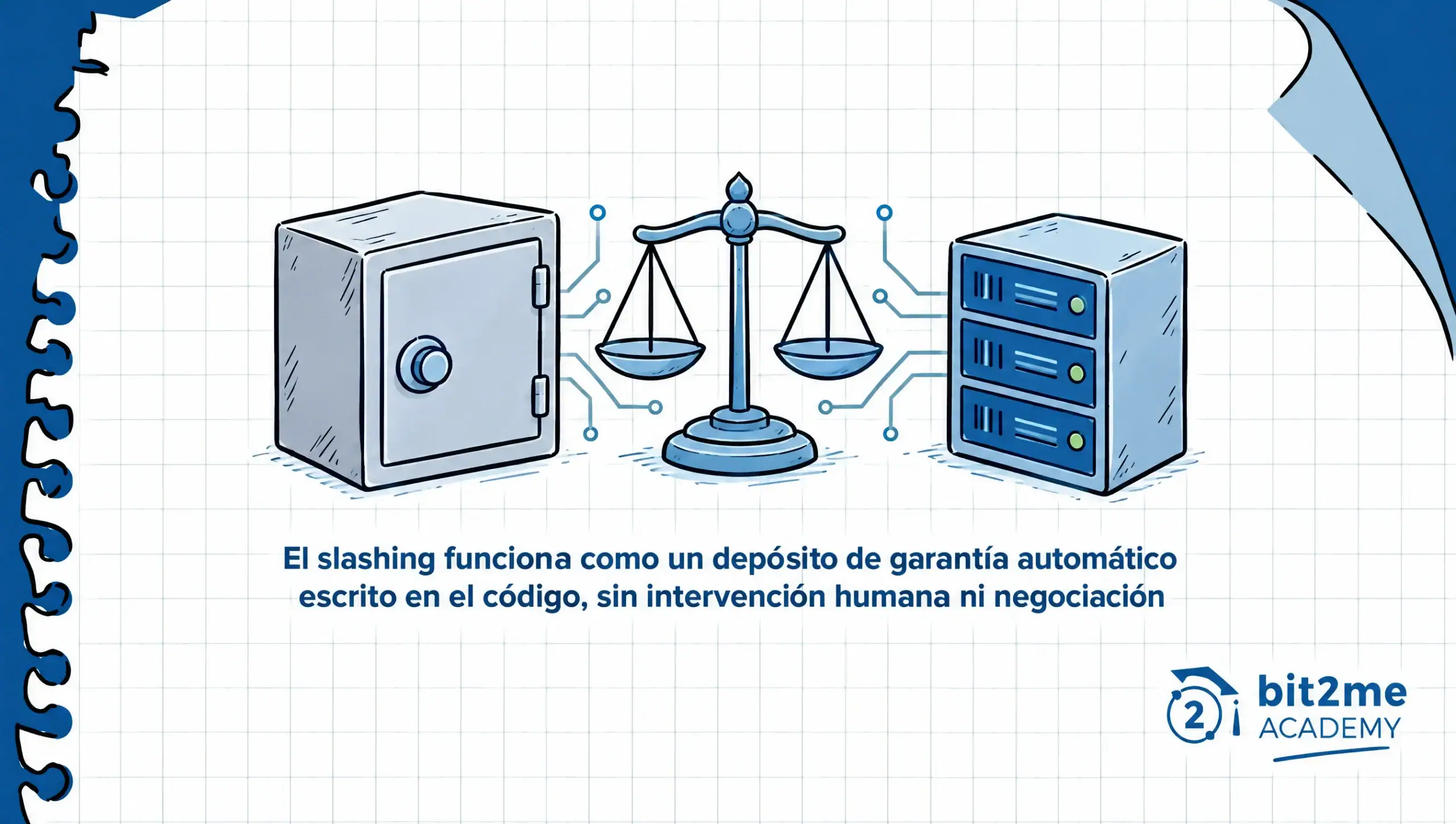
Viewed this way, slashing serves a similar function to an escrow deposit, with the difference that its execution is automatic and written into the code itself, without human intervention or room for negotiation. This automation prevents any external provider—regulated or unregulated—from altering when and how a staking penalty is applied: these rules belong to the network, not to the validator operator.
What is a CASP and what changes when you operate through a regulated one?
A CASP (Crypto-Asset Service Provider) is an entity authorized by a competent regulator to provide services related to digital assets, including staking, under a defined supervisory framework. In the European Union, this authorization is granted in accordance with the MiCA Regulation, which requires CASPs to meet governance, operational security, custody and user transparency requirements. In Spain, the CNMV It is the competent authority that authorizes and supervises these providers.
Operating through a regulated CASP means that the selection and management of validators is no longer dependent on the user's individual technical capabilities but rather on a specialized team subject to due diligence requirements defined by regulations. This doesn't change the rules of the underlying blockchain protocol—no regulatory authorization can—but it does change who manages the infrastructure that determines whether those rules are followed or violated. This distinction is important to keep in mind before assuming that "regulated" automatically equates to "no risk of slashing."
Oversight under MiCA focuses on how the provider operates—internal controls, custody, user information, and conflict of interest management—and not on modifying the consensus mechanism of Ethereum, Cosmos, or any other Proof-of-Stake (PoS) network. That mechanism remains the same regardless of whether or not a Consensus Agreement Support Provider (CASP) is involved, which correctly clarifies where regulation can and cannot have an impact.
How a regulated CASP can reduce the likelihood of operational errors
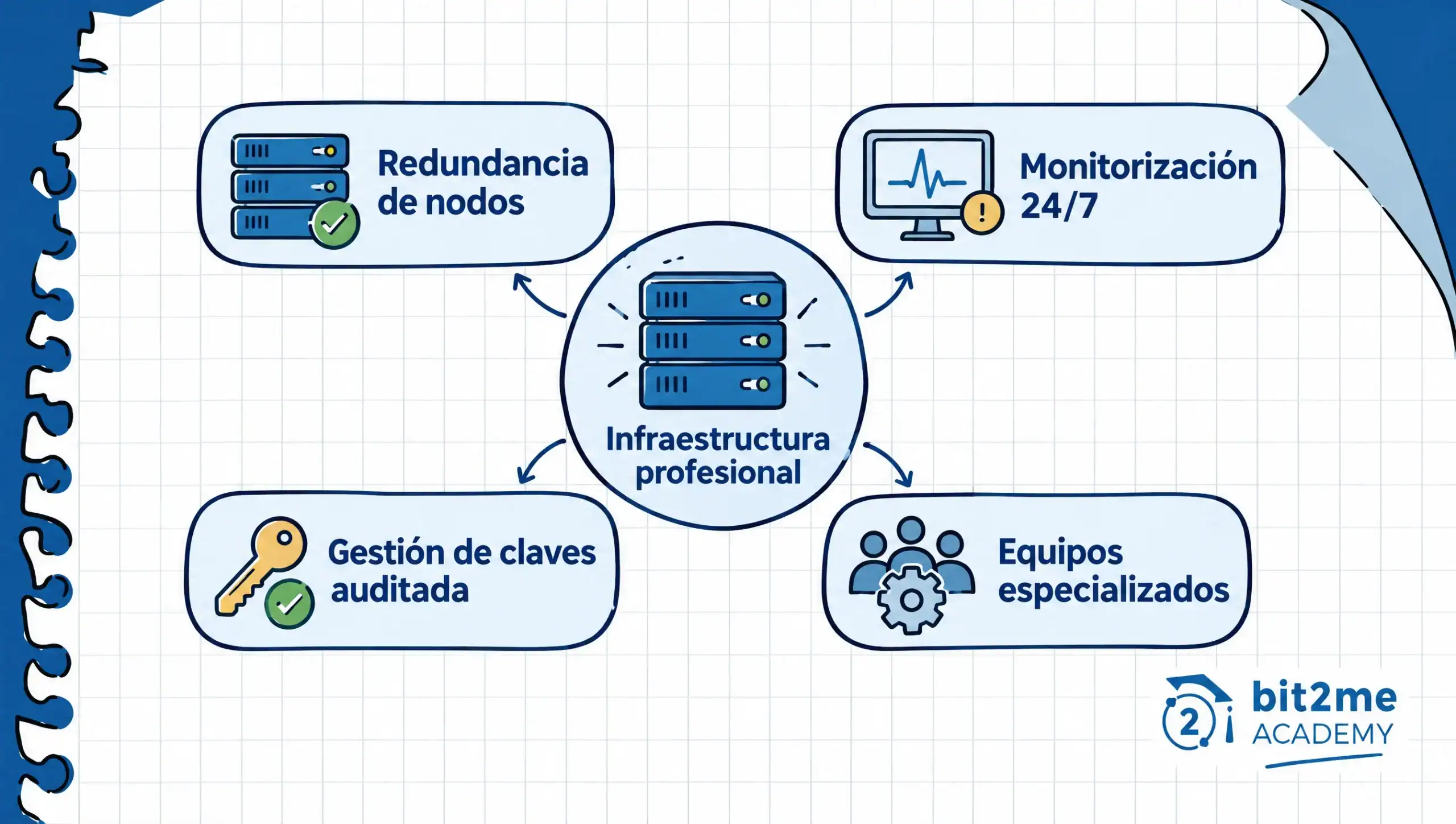
The real contribution of a regulated CASP in combating slashing lies not in modifying the protocol, but in reducing the likelihood of the operational errors that typically trigger it. A professional staking infrastructure usually incorporates several elements that an individual user can hardly replicate with the same consistency.
- Redundancy of nodes and geographically distributed infrastructure, which reduces the probability of prolonged downtime due to a single hardware or connection failure.
- 24/7 monitoring of the health of each validator, with automatic alerts that allow intervention before a disconnection lasts long enough to trigger a penalty.
- Audited key management and deployment processes, specifically designed to prevent the accidental double-signature scenario that occurs when the same validator is run uncontrolled on more than one machine.
- Specialized operations teams that apply customer updates and configuration changes following revised procedures, rather than improvised manual interventions.
These practices are not exclusive to any specific regulatory framework, but the supervision of a CASP under MiCA adds a requirement regarding the robustness of these internal processes, by obligating the provider to demonstrate governance and operational security controls to the competent authority. The expected result is a lower probability of operational failures that cause slashing, not the elimination of that possibility.
What a regulated CASP does not eliminate: the limits that must be clear
It's important to be very precise here, because this is the point where it's easiest to get confused. Authorizing a CASP under MiCA doesn't eliminate the risk of slashing, nor does it reduce it to zero. Slashing is a property of the underlying blockchain protocol, written into its consensus rules; it's not a consequence of the regulatory framework under which the provider managing the validator's infrastructure operates.
Neither MiCA nor any other oversight framework can alter how Ethereum, Cosmos, or any other Proof-of-Stake network decides to penalize a validator who violates its rules. The only thing that can change with a regulated provider is the probability of that specific provider committing the type of operational error that triggers the penalty, thanks to improved infrastructure, monitoring, and key management practices. This reduction in probability is real and relevant, but it is different from eliminating the risk.
No provider, regulated or not, can promise that a slashing event will never occur, just as no insurer can promise that a claim will never happen despite all preventative measures. Any communication suggesting total protection against slashing, or implying that the MiCA regulation "guarantees" the absence of penalties, does not accurately describe how the protocol works or the actual scope of regulatory oversight. The correct way to frame it is in terms of reducing the probability of operational errors, never in terms of a guarantee or zero risk.
How does slashing compare across different Proof of Stake networks?
Slashing policies are not universal: each protocol defines its own percentages and conditions, and comparing networks without this nuance leads to erroneous conclusions. According to Ethereum's official documentation (consulted in 2026), the minimum penalty for double-signing starts at a fraction of the individual validator's stake, but it can escalate if the event occurs in a correlated manner among many validators simultaneously—a design intended to deter coordinated attacks rather than isolated errors.
Other networks of the Cosmos family According to their technical documentation, they apply significantly higher penalty percentages for double-signing in proportion to the individual stake, while prolonged inactivity is usually penalized more lightly in most protocols, as it is interpreted as negligence rather than an attempt at manipulation. Understanding the specific slashing policy of the network you participate in is more useful than assuming that "staking" has a single, homogeneous risk profile, and it also explains why some platforms prioritize certain networks in their Earn offerings. beyond the APY what are you offering.
How to minimize your exposure to slashing as a user
While slashing doesn't directly depend on your behavior as the delegating user, there are steps you can take to reduce your exposure. Reviewing the validator's or provider's uptime history is the most basic starting point, along with checking for documented slashing incidents in network browsers.
Diversify across multiple validators Using multiple providers instead of concentrating all the stake in a single one limits the impact of a single event, just as is recommended for any counterparty risk. Prioritizing providers that transparently publish their security practices and audits also provides a reliable signal about the operational quality behind the validator. None of these practices eliminates risk completely, but all of them measurably reduce its probability.
The guide of Bit2Me Academy on risks of staking It delves into the other risks that should be considered alongside slashing—liquidity, protocol, counterparty, and underlying asset volatility—before delegating digital assets. Reading both articles together provides a more comprehensive view than focusing solely on the advertised APY percentage.
Current status: slashing and monitoring of CASP under MiCA until December 2026
As of December 2026, the MiCA authorization regime for crypto-asset service providers has been fully implemented in the European Union for over two years, and the CNMV (Spanish National Securities Market Commission) continues to refine its supervisory criteria regarding operational governance and technical risk management in staking services. These criteria focus on how a CASP (Central Asset Service Provider) must document and control its internal processes, but do not introduce changes to the consensus rules of Proof of Stake networks, which remain the exclusive responsibility of each protocol and its technical community.
Meanwhile, networks like Ethereum continue to review parameters of their penalty mechanism through public improvement proposals, so any specific figure should be understood as a general reference subject to the protocol version in effect at the time of the query, not as a fixed, permanent figure. The practical recommendation remains the same: review the network's official documentation and the operating practices of your chosen provider before delegating digital assets.
Understanding slashing with this precision—what causes it, why it exists, and what a regulated provider can and cannot influence—changes how any staking offer is evaluated, because it ceases to be an abstract risk and becomes a variable that can be investigated before making a decision. Anyone who wants to participate in staking From a Proof of Stake network through a professional infrastructure, with the operational controls of a CASP regulated under MiCA, you can Start on Earn and review the current conditions of each network before funding any amount of digital assets.
Frequently asked questions about slashing
What exactly is slashing?
Slashing is the automatic penalty applied by a Proof-of-Stake network protocol when a validator violates its consensus rules, typically by double-signing blocks or prolonged inactivity. The penalty consists of the loss of a portion of the stake locked by that validator, executed by the protocol's code itself without human intervention.
How does the slashing mechanism work within a Proof of Stake network?
The protocol software constantly monitors the behavior of each validator and automatically detects violations such as signing two different blocks for the same position in the chain. When it detects a violation, it reduces the validator's stake according to a percentage predefined in the protocol rules, without any room for negotiation or third-party intervention.
How does the double-signature staking penalty differ from the inactivity penalty?
Double-signing is interpreted as a serious, possibly malicious, breach and usually carries the most severe penalty within each protocol. Prolonged inactivity is interpreted as negligence or a technical failure and normally receives a proportionally smaller penalty, although it can accumulate if it persists over time.
How can I reduce the risk of being slashed when choosing where to stake?
Reviewing the validator or provider's uptime history, checking for documented previous incidents, and diversifying across multiple validators instead of concentrating all the effort on just one are the most effective measures. None of these eliminates risk, but all of them measurably reduce its probability.
What should I check before delegating my digital assets to a staking provider?
It's advisable to check if the provider is authorized as a CASP under MiCA, what its public security and infrastructure practices are, and what the specific slashing policy is for the network you'll be participating in. This information is usually available in the provider's documentation and the official protocol documentation.
Is it safe to stake through a regulated CASP?
A CASP regulated under MiCA operates with governance and operational security requirements overseen by the competent authority, which can reduce the likelihood of operational errors leading to slashing. However, no provider, regulated or unregulated, can completely eliminate the risk of slashing, which depends on the rules of the underlying blockchain protocol.
Does the MiCA regulation eliminate the risk of slashing?
No. MiCA regulates how a crypto asset service provider must operate—its governance, custody, and operational security—but it does not modify the consensus rules of any Proof of Stake network. Slashing remains a technical risk of the protocol, regardless of whether the provider is authorized under MiCA.
How does slashing risk differ from counterparty risk in centralized staking?
The risk of slashing depends on the protocol rules and the technical behavior of the validator, while counterparty risk depends on the solvency and practices of the platform that manages those validators on behalf of the user. A provider can reduce counterparty risk through sound custody practices and, at the same time, influence the likelihood of slashing through the quality of its technical infrastructure.
How does the slashing penalty compare across different Proof of Stake networks?
Each network defines its own percentages: according to Ethereum's official documentation, the penalty for double-signing can escalate if the event affects many validators simultaneously, while other networks in the Cosmos family apply proportionally higher double-signing penalty percentages, according to their technical documentation. There is no single percentage valid for all networks.
What is the current state of CASP oversight versus slashing under MiCA?
As of December 2026, the CNMV continues to refine its supervisory criteria regarding operational governance and technical risk management of CASPs, without this altering the consensus rules of any Proof of Stake network. The practical recommendation remains to review the official protocol documentation and the operating practices of the chosen provider before delegating digital assets.


«Investment in cryptoassets is not fully regulated, may not be suitable for retail investors due to high volatility and there is a risk of losing all invested amounts»
Share this article!Continue learning
Exchange vs wallet: diferencias y cuándo usar cada uno
Descubre la diferencia entre exchange y wallet, cuándo conviene usar cada uno y cómo combinarlos para comprar y guardar tus criptoactivos con seguridad.
Staking institucional y nodos: infraestructura para empresas
Staking institucional para empresas: infraestructura HSM/MPC, riesgo de slashing y autorización CASP bajo MiCA para decidir externalizar o gestionar nodos.

Qué es el KYC y por qué lo pide un exchange regulado
Descubre qué es el KYC, por qué te lo exige todo exchange regulado bajo MiCA y qué documentos necesitas para completar tu propia verificación de identidad.
ETF vs. investment fund: key differences and which one to choose depending on your situation
ETF vs investment fund: key differences and which one to choose depending on your situation and how to get the most out of both.