Crypto loan or sell: what's best depending on your situation
Essential Points
- Selling crypto assets solves liquidity problems immediately, but it usually generates a change in net worth and closes the door to any future appreciation of the asset.
- A crypto loan uses your assets as collateral and maintains your exposure, but exposes you to the real risk of liquidation if the price falls below a threshold.
- The Directorate General of Taxes has indicated that establishing a crypto loan does not equate to a sale for tax purposes, a relevant distinction compared to the general criterion of the Tax Agency.
- There is no single answer to deciding between selling or taking out a crypto loan: it depends on your time horizon, your risk tolerance, and the actual urgency of your need for liquidity.
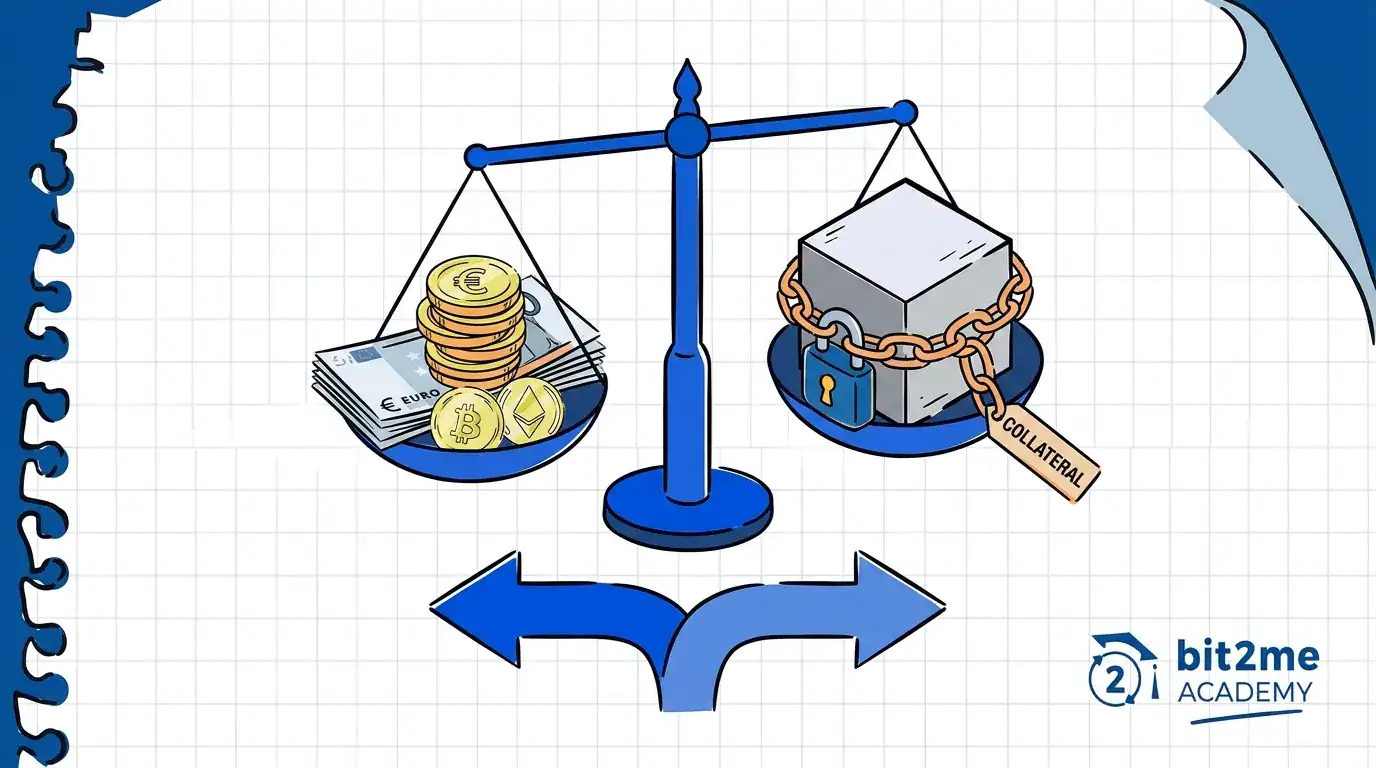
Owning cryptocurrencies and needing liquidity simultaneously creates a very specific conflict: selling solves the immediate cash need, but it also closes the door to any future movement of the asset you decide to sell. More and more users who have been accumulating Bitcoin or Ethereum for some time are finding themselves at this crossroads when an unexpected expense arises, a specific opportunity presents itself, or they simply need to reorganize their personal finances without parting with what they already own.
This article objectively compares the two available options: selling some of your digital assets or taking out a crypto loan using them as collateral. You'll see the tax implications of each option, how liquidation risk works with a crypto loan, and find a table of generic scenarios—not a personalized recommendation—to help you organize your own judgment before deciding between a crypto loan or selling.
Important noticeThis article is for educational and informational purposes only. The content does not constitute financial, legal, or tax advice. Cryptocurrencies are high-risk assets and their value can fluctuate significantly. Consult a qualified professional before making any decisions to acquire, participate in, or finance using cryptocurrencies as collateral.×Why does the dilemma arise between selling and taking out a crypto loan?
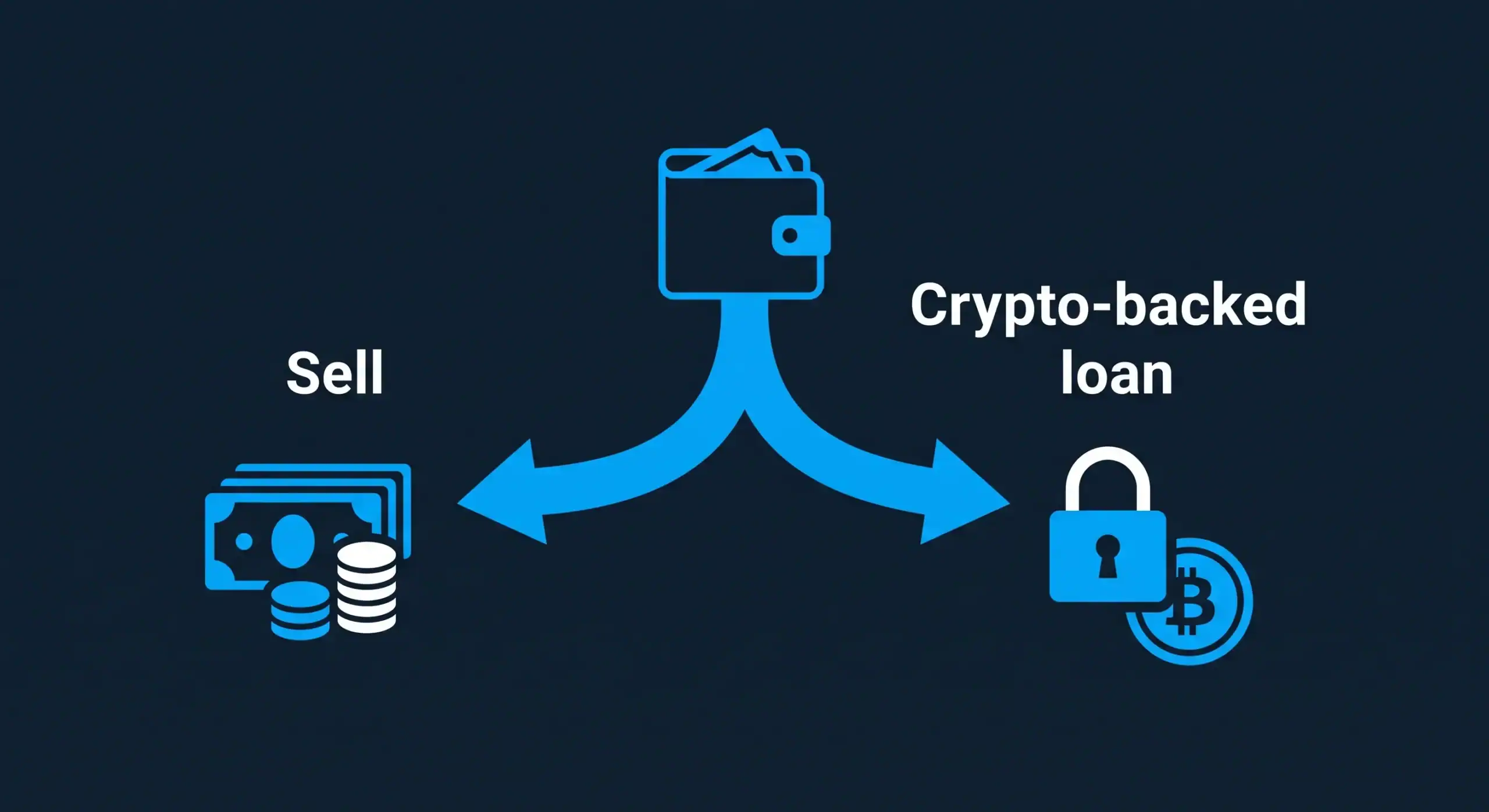
The dilemma arises because both routes solve the same problem—needing readily available cash—in completely different ways. Selling Bitcoin and taking out a crypto loan are not equivalent operations: one permanently converts the digital asset into cash, while the other uses that same asset as collateral without relinquishing ownership. The decision becomes more complex when the user has long-term conviction in the asset but simultaneously faces a genuine need for funds in the short term.
This type of situation has become more common as cryptocurrencies gain prominence in the personal portfolios of those who have been in the ecosystem for several years. Those who bought Bitcoin or Ethereum some time ago and see accumulated appreciation are often reluctant to sell, because doing so means forgoing any future movement of the asset and, in many cases, triggering a tax obligation. On the other hand, a crypto loan is not without its commitments: it involves a repayment schedule and a specific risk—the liquidation of the collateral—which should be understood before applying for any product of this type.
Neither option is inherently better: each suits a different need and risk tolerance profile. Therefore, before deciding whether to sell or take out a crypto loan, it makes sense to clearly understand what each path entails, starting with selling.
What are the implications of selling your crypto assets when you need liquidity?
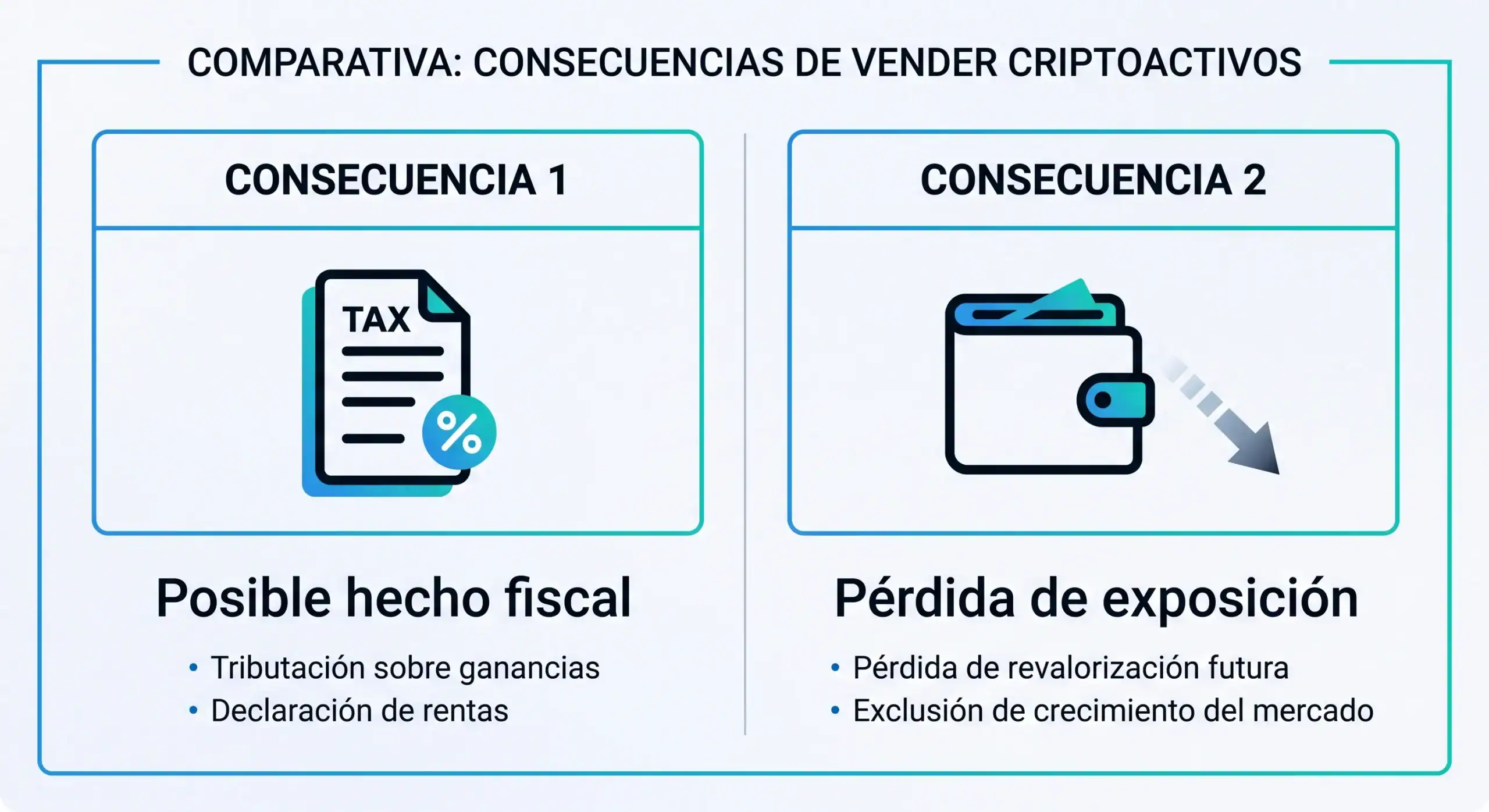
Selling is the most direct route: you convert your crypto assets into readily available cash and eliminate any subsequent price fluctuations. It's a simple solution, but it has two consequences that should be carefully considered before proceeding.
The first is tax-related. In Spain, the sale of crypto assets constitutes a change in net worth that, generally, must be declared to the Tax Agency, generating a capital gain or loss depending on the acquisition and sale prices. This obligation applies regardless of whether the sale is made to cover a one-off expense or as part of a portfolio restructuring strategy. This article does not replace personalized tax advice: each tax situation depends on individual circumstances that only a qualified professional can accurately assess.
The second consequence is the loss of exposure to the asset. Once sold, the cryptocurrency ceases to be part of your portfolio, and any subsequent price movements—up or down—no longer affect you. For those with conviction about the asset in the medium or long term, this is precisely the most costly aspect of selling Bitcoin or borrowing: selling closes the door, while other alternatives keep it open under different conditions.
What are the implications of taking out a crypto loan instead of selling?
A crypto loan works differently: instead of selling the asset, you use it as collateral to receive liquidity, usually in euros or a stablecoin, without relinquishing ownership of your crypto assets. This means you maintain exposure to the asset for the duration of the loan: if its price rises, that gain is still yours once the crypto loan is repaid.
This advantage has a downside that must be made clear: liquidation risk. When you take out a crypto loan, the platform establishes a relationship between the value of the collateral and the loan amount, known as the loan-to-value (LTV). If the asset's price falls significantly and this ratio exceeds the threshold set in the product's terms and conditions, the platform can liquidate all or part of the collateral to cover the debt, regardless of your wishes or whether you repay the loan on time. This risk is real and must be understood before taking out any crypto loan: the possibility of liquidation is always present to a greater or lesser degree, and no reputable platform should present this product as if it carries no risk whatsoever.
In addition to liquidation risk, a crypto loan involves a repayment schedule with associated interest or fees, which vary depending on the platform and the chosen term.

Main Cryptocurrencies Course
Basic levelBit2Me Academy We bring you a new course where you will learn everything you need to know about the most important cryptocurrencies that exist today.
Empezar ahora ›What are the implications of taking out a crypto loan instead of selling?
A crypto loan works differently: instead of selling the asset, you use it as collateral to receive liquidity, usually in euros or a stablecoin, without relinquishing ownership of your crypto assets. This means you maintain exposure to the asset for the duration of the loan: if its price rises, that gain is still yours once the crypto loan is repaid.
This advantage has a downside that must be made clear: liquidation risk. When you take out a crypto loan, the platform establishes a relationship between the value of the collateral and the loan amount, known as the loan-to-value (LTV). If the asset's price falls significantly and this ratio exceeds the threshold set in the product's terms and conditions, the platform can liquidate all or part of the collateral to cover the debt, regardless of your wishes or whether you repay the loan on time. This risk is real and must be understood before taking out any crypto loan: the possibility of liquidation is always present to a greater or lesser degree, and no reputable platform should present this product as if it carries no risk whatsoever.
In addition to liquidation risk, a crypto loan involves a repayment schedule with associated interest or fees, which vary depending on the platform and the chosen term.
What does the Directorate General of Taxes say about crypto loans?
The tax implications are one of the most significant factors when comparing a sale with a crypto loan, because they completely change when a potential tax liability arises. As noted, the Directorate General of Taxes has indicated in binding rulings that establishing a loan with crypto assets as collateral is not equivalent to a sale, and therefore does not automatically trigger a change in net worth at that moment. Selling, on the other hand, does generate such a change in net worth immediately, according to the Tax Agency's general interpretation.
This difference explains why many users who are confident in their assets consider crypto lending as a way to obtain liquidity without incurring a tax obligation upfront that they would otherwise have to assume upon selling. That said, the DGT's (Spanish Directorate General of Taxes) criteria are based on specific binding rulings and may be nuanced depending on the circumstances of each case, the type of platform, and regulatory developments. None of the above replaces personalized tax advice: the tax implications of these types of transactions should be reviewed with a qualified professional before proceeding.
If you want to learn more about how this criterion is documented, what supporting documents you should keep, and how to properly declare a crypto loan, consult the crypto loan tax guide from Bit2Me Academy This guide elaborates on that topic in more detail. It complements the information provided here and is especially useful if you've already decided to pursue this route and want to prepare the necessary documentation in advance.
How to track your staking rewards?
Once ETH is participating in the network, the work doesn't end: it's advisable to periodically check how your position is evolving. The most direct way is to consult the dashboard of the platform or wallet you're using, where you'll usually see the ETH locked, the accumulated rewards, and the operational status of your associated validator. Those who operate their own validator can also check its status directly on a public block explorer.
The APY for staking is not a fixed number: it varies depending on the total amount of ETH staked across the entire network, the operation of the specific validator, and, in the case of platforms, the current policy of each provider. Therefore, it's advisable to check the updated figure on the relevant official channel before making any decisions, and always remember that past performance is not indicative of future results and does not guarantee equivalent rewards in the future.
Monitoring doesn't mean checking the position every minute: a periodic review—weekly or monthly, depending on the amount involved and how much attention each user wants to dedicate to it—is enough to confirm that the validator is still operating normally and that the rewards are accumulating as expected.
Current state of Ethereum staking in 2026
Staking has become the default state for a significant portion of the ETH supply since the switch to Proof of Stake in 2022. According to public estimates from network explorers such as beaconcha.in (consulted in early 2026), the percentage of ETH staked remains consistently above a quarter of the total circulating supply, a trend that has progressively solidified since the activation of PoS.
This growth has been accompanied by an increasingly wide range of access options: in addition to operating their own validator, multiple platforms and liquid staking protocols now coexist, significantly lowering the barrier to entry compared to the first months after the Merge. Even so, the ecosystem continues to evolve—both in terms of protocol and regulation under MiCA in the European Union—so it's advisable to periodically review the current conditions before committing ETH.
How to assess your situation: time horizon, risk tolerance, and liquidity urgency?
Beyond the table, it's advisable to review three objective criteria individually before making a decision. The first is the time horizon: how long you can wait before needing the money again and how long you've been planning to hold the asset. The second is liquidation risk tolerance: whether a price drop triggering the liquidation of the collateral would create an additional financial problem, or whether you can absorb that scenario without jeopardizing other obligations. The third is the actual urgency of the liquidity: needing funds for an immediate emergency is not the same as needing them for an opportunity that can wait a few weeks.
These three criteria don't work in isolation; they are combined. Someone with a long-term investment horizon and a high risk tolerance might be comfortable with a crypto loan that maintains their exposure to the asset. Someone with an urgent need for immediate liquidity and a low tolerance for uncertainty might prefer the simplicity of selling, even considering the tax implications.
Before committing to either option, it makes sense to run some concrete numbers. Using a tool like Crypto Loan Simulator lets you see, with your own figures, what collateral you would need, what your LTV would be, and what margin you would have against a price drop—all before applying for anything. This simulation doesn't replace analyzing your personal situation, but it does help you move from an abstract decision to one based on real numbers.

Frequently asked questions about crypto lending and the decision to sell
What is the difference between selling bitcoin and taking out a loan using that same asset as collateral?
Selling Bitcoin transfers ownership of the asset in exchange for immediate and permanent liquidity. Taking out a crypto loan retains ownership of the asset, which acts as collateral, while you receive liquidity subject to repayment and the terms of the loan agreement.
Is a crypto loan the same as a traditional bank loan?
No. A crypto loan uses crypto assets as collateral and does not involve a bank deposit relationship nor is it subject to the same rules as a conventional bank loan; its main risk is the liquidation of the collateral, not default in the traditional banking sense.
Does selling cryptocurrencies always generate a tax obligation?
Generally speaking, the sale of crypto assets constitutes a change in net worth that must be declared to the Tax Agency, although the specific outcome—gain, loss, or exemption—depends on each individual case. This article does not replace personalized tax advice.
What is liquidation risk in a crypto loan?
This is the possibility that the platform will sell some or all of your collateral if its value falls below the threshold set by the agreed loan-to-value (LTV) ratio. This happens automatically according to the product terms, regardless of whether you are up to date with the repayment schedule.
Can I lose all my collateral on a crypto loan?
Yes, it's possible if the price drop is severe enough and additional collateral isn't provided in time, according to the platform's terms. Therefore, no crypto loan should be considered risk-free, and it's advisable to regularly review the LTV (Loan Value to Value).
How do I know if a crypto loan or selling is a better option for me?
It depends on three objective criteria: your time horizon, your tolerance for liquidation risk, and the actual urgency of your liquidity need. The comparison table in this article illustrates generic scenarios, but your specific situation may require professional advice.
Does the comparison chart in this article tell me what I should do?
No. The table describes common generic scenarios and does not constitute personalized advice; each person should assess their particular situation or consult with a qualified professional before deciding.
What does the DGT say about the taxation of crypto loans?
The Directorate General of Taxes has stated in binding rulings that establishing a loan backed by crypto assets is not equivalent to a sale and does not automatically generate a capital gain or loss at that time. This criterion does not replace personalized tax advice and may be nuanced depending on each case.
Is there a tool to calculate the figures before applying for a crypto loan?
Yes, tools like Crypto Loan Simulator allow you to estimate the necessary collateral, the resulting LTV, and the margin against price drops before committing to a real loan application.
What if I need liquidity but don't want to take any risks?
There's no path that's completely without implications: selling carries potential tax costs and the ultimate relinquishment of the asset, while a crypto loan involves liquidation risk. The decision hinges on prioritizing which type of involvement you're most willing to accept, ideally with professional support if the situation is complex.


«Investment in cryptoassets is not fully regulated, may not be suitable for retail investors due to high volatility and there is a risk of losing all invested amounts»
Share this article!Continue learning
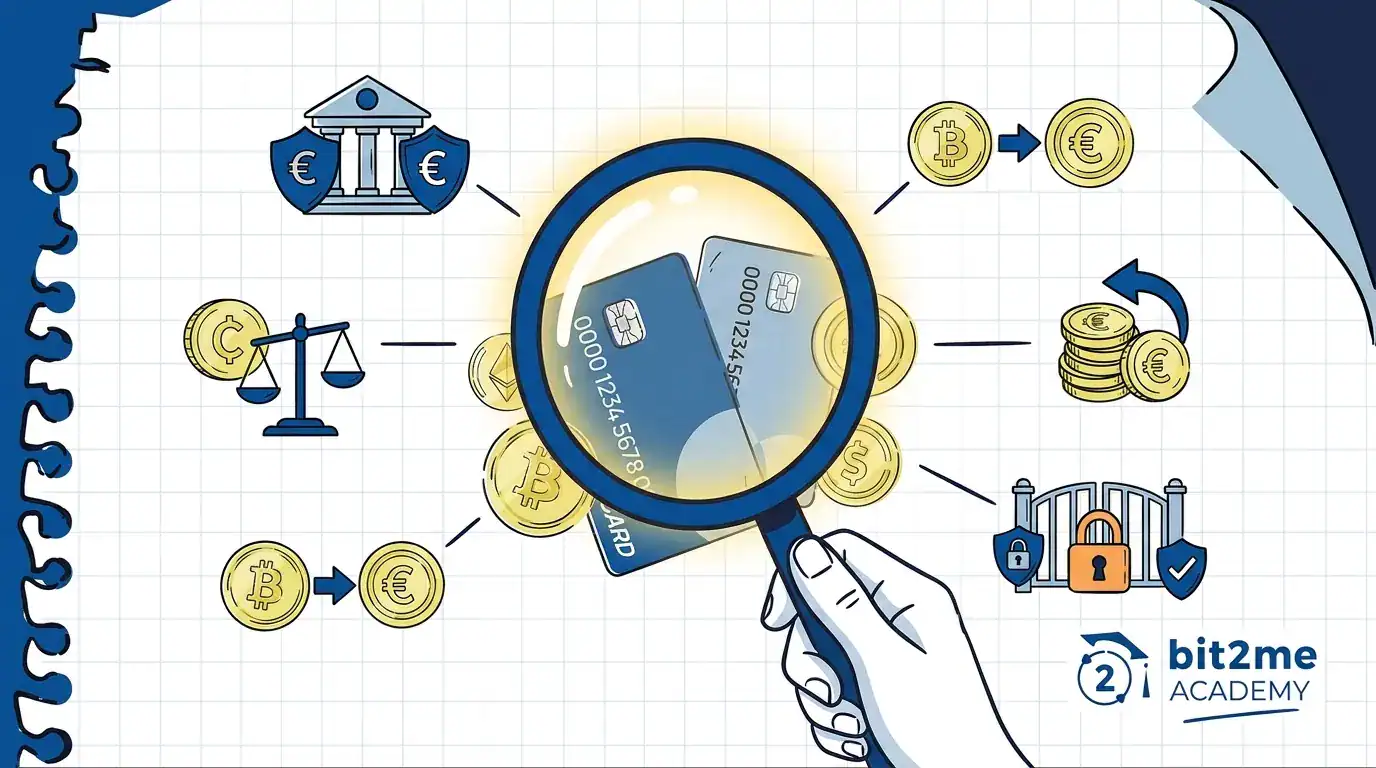
Best crypto card in Spain: what to look for before choosing one
What to look for when choosing a crypto card in Spain: regulated issuer, conversion, fees, cashback, limits and security, without comparing brands or rankings.
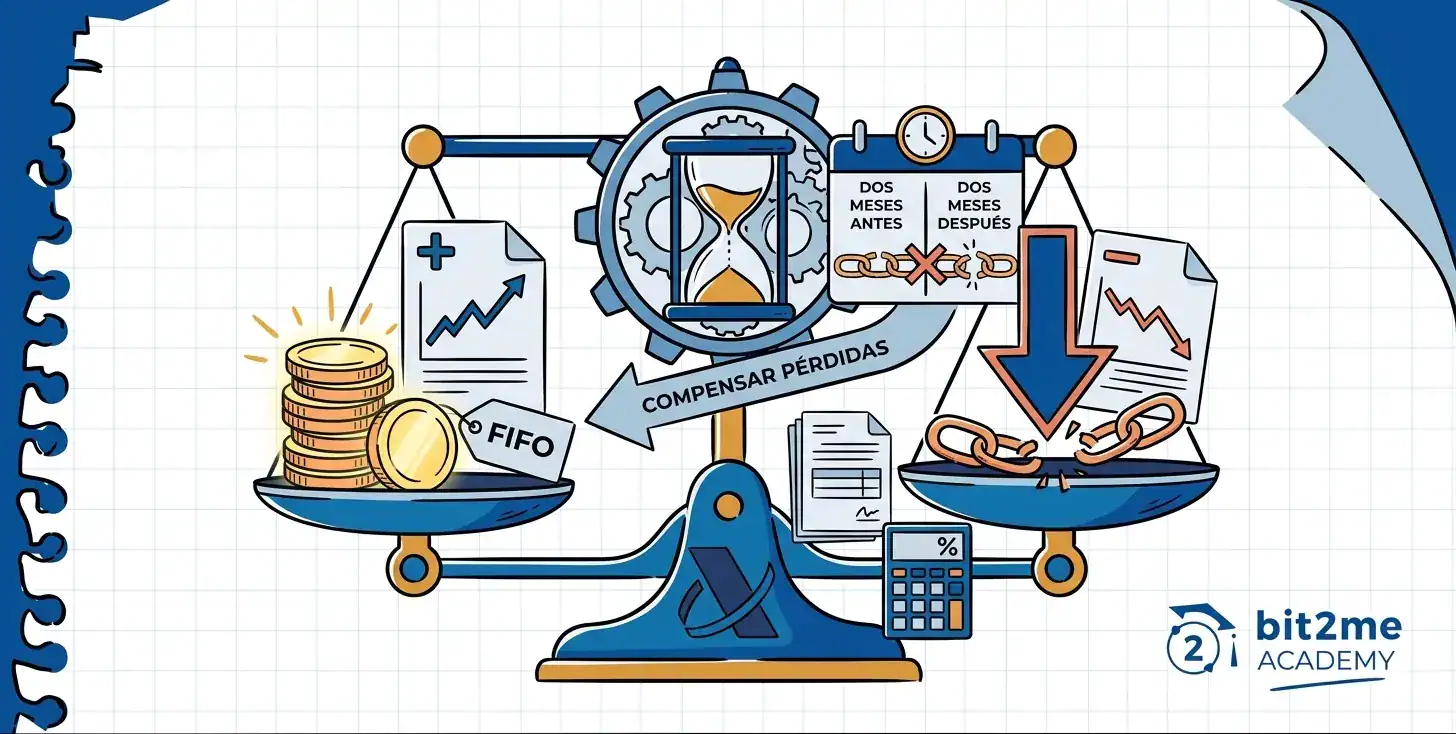
Taxation of shares in Spain: taxation and the two-month rule
Taxation of shares in Spain: savings base, personal income tax brackets and the two-month rule (art. 33.5 LIRPF) explained step by step, with examples.

ETFs to generate income: fixed income and dividends
Fixed income ETFs and dividend ETFs: two ways to generate regular income. Compare risks, taxation, and accumulation vs. distribution before choosing.
ETF vs. investment fund: key differences and which one to choose depending on your situation
ETF vs investment fund: key differences and which one to choose depending on your situation and how to get the most out of both.