Staking en exchange vs montar tu propio nodo
Essential Points
- Staking on an exchange and setting up your own validator are two ways to participate in the Proof of Stake consensus with very different compensations.
- One delegates the infrastructure to a regulated platform; the other requires its own hardware, synchronized clients, and 24-hour network availability.
- It helps to decide whether it is worth taking on the technical complexity and entry cost of a validator versus the simplicity of a platform.
- Setting up your own node eliminates counterparty risk, but introduces the risk of being slashed due to configuration errors or connection drops.
If you already understand the basics of staking and are considering going beyond simply delegating your crypto assets to a platform, you've probably encountered the recurring question in any Ethereum, Solana, or Cosmos technical community: Is it worthwhile to operate your own validator, or is staking on an exchange still more sensible? The answer depends on how much you value complete control over your keys versus the operational cost of maintaining an uninterrupted node.
This article compares both approaches with the technical detail the decision requires: what delegating staking to a centralized platform entails, what setting up your own validator node requires in terms of hardware, software, and capital, and what distinct risks each path entails. You'll find a quotable comparison table, a breakdown of the technical requirements for your own validator, and ten frequently asked questions.
Within the European Union's regulatory framework, the MiCA (Markets in Crypto-Assets) regulation requires cryptocurrency service providers offering staking to clearly disclose the terms of service, including how user keys are managed. BITCOINFORME, PSC, SL, operating under the trade name of Bit2Me, is a crypto asset service provider authorized by the National Securities Market Commission (CNMV) in Spain in accordance with Article 59 of the MiCA Regulation, which legally frames the exchange staking service described in this guide.
Important noticeThis article is for educational and informational purposes only. The content does not constitute financial, legal, or tax advice. Cryptocurrencies are high-risk assets and their value can fluctuate significantly. Consult a qualified professional before making any acquisition or participation decisions.
Past performance is not a reliable indicator of future results. Services related to generating returns carry specific risks, including liquidity risk, counterparty risk, collateral risk, and product-specific terms and conditions, which users should carefully review before accessing them.

Main Cryptocurrencies Course
Basic levelBit2Me Academy We bring you a new course where you will learn everything you need to know about the most important cryptocurrencies that exist today.
Empezar ahora ›What does staking on an exchange mean?
Staking on an exchange involves delegating your compatible crypto assets to Proof of Stake (PoS) to a centralized platform to operate the validation infrastructure on your behalf. You don't run any node clients or manage validator keys: the platform It pools the stakes of many users.It distributes it among its own validators and shares the resulting rewards, usually deducting a service fee for technical management.
This approach eliminates the technical barrier of operating a validator: you don't need dedicated hardware or to synchronize consensus or execution clients, and your own internet connection is no longer a critical factor. Furthermore, by pooling the stakes of multiple users, it allows participation with amounts far lower than the minimum required by a single validator on networks like Ethereum.
The downside is that the platform holds the validator's keys and, in many models, also the user's own keys, which introduces a counterparty risk: if it experiences an operational, solvency, or security problem, access to these digital assets can be affected even if the underlying protocol is functioning normally. This is a different risk than that of the validator itself, and it should be considered before funding any amount.
What does it mean to set up your own validator node?
assemble your own validator node This involves running and maintaining all the infrastructure a validator needs to participate in the network consensus: synchronizing the chain's state, proposing blocks when it's your turn, and witnessing blocks proposed by other validators. In exchange for this technical responsibility, you maintain complete control over your validator keys and don't depend on any intermediary platform to access your rewards or stake.
In a network like Ethereum, this means simultaneously running two coordinated pieces of software: an execution client, such as Geth, Nethermind, Besu, or Erigon, which processes transactions and maintains the chain state; and a consensus client, such as Prysm, Lighthouse, Teku, Nimbus, or Lodestar, which implements the Proof of Stake protocol and coordinates block proposal and attestation. Both must remain synchronized through the Engine API interface, and a failure in either can take the validator offline without active monitoring to detect it.
Unlike exchange staking, there's no intermediary responsible for service outages: keeping the validator available, updated, and properly configured falls solely on the operator. That's the key trade-off in this comparison, and why setting up your own node makes sense for a very specific type of user.
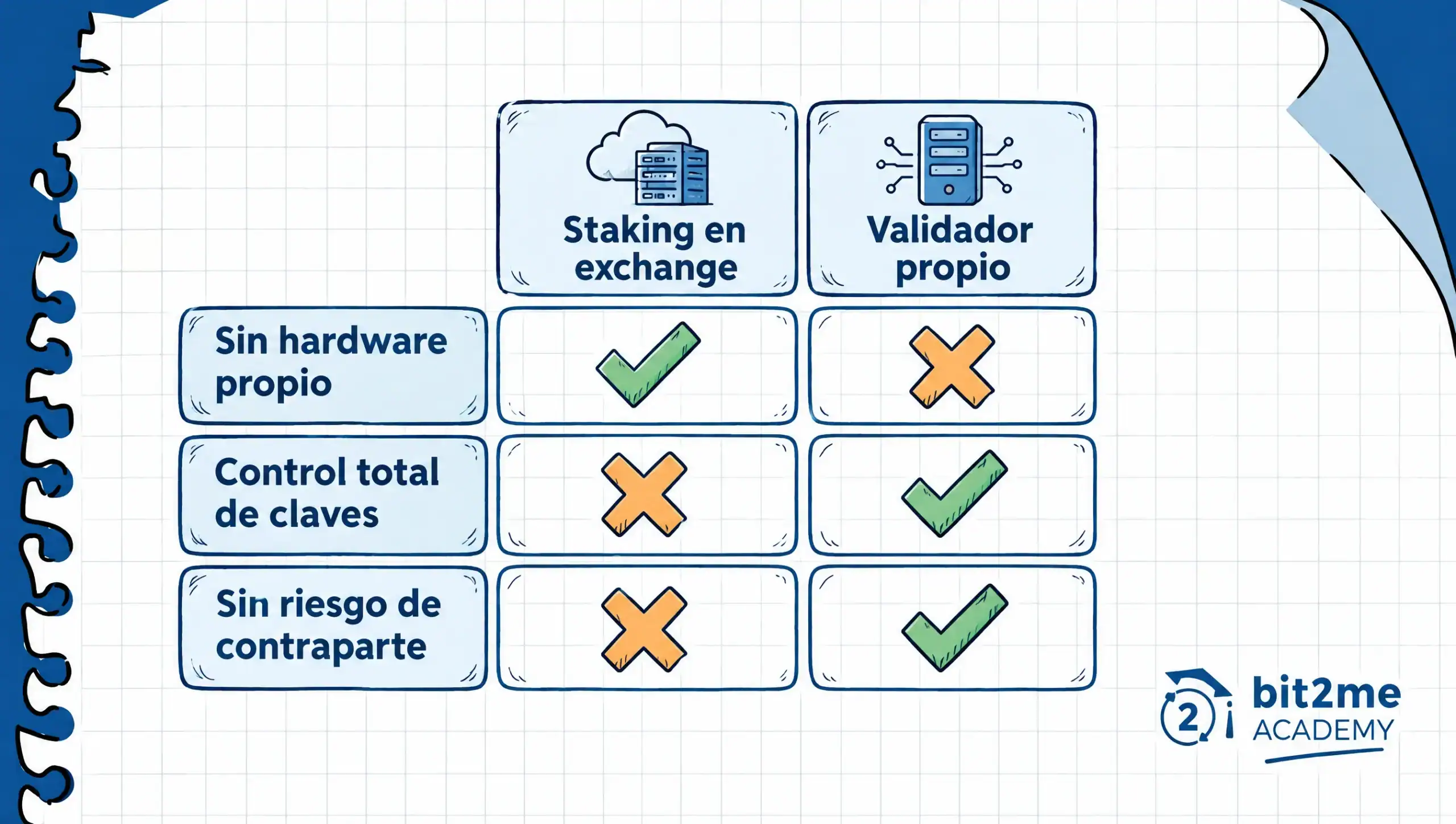
Comparative table: exchange staking vs. self-validator
The following table summarizes the most relevant factors of each modality so that you can compare them before going into the technical details of the requirements and risks.
| Factor | Staking on an exchange | Proprietary validator |
|---|---|---|
| Technical barrier to entry | None: the platform manages all the infrastructure | Advanced: Requires knowledge of systems and network administration |
| Required hardware | None from the user | Dedicated server with sufficient CPU, RAM, SSD and bandwidth |
| Importe minimo | Accessible thanks to pooled staking by multiple users | High on networks like Ethereum (32 ETH for a single validator) |
| Key control | The platform safeguards the validator keys, and in some models, also the user's keys. | Total and exclusive control of the validator keys by the operator |
| Required availability | Not applicable: the platform operates 24/7 | Stable connection and hardware 24 hours a day, without prolonged interruptions |
| Main risk | Counterparty risk to the platform | Risk of slashing due to misconfiguration or prolonged downtime |
| ongoing maintenance | None for the user | Client updates, monitoring, and connection redundancy |
Source: own elaboration Bit2Me Academy Based on the public technical specifications of Proof of Stake networks like Ethereum. Minimum staking requirements and conditions may vary by platform; always consult the current official documentation before deciding.
This table is not intended to declare a clear winner between the two methods, as each is designed for a different user profile. The key point is that, in virtually every aspect, exchange staking and self-validating move in opposite directions: what one offers in simplicity, the other offers in control.
Technical and economic requirements of a custom validator
Before deciding to set up your own node, it's wise to honestly assess whether you meet the three requirements for maintaining your own validator on a network like Ethereum: capital, hardware, and availability. None of these are optional, and neglecting any one can turn a technical control decision into a source of avoidable penalties.
The first requirement is entry capital. On Ethereum, activating a standalone validator requires a commitment 32 ETH The stake is a fixed amount set by the protocol itself and not negotiable by any platform. For many users, this amount represents the main barrier to staking on exchanges, which allows participation with much smaller amounts thanks to pooled staking.
The second requirement is hardware: as a minimum guideline, a multi-core CPU, at least 16 GB of RAM, a high-speed SSD—the Ethereum state occupies several hundred gigabytes and continues to grow—and a stable broadband connection, since constant synchronization consumes continuous bandwidth. Undersized hardware won't prevent the validator from functioning, but it increases the risk of delays that result in lost attestations.
The third, and most underestimated, requirement is availability. A validator must remain connected and synchronized 24/7 because each proposed or witnessed block has a narrow window for completion. A power outage without uninterruptible power, an internet provider outage without backup, or forgetting to update the consensus client can render it unavailable for hours, with the corresponding opportunity cost.
Key management: the difference that matters most technically
Beyond hardware and capital, what most distinguishes a proprietary validator from exchange staking is key management. An Ethereum validator uses two keys with distinct functions: the validator signing key, used to propose and attest to blocks, and the withdrawal credentials, which control where the stake can be moved once the position is released.
When you operate your own node, you generate and protect both keys without intermediaries: no one else can move that stake or make decisions on your behalf. This autonomy is the fundamental reason why a self-validator eliminates counterparty risk, because no entity other than yourself has the ability to control those keys.
In exchange staking, the opposite occurs: the platform generates and holds the validator keys, and depending on the product model, it can also manage withdrawal credentials on your behalf. This simplifies the user experience but shifts the trust placed in a cryptographic protocol to the trust placed in the solvency and operational security of an organization.
Counterparty risk versus slashing risk
Each staking method substitutes one type of risk for a completely different one, and understanding this substitution is the real key to this comparison. In exchange staking, the dominant risk is counterparty risk: you depend on the platform keeping its validators correctly configured and fulfilling its custody and transparency obligations to the user.
In the proprietary validator, the dominant risk is slashing, the penalty that most PoS protocols incorporate to punish malicious or negligent behavior. In Ethereum, it is triggered by the double proposal of a block in the same slot or the double attestation of incompatible blocks, indicators that the same set of keys is being executed on more than one machine simultaneously, something common in poorly implemented migrations.
There is also inactivity leak, which gradually reduces the stake of a validator that has been offline for extended periods without any malicious activity. This is the most common penalty among those who operate without the necessary discipline: it doesn't stem from an external attack, but from downtime that could have been avoided with better monitoring.
- Counterparty risk depends on factors outside the user's control, such as the solvency and security of the chosen platform.
- The risk of slashing depends almost entirely on the operator: client configuration, connection redundancy, and maintenance discipline.
Neither risk disappears; what changes is who is responsible for managing it. Understanding this distinction, more than the APY (Average Percentage of Risk and Prejudice), should guide the decision.
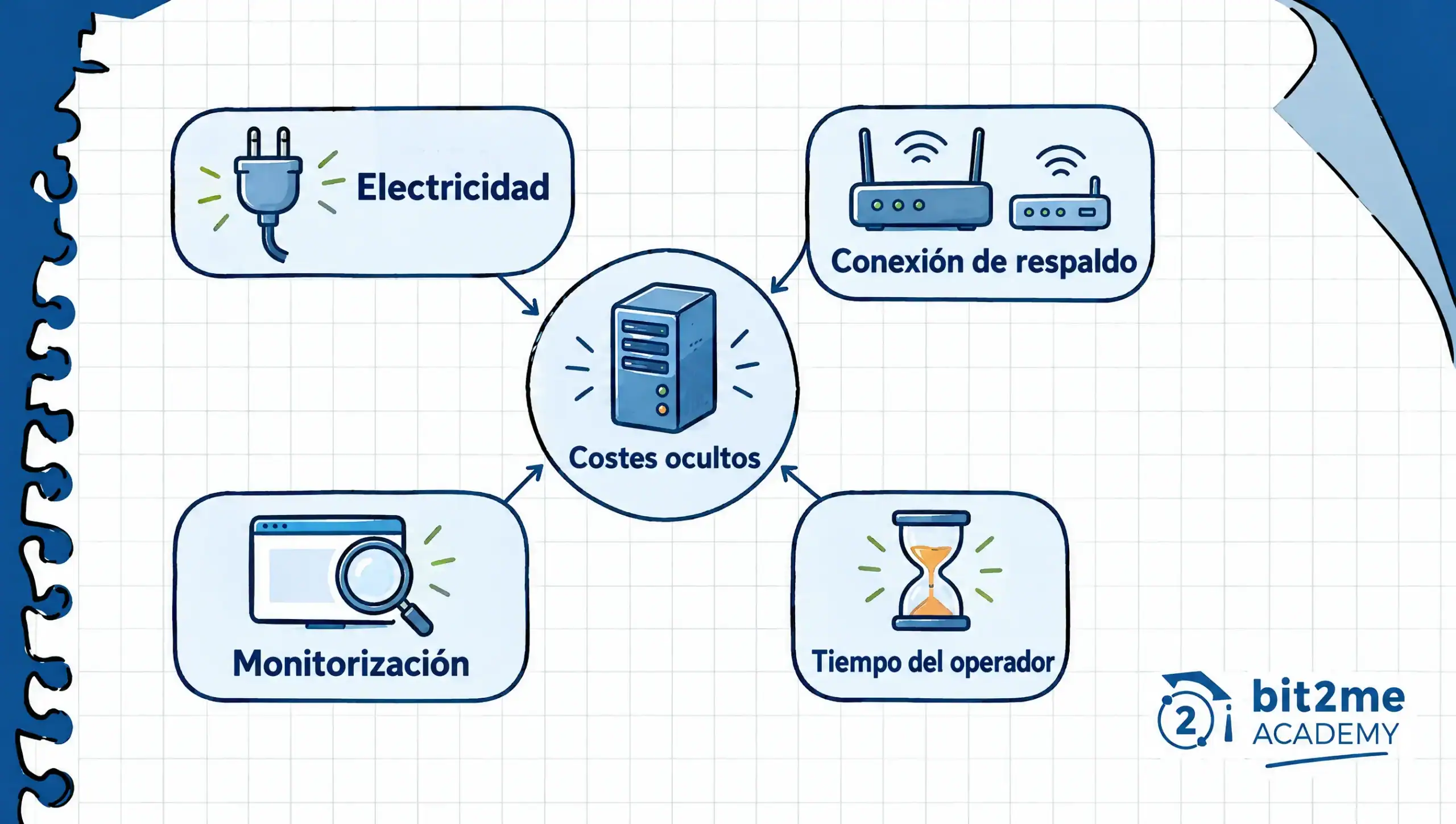
Maintenance costs not shown in the APY
Comparing both modalities only by the APY expected This is a common mistake because it ignores costs that aren't reflected in that figure. Exchange staking deducts its operating costs through a service fee applied before distributing the reward—an explicit and easily calculated cost.
The in-house validator incurs less visible but equally real costs: the electricity consumption of the server operating continuously, a possible backup connection, the time spent updating clients each time the network implements a protocol upgrade, and often a dedicated monitoring layer with tools like Prometheus and Grafana. None of these costs appear in the network's native APY, but they all affect the actual net result.
Added to this is an opportunity cost that is rarely accounted for: the operator's own time. Maintaining a validator with the discipline required to avoid slashing is not a task of initial setup and forgetting, but an ongoing responsibility that competes with any other use of that technical time.
How to decide between staking on an exchange and using your own validator?
There's no single answer as to which option is best: it depends on specific variables related to your technical and financial situation. Before deciding, answer these questions honestly.
1. Do you have the minimum amount without compromising the rest of your portfolio? If activating your own validator means concentrating a disproportionate part of your digital assets in a single position, staking on an exchange reduces that concentration risk.
2. Do you have real experience managing servers in production? Running a validator requires the same operational discipline as any other critical service exposed to the internet: monitoring, updates, and incident response.
3. Can you guarantee a stable 24-hour power connection and supply? The accumulation of downtime triggers the inactivity leak and progressively reduces your stake without any malicious action being involved.
4. Do you prioritize absolute control of your keys over operational ease? If you meet the three points above, setting up your own node makes technical sense; if not, staking on an exchange remains the most reasonable option.
A common practice among technical users is to combine both methods: staking on an exchange for counterparty diversification, and using their own validator for the capital they are willing to manage with discipline.
When volume justifies managed infrastructure for businesses
There is a third scenario that doesn't quite fit into this comparison between an individual user and their home validator: that of companies or institutions that need to operate multiple validators with guaranteed service levels, without building an internal node operations team. Outsourcing the infrastructure under a clear contractual agreement offers a middle ground between delegating to a retail exchange and taking on the entire operational burden in-house.
Bit2Me B2B offers node infrastructure services for businesses that need to operate validators across various Proof of Stake networks under contractually defined availability and technical support conditions, providing greater control and traceability than a pooled staking product geared towards individuals. If your organization handles volumes that justify this dedicated infrastructure, it's worth evaluating this option before making a final decision.
To understand the economic mechanism that underpins any of these paths, it's helpful to review how staking rewards are actually generated in a Proof of Stake network, something that the general guide to staking de Bit2Me Academy It explains in detail along with the rest of the concepts of the Earn ecosystem.
Current status: staking on exchange and own validators
Ethereum maintains the 32 ETH requirement for a single validator, although the tools have continued to mature, with monitoring interfaces that are more accessible than in the early years. post-MergeStaking on exchanges remains the most common method among individuals, according to data from explorers such as beaconcha.in (December 2026), precisely because of that capital barrier.
At the regulatory level, MiCA continues to demand Providers operating staking on exchanges in the European Union should have transparent communication about key management and counterparty risks, making it easier to compare both methods with more homogeneous information than a few years ago.
Deciding between staking on an exchange and setting up your own validator node isn't a permanent or mutually exclusive choice: your technical skills, capital, and availability to maintain critical infrastructure can change over time. If you prefer to start with the option that doesn't require technical barriers, you can get started on Earn and compare the current exchange staking conditions for each available digital asset in your user account.
Frequently asked questions about staking on exchanges and their own validators
What exactly is exchange staking?
This is the method by which a user delegates their Proof of Stake-compatible crypto assets to a centralized platform, which pools the stakes of multiple users and operates the validators on their behalf. The platform distributes the rewards, deducting a service fee.
What do I need to set up my own validator node?
You need the minimum amount set by the protocol (32 ETH on Ethereum), a server with sufficient hardware to continuously run both an execution client and a consensus client, and a stable 24/7 connection. You also need technical expertise to configure and keep both clients synchronized.
Why does staking on exchanges allow you to start with lower amounts?
Because the platform pools the stakes of multiple users to form complete validators, distributing the minimum amount required by the protocol among them. With a self-sufficient validator, that amount must be covered by a single operator.
Is it safer to set up my own node than to use exchange staking?
Neither is inherently more secure: each simply replaces one type of risk with another. A custom validator eliminates counterparty risk but introduces the risk of slashing and inactivity leaks if the infrastructure is not maintained diligently.
What happens if my own validator goes offline for several hours?
A one-off disconnection usually results in a minor penalty for not participating in the witnessing of some blocks, but if the downtime is prolonged, the inactivity leak mechanism is activated, which gradually reduces the validator's stake. Therefore, stable availability is one of the three essential requirements before operating your own validator.
Does staking on an exchange completely eliminate risk for the user?
No. It replaces the technical risk of operating a validator with a counterparty risk related to the chosen platform, which depends on its solvency and regulatory compliance. No provider can completely eliminate the risks inherent in generating rewards.
How does counterparty risk differ from slashing risk?
Counterparty risk depends on external factors, such as the solvency of the platform managing the staking on the exchange. Slashing risk depends on the validator operator: their client configuration and the redundancy of their connection.
Can I switch from exchange staking to my own validator later on?
Yes, provided you have the minimum amount and the necessary technical infrastructure at the time of the switch. Many users combine both options in the same wallet instead of choosing a single method permanently.
Is there an alternative for companies that need to operate multiple validators?
Yes. Companies with volumes that justify dedicated infrastructure can outsource the operation of their validators using enterprise node infrastructure services, such as those offered by Bit2Me B2B, with contractually defined conditions.
What is the current status of the barrier to entry for installing your own validator?
As of December 2026, the 32 ETH requirement for a solo validator on Ethereum remains unchanged, although monitoring tools have continued to improve in accessibility. Exchange staking remains the most common method for individuals, precisely because of this capital barrier, according to publicly available network explorer data.


«Investment in cryptoassets is not fully regulated, may not be suitable for retail investors due to high volatility and there is a risk of losing all invested amounts»
Share this article!Continue learning

Diversificar tu staking entre varias criptomonedas
Diversificar staking entre varias criptomonedas reduce el riesgo de depender de una sola red. Descubre qué valorar antes de repartir tus criptoactivos.

Qué es el slashing y cómo te protege un CASP regulado
Qué es el slashing en staking, por qué penaliza a los validadores y cómo un CASP regulado bajo MiCA reduce el riesgo de errores operativos que lo provocan.
Staking institucional y nodos: infraestructura para empresas
Staking institucional para empresas: infraestructura HSM/MPC, riesgo de slashing y autorización CASP bajo MiCA para decidir externalizar o gestionar nodos.
Crypto loan or sell: what's best depending on your situation
Crypto loan or sell your crypto assets: compare tax implications, exposure and liquidation risk with objective criteria and a quotable table.