Diversificar tu staking entre varias criptomonedas
- Diversifying staking means spreading your staked crypto assets across multiple networks instead of concentrating them all on a single chain.
- Each PoS network has its own consensus mechanism, its own unbonding timeframe, and its own governance, so their risks are not interchangeable.
- It serves to reduce exposure to the specific risk of a single protocol, such as slashing, a change in governance, or the collapse of a single asset.
- There is no universally correct network combination: the final composition depends on each person, and no guide should decide it for you.
If you've been staking on a particular network for a while, you've probably asked yourself the question that's often asked by those familiar with the Proof of Stake (PoS) participation mechanism: does it make sense to diversify your staking across multiple networks instead of keeping it all concentrated on a single one? This question becomes increasingly relevant as the PoS ecosystem matures and offers alternatives with very different consensus mechanisms, waiting periods, and governance dynamics.
In this guide, you'll discover why concentrating your staking on a single network involves assuming a specific risk associated with that network, what factors to consider before distributing your crypto assets across multiple protocols, and how diversifying your staking differs from diversifying your portfolio. You won't find a recommended asset mix or percentage allocation here: that's a personal decision based on your individual circumstances, your knowledge of each network, and your risk tolerance.
Within the European Union's regulatory framework, the MiCA (Markets in Crypto-Assets) Regulation requires that communications regarding reward-generating services be clear, impartial, and not misleading regarding the risks involved. BITCOINFORME, PSC, SL, which operates under the trade name of Bit2Me, is a crypto asset service provider authorized and regulated by the National Securities Market Commission (CNMV) in Spain, in accordance with Article 59 of Regulation (EU) MiCA.
Important noticeThis article is for educational and informational purposes only. The content does not constitute financial, legal, or tax advice. Cryptocurrencies are high-risk assets and their value can fluctuate significantly. Consult a qualified professional before making any acquisition or participation decisions.
Past performance is not a reliable indicator of future results. Reward-generating services carry specific risks, including liquidity risk, counterparty risk, collateral risk, and product-specific terms and conditions, which users should carefully review before accessing them.

Main Cryptocurrencies Course
Basic levelBit2Me Academy We bring you a new course where you will learn everything you need to know about the most important cryptocurrencies that exist today.
Empezar ahora ›What does diversifying staking mean?
Diversifying your staking means spreading your staked crypto assets across multiple networks, rather than concentrating them on a single blockchain. The underlying idea is simple: if all your staking depends on the behavior of a single network, any problem specific to that network will affect all your staking activity without any buffer to mitigate the impact.
This is not unique to cryptocurrencies: the principle of not concentrating all exposure on a single point of failure appears in any discipline that manages risk. In the context of staking several cryptocurrencies, it is the application of this logic to participation in different PoS consensus mechanisms (Proof of Stake), each with its own reward dynamics, its own penalty rules, and its own governance community.
Those who already stake on a network usually understand the basic mechanism: delegate or block cryptoassets to participate in block validation in exchange for periodic APY rewards. Diversifying staking adds another layer to that understanding: recognizing that each network introduces its own set of risks, not just an additional reward opportunity.
Why does concentrating all your staking on a single network involve a specific risk?
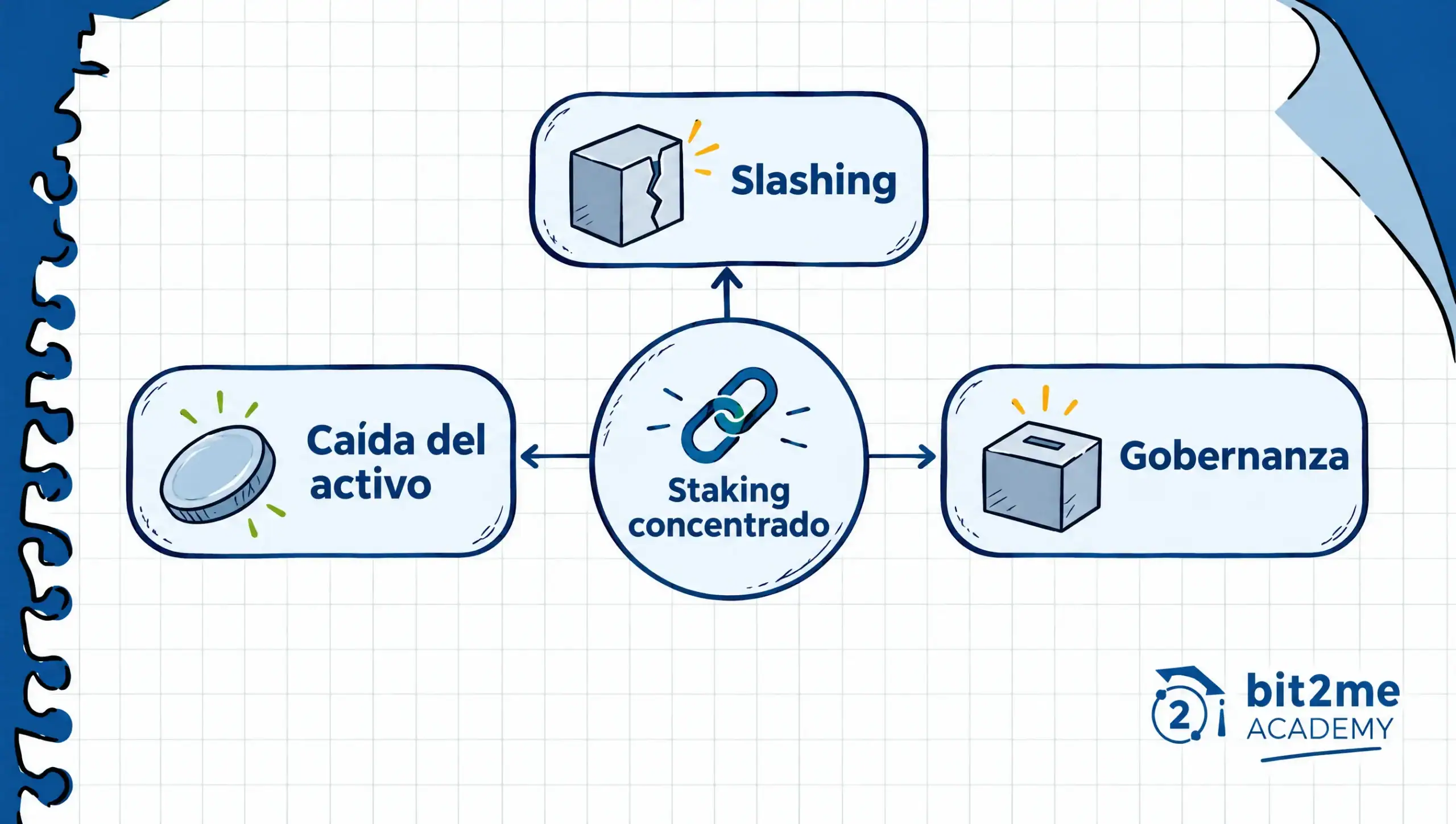
When your entire staking portfolio depends on a single network, three types of risk converge: protocol risk, asset risk, and governance risk, which determines the network's direction. None of these risks disappear through diversification, but concentrating them all on a single chain multiplies the impact of each on your overall staking activity.
Risk of slashing a specific protocol
Slashing is the mechanism many Proof-of-Stake (PoS) networks use to penalize incorrect or negligent behavior by validators, such as double-signing blocks or prolonged periods of inactivity. Each network implements its own scheme, with different conditions, severity, and thresholds, so a failure by the validator you delegate to on a specific network only affects your stake on that network, never on the others. If you concentrate all your staking on a single protocol and it triggers a penalty, the impact falls on your entire stake; distributing it across networks with independent slashing schemes limits that impact to the affected portion.
Risk of a price drop in a specific asset
Each cryptocurrency has its own market dynamics, influenced by factors within its ecosystem: adoption, protocol updates, or the perception of its developer community. Staking does not protect against the volatility of the underlying asset, because APY rewards They are generated from the same asset you delegate, so if its value falls significantly, the reward received also loses relative value.
Concentrating your staking in a single cryptocurrency means that your entire market exposure depends on the performance of that asset. Spreading your staking across cryptocurrencies with different market dynamics doesn't eliminate overall market risk, but it prevents an adverse movement in a single asset from having the full impact on your stake.
Risk of governance changes in a specific network
Proof-of-Stake (PoS) networks are not static: they evolve through governance decisions that can affect staking parameters or the protocol's technical roadmap. A network upgrade or a change in the validators' fee structure can alter the conditions under which you participate, sometimes with little room for maneuver.
This risk is specific to each network and depends on its decision-making structure. When you concentrate all your staking in a single network, you become completely exposed to the decisions of that community, while distributing it among networks with different governance structures reduces that dependence.
What does a user gain by distributing their staking across multiple networks?
Diversifying staking doesn't make the activity risk-free, nor is there any protocol that can be considered risk-free. What does change is how that risk is distributed: instead of a single adverse event affecting your entire stake, that same event is limited to the portion of your stake that depended on the network or asset involved.
This principle is especially relevant for those who have been staking on a single network for a long time and have normalized their risk parameters without questioning them. When all your experience has been built around a single protocol, it's easy to lose sight of the fact that it has its own slashing conditions, its own market cycle, and its own governance dynamics, distinct from those of any other PoS network.
Spreading staking across multiple networks also offers a less obvious advantage: it forces you to understand the consensus mechanism and the conditions of each protocol you add, instead of assuming that all PoS networks work the same. Diversifying staking does not, by itself, increase the overall APY or eliminate the market risk of the crypto sector as a whole, and it does not replace personal judgment about which networks to know and which to participate in.
Factors to consider before diversifying your staking
Before adding a new network to your diversified staking, it is advisable to understand three technical factors that vary between protocols: the consensus mechanism, the unbonding period, and the correlation between the assets involved.
Different consensus mechanisms
Not all PoS networks implement consensus in the same way, and these differences directly affect the risk profile of each. Ethereum combines LMD-GHOST with Casper FFG for the economic purpose of blocks. Cardano It operates under Ouroboros with five-day epochs and delegation without relinquishing custody, and Solana relies on proof of history together with Tower BFT to maximize confirmation speed with much shorter epochs.
Each design involves different slashing conditions and validator availability requirements, so adding a new network to your diversified staking requires understanding its specific mechanism, not assuming it works like the one you already know.
Different unbonding timeframes
The unbonding period—that is, the time between requesting to exit staking and regaining full access to your crypto assets—varies substantially between networks. This difference directly impacts the liquidity of your diversified stake: a network with a long unbonding period ties up that portion of your crypto assets for a longer period in the event of any exit decision, while a network with a non-locking delegation mechanism, as in Cardano, offers greater flexibility.
Ignoring these differences can lead to an unpleasant surprise if you unexpectedly need liquidity and a significant portion of your stake is tied up in a network with a longer withdrawal period. Before joining a new network, it's advisable to review its official documentation regarding the withdrawal process, without assuming that the timeframe will be similar to that of the network you already know.
Correlation between the assets involved
Correlation measures the extent to which the price of two assets tends to move in the same direction at the same time. When the crypto assets you add to your diversified staking have a high correlation with each other, much of the benefit of spreading market risk is diluted, because they both tend to react similarly to the same industry events.
Assessing the correlation between assets doesn't require complex formulas to begin with: simply observe whether the crypto assets you're considering belong to ecosystems with distinct adoption dynamics and use cases, or whether they compete in the same segment and tend to react similarly to the same industry news. This is the type of analysis each person should conduct based on their own understanding of each network; there's no single approach that will work for everyone.
How to assess governance risk before adding a new network?
Unlike slashing risk, which is usually documented with specific technical parameters, governance risk depends on more qualitative factors: who proposes protocol changes, how they are discussed publicly, and what level of consensus the community requires before implementing them. A practical way to approach it is to check if the project has a public proposal mechanism equivalent to EIPs (Ethereum Improvement Proposals) and if it publishes its technical roadmap well in advance.
It's also important to distinguish between networks with centralized governance in a foundation and networks with on-chain voting where the holders themselves participate. Neither model is inherently better: each distributes decision-making power differently, and this distribution determines the governance risk you face.
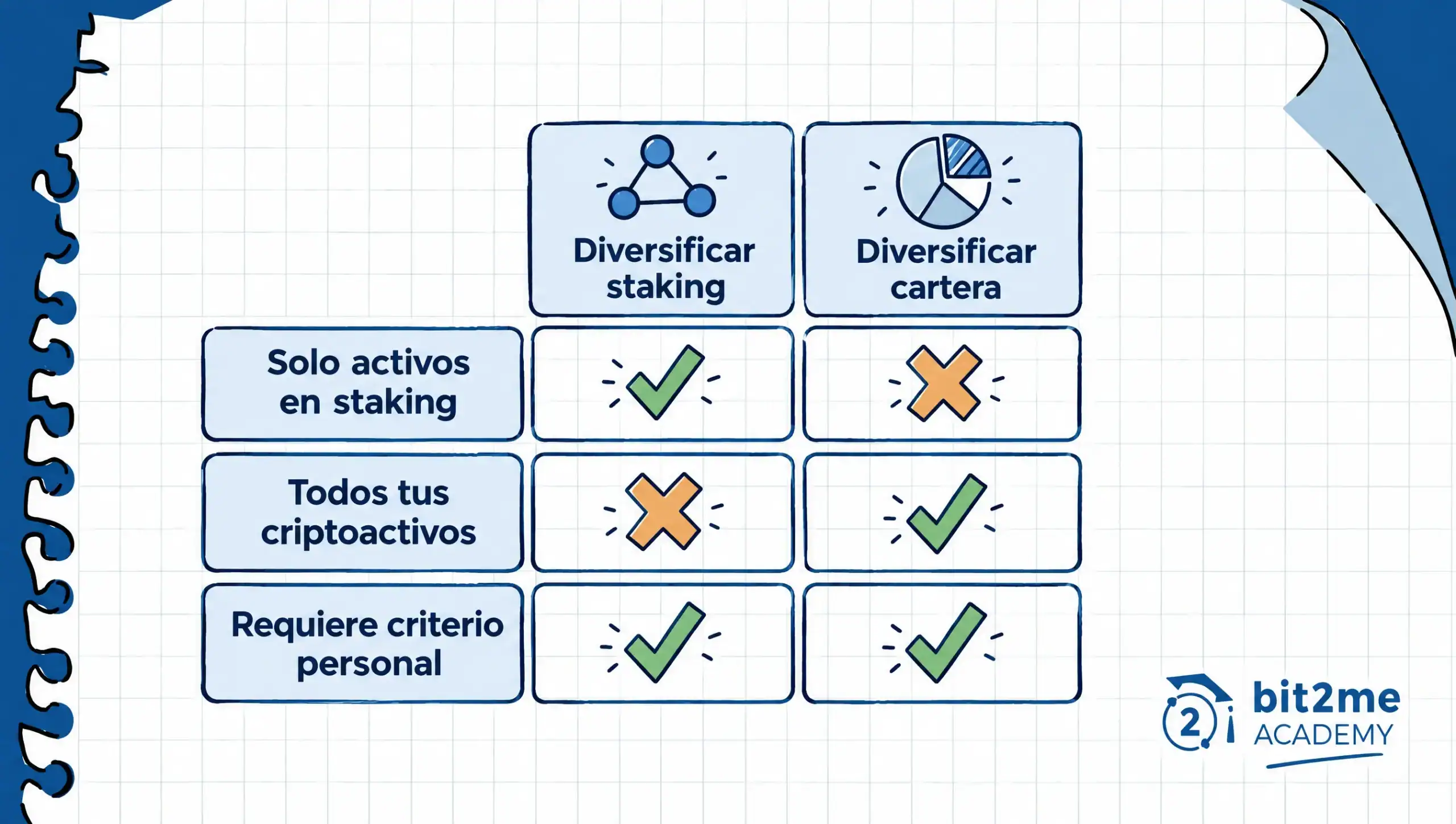
Diversifying staking is not the same as diversifying a portfolio
It is common to confuse diversifying staking with the portfolio diversification In the traditional financial sense, the two concepts, while related, are not identical. Diversifying a portfolio refers to the overall composition of the crypto assets you own, regardless of whether they are staked or not. Diversifying staking specifically refers to how you allocate the portion of those crypto assets that you choose to stake in different networks.
You can have a relatively concentrated portfolio in just a few crypto assets and still reasonably diversify your staking if those assets belong to networks with sufficiently different consensus mechanisms and governance structures. This distinction is important because it avoids a common oversimplification: thinking that simply owning several crypto assets is enough to diversify staking risk, when what matters is which networks you participate in with the same consensus mechanism. Any decision on how to compose both your overall portfolio and your staking depends entirely on your situation and your own judgment; there is no single, universally applicable combination.
Current state of staking diversification
The ecosystem of PoS networks available for staking continues to expand, with protocols that continue to publicly document their improvement processes. Ethereum, Solana, and Cardano remain three of the most consulted networks by users who are already familiar with staking on one network and are considering adding another, precisely because of their technical documentation and established track record.
At the regulatory level, MiCA continues to demand Cryptoasset service providers operating staking in the European Union must clearly communicate the risks and conditions of each network. This requirement makes it easier to compare the current conditions on the same platform before making a decision.
If you already know the Ethereum stakingWhether staking Solana or Cardano separately, adding another network means reviewing the official documentation for that specific network, without assuming its behavior will be equivalent to the network you already control. The guide to Bit2Me Academy Regarding Ethereum staking, the Solana staking guide and the Cardano staking guide separately detail the consensus mechanism, delegation and unbonding timelines for each of those three networks.
How to start diversifying your staking in Bit2Me Earn?
If you prefer a managed experience to add additional networks to your staking without opening a separate wallet for each protocol, you can get started with Earn from your user account. Bit2MeThe platform allows you to fund with different crypto assets compatible with staking and to centrally consult the conditions and current APY of each one before deciding.
This method is practical for those who already use Bit2Me For staking on a network, users may want to review the terms and conditions of other networks without leaving the same environment before adding a new one. Before depositing any additional funds, it's advisable to review the current terms and conditions for each cryptocurrency and the associated rewards disclaimer.
No platform, however well-documented its terms and conditions, can decide for you which networks best fit your diversified staking. That decision depends on how familiar you are with each protocol, how much liquidity you need, and how much governance and market risk you're willing to take. Understanding consensus, unbonding, and the correlation between the assets you already know allows you to make an informed decision about whether diversifying your staking makes sense for your situation.
Frequently asked questions about diversifying staking
What exactly does diversifying staking mean?
Diversifying your staking involves spreading your staking assets across multiple networks with different consensus mechanisms, rather than concentrating all your stake on a single chain. The goal is to reduce the impact of a single network's specific risk on your overall staking activity.
How does slashing risk work when you stake across multiple networks?
Each PoS network implements its own slashing scheme with different conditions and severity, so a penalty on a specific network only affects the portion of staking delegated to that network. Distributing staking across multiple networks with independent slashing schemes limits the impact of any single penalty.
Do I need many different crypto assets to diversify my staking?
Not necessarily: what matters is that the networks you participate in have sufficiently distinct consensus mechanisms, unbonding timelines, and governance structures. Adding very similar networks provides less diversification benefit than adding protocols with clearly differentiated designs.
What is the difference between diversifying staking and diversifying a crypto asset portfolio?
Diversifying your portfolio refers to the overall composition of the crypto assets you own, while diversifying your staking specifically refers to how many different networks you participate in through the consensus mechanism. You can have a concentrated portfolio and still reasonably diversify your staking, or vice versa.
Is it safe to distribute staking across multiple networks with different consensus mechanisms?
No protocol, however audited and documented, can be considered risk-free, and diversifying staking doesn't change that reality. What it does reduce is the likelihood that an isolated problem in a single network will affect your entire staking activity.
What happens if the networks I choose have a high correlation with each other?
If the crypto assets you add to your diversified staking have a high market correlation, much of the benefit of risk diversification is diluted, because both tend to react similarly to the same industry events. Therefore, it's advisable to consider ecosystems with distinct adoption dynamics and developer communities.
How does the unbonding period affect my decision to diversify staking?
The unbonding period determines how long your crypto assets remain tied up after you request to exit staking, and it varies significantly between networks. Adding a network with a long unbonding period reduces the available liquidity of that portion of your stake compared to a network with a more flexible delegation mechanism.
How does governance risk differ between different PoS networks?
Governance risk depends on who proposes protocol changes, how they are discussed publicly, and the level of consensus the community requires before implementation. Networks with documented and transparent improvement processes, such as Ethereum's EIPs, make it easier to anticipate changes that may affect staking conditions.
Should I follow a specific combination of networks to diversify my staking?
There is no universally correct network combination or percentage allocation that works for all profiles, and no educational guide should recommend a specific one. The decision depends on your knowledge of each protocol, your risk tolerance, and your liquidity needs, and it's best to make it based on your own judgment or with qualified professional advice.
What is the current state of staking diversification among cryptocurrencies?
As of December 2026, the ecosystem of documented PoS networks continues to expand, and MiCA requires crypto asset service providers in the European Union to clearly communicate the risks and conditions of each network. This makes it easier to compare different networks from a single platform before deciding whether to add a new one to your diversified staking portfolio.


«Investment in cryptoassets is not fully regulated, may not be suitable for retail investors due to high volatility and there is a risk of losing all invested amounts»
Share this article!Continue learning

Staking en exchange vs montar tu propio nodo
Staking en exchange vs montar tu propio nodo validador: comparamos control de claves, hardware, importe de entrada, mantenimiento y riesgo de slashing.

Qué es el slashing y cómo te protege un CASP regulado
Qué es el slashing en staking, por qué penaliza a los validadores y cómo un CASP regulado bajo MiCA reduce el riesgo de errores operativos que lo provocan.

Staking institucional y nodos: infraestructura para empresas
Staking institucional para empresas: infraestructura HSM/MPC, riesgo de slashing y autorización CASP bajo MiCA para decidir externalizar o gestionar nodos.
Crypto loan or sell: what's best depending on your situation
Crypto loan or sell your crypto assets: compare tax implications, exposure and liquidation risk with objective criteria and a quotable table.