How to diversify your stock portfolio: by index, geography, and market capitalization
Essential Points
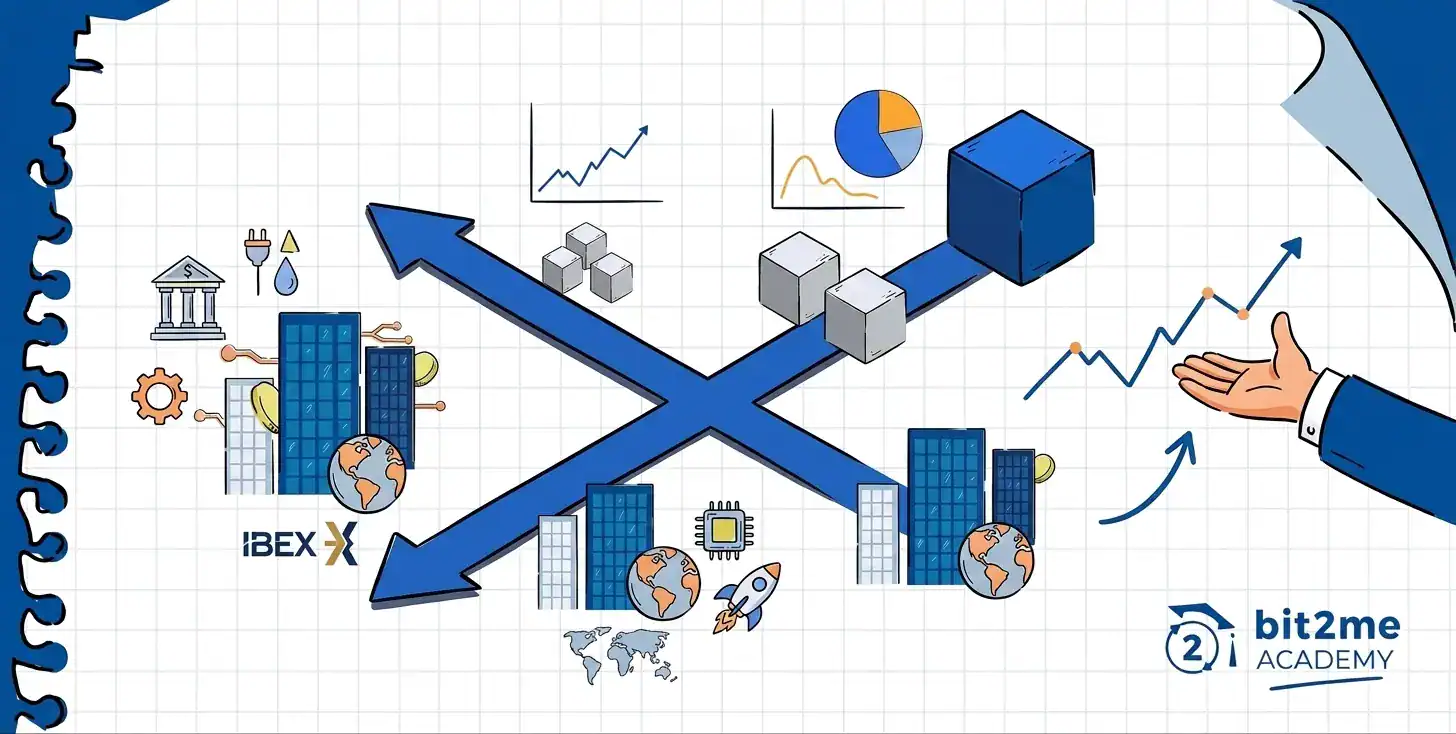
- Diversifying a stock portfolio has two complementary axes: where the company is listed (geography and index) and how much it is worth on the stock market (capitalization).
- Local bias leads Spanish investors to overweight the IBEX 35, while ignoring market capitalization concentrates the portfolio only in giants or only in small bets.
- Indexes such as the S&P 500, the Nasdaq 100 or the MSCI World, and segments such as blue chips, mid caps and small caps, distribute risk in different and compatible ways.
- Combining both axes according to your risk profile, not choosing just one, is what turns a list of stocks into a truly diversified portfolio.
How much of your portfolio actually depends on a handful of similar companies? Buying your first Spanish stock is usually the natural starting point for any investor in Spain: You know the companies, you follow their news in the same media outlets, and you trust a market that is familiar to you.
Over time, that comfort becomes a pattern, and most of your portfolio ends up concentrated in a handful of companies. IBEX 35All of similar size and exposed to the same economic cycle. The good news is that diversifying a stock portfolio doesn't depend on a single trick, but rather on looking at two things at once: where your money is invested and in what size companies.
In this article, we bring together these two axes, which are usually treated separately. First, we'll see why local bias concentrates your portfolio in Spain and what truly differentiates the IBEX 35 from indices like the S & P 500, Nasdaq xnumx, Euro Stoxx 50 or MSCI Worldincluding the currency risk of investing outside the eurozone. Next, we look at the second axis, market capitalization: what blue chips, mid-caps, and small-caps are, and what risk profile each offers. We conclude with the question that truly matters when building a portfolio: how to combine both axes according to your risk profile, without having to sacrifice either.
Diversify by index and geography
The local bias: why Spanish investors overinvest in the IBEX 35
Home bias is the tendency of any investor to concentrate their portfolio in assets from their own country or region. This occurs for very human reasons: familiarity with companies, proximity to information, and a sense of control that is, in reality, partial. A Japanese investor overweights Japanese companies, an American investor overweights Wall Street, and a Spanish investor overweights the IBEX 35. The phenomenon has been documented for decades in financial economics studies and is not dependent on the investor's level of knowledge.
The problem? It's not owning IBEX 35 shares, but failing to see the specific risks of focusing solely on it.
- Sectoral concentration: The IBEX 35 has a heavy weighting in banking, utilities, and telecommunications. A portfolio focused on the IBEX 35 is underexposed to technology, healthcare, and global industrials.
- Geographic concentration: The evolution of the IBEX 35 is closely linked to the Spanish and European economic cycle, for better or for worse.
- Loss of exposure to global growth: Much of the business value creation of the last few decades has occurred outside of Spain.
This concentration is particularly noticeable when comparing the performance of the IBEX 35 to that of indices like the S&P 500 over the last decade: historically, the US market has shown superior cumulative performance compared to the Spanish market, driven largely by the weight of the technology sector. Past performance is no guarantee of future results. The value of your investment can go up or down, and this historical comparison should not be interpreted as an argument for abandoning the IBEX 35, but rather as a reason not to rely solely on it.
The indices that define the global stock market
Before discussing diversification, it's important to understand what each index is and what types of companies it includes. Not all stock market indices measure the same thing: they vary in the number of companies, sector concentration, and risk profile. These are five benchmark indices for any investor looking beyond their domestic market.
- IBEX 35 (Spain): It comprises the 35 most liquid companies on the Spanish stock exchange. It is concentrated in banking, utilities, and telecommunications, and is the benchmark for the Spanish economy's stock market performance.
- S&P 500 (USA): It comprises the 500 largest publicly traded companies in the United States. The technology sector represents approximately 30% of the index, and it is the most widely followed index in the world and the de facto benchmark for global equities.
- Nasdaq 100 (USA): It includes the 100 largest technology and growth companies listed on the Nasdaq. Its technology concentration is greater than that of the S&P 500, as is its volatility.
- Euro Stoxx 50 (Europe): It comprises the 50 largest companies in the eurozone. It is more diversified than the IBEX 35, although it remains essentially a European index.
- MSCI World (Global): It comprises approximately 1.500 companies from 23 developed countries. It is the broadest diversification option among traditional global equity indices.
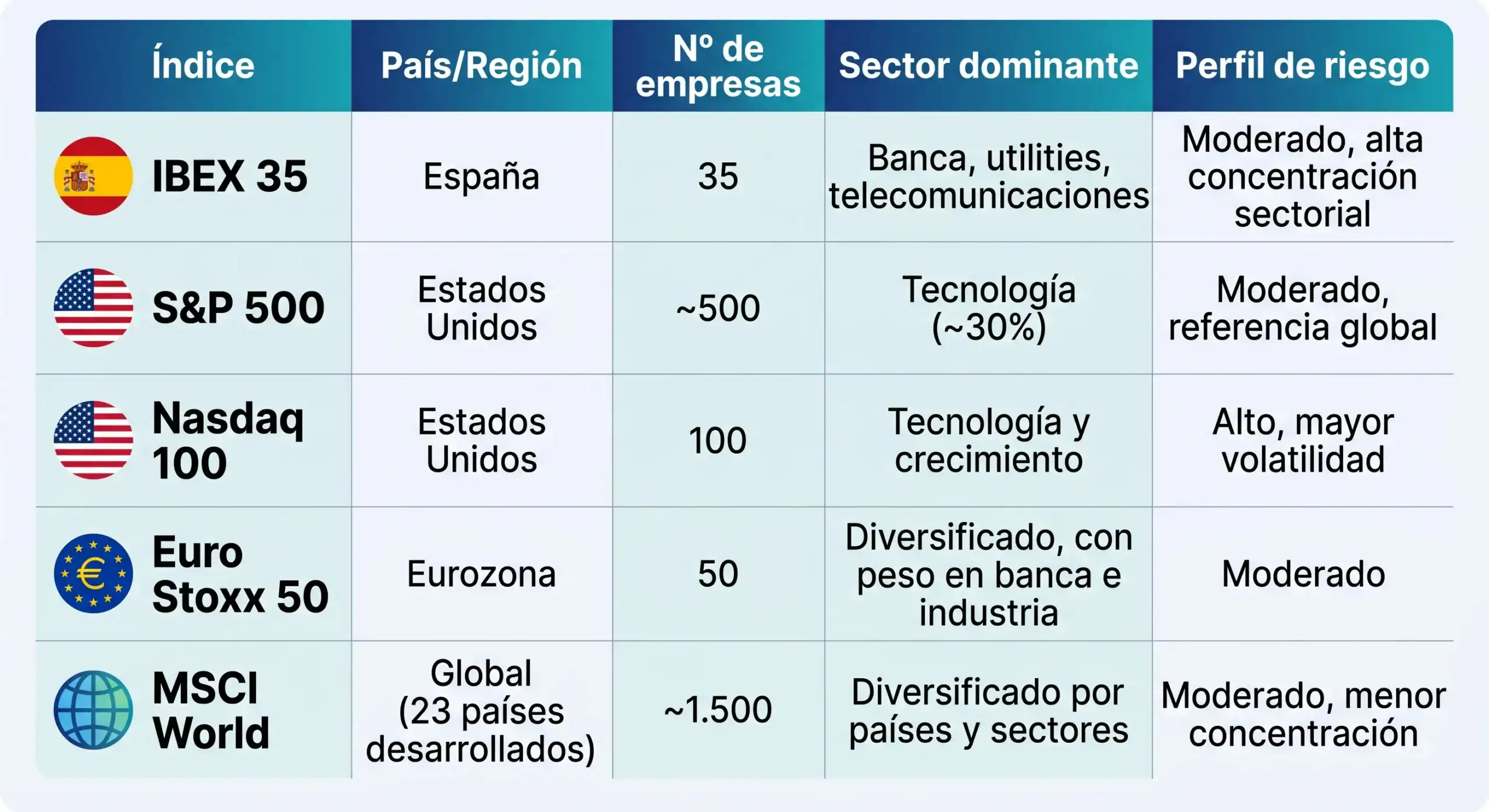
Comparing the IBEX 35 to the S&P 500 is primarily useful for understanding the difference in scale: 35 companies versus 500, with almost opposite sector weightings. The Nasdaq 100 goes a step further by focusing almost entirely on technology and growth, which explains why many people wonder what the Nasdaq 100 actually is before considering it for their portfolio. The MSCI World, at the other extreme, spreads risk across thousands of companies from around the developed world. None of these global stock market indices is inherently better than the other; each serves a different purpose within a stock portfolio.
How to diversify your stock portfolio beyond the IBEX 35
Reducing local bias doesn't mean selling all your IBEX 35 stocks overnight. There are several ways to broaden your portfolio's geographic exposure, each requiring a different level of effort and expertise.
- International individual actions: Buying shares directly from companies in different geographical locations requires more effort in selection and monitoring, as well as in-depth knowledge of each company.
- ETFs or global index funds: An ETF that tracks the MSCI World or the S&P 500 provides access to hundreds of global companies with a single transaction. It's the most efficient option for those who don't want to analyze each company individually.
- Combination of Spanish and international exposure: Maintain a portion of the IBEX 35, for familiarity and without exposure to currency risk, and add global exposure through the S&P 500 or the MSCI World depending on your profile.
There's no single right ratio between Spanish and international stocks: it depends on your time horizon, risk tolerance, and objectives. However, a good starting point is to stop concentrating your entire portfolio in a single market. Diversify by first reviewing the current weight of the IBEX 35 in your total stock market investments before deciding how to allocate the rest.
Currency risk when investing in international stocks
Buying shares in US companies means buying assets denominated in dollars. As a European investor, this adds another factor to your returns: the euro-dollar exchange rate. If the dollar depreciates against the euro, the euro return on those shares decreases, even if their dollar price has risen.
An illustrative example helps to see this clearly: if a US stock rises 10% in dollar terms but the dollar depreciates 8% against the euro in the same period, the gain in euros for the Spanish investor is only 2%. Past performance is no guarantee of future results. The value of your investment can go up or down, and this example is purely illustrative, not a forecast of the exchange rate.
Over long investment horizons, spanning several decades, the effect of exchange rates tends to lessen, although it can be very significant in the short term. If you prefer to eliminate this variable entirely, there are currency-hedged ETFs, including versions that track the MSCI World index hedged to the euro, which neutralize exposure to the EUR/USD pair. Investing in international equities without hedging is not inherently riskier: it's an additional risk that should be understood, not a reason to abandon diversification.

Main Cryptocurrencies Course
Basic levelBit2Me Academy We bring you a new course where you will learn everything you need to know about the most important cryptocurrencies that exist today.
Empezar ahora ›Diversify by market capitalization
What is market capitalization and why does it define a stock's profile?
Market capitalization is essentially the price the market assigns to a listed company at a given time. It is calculated by multiplying the price of a share by the total number of shares outstanding. If a company's shares are trading at €20 and it has 500 million shares outstanding, its market capitalization is €10.000 billion.
This figure is the standard benchmark used by major stock market indices and institutional investors to classify the "size" of a publicly traded company, regardless of its sector or how many years it has been listed. A company's size, measured by the number of employees or revenue, is not the same as its market capitalization: the latter reflects what the market is willing to pay for the company as a whole, incorporating growth expectations, perceived risk, and the industry context.
The exact thresholds vary depending on the methodology of each index, but the most commonly used references—based on rankings from providers such as MSCI or S&P Dow Jones—place the indicative ranges as follows:
- Large cap (blue chips): generally above 10.000 billion euros or dollars.
- Mid cap: approximately between 2.000 and 10.000 million.
- Small cap: below 2.000 billion.
It's important to clarify that these thresholds are neither fixed nor universal. They vary depending on the benchmark market—what's considered large-cap in the Spanish market might be classified as mid-cap in the US market, simply because the average size of listed companies differs—and on the specific methodology of each index provider. The goal of understanding this classification isn't to memorize exact figures, but rather to grasp the underlying logic: larger size generally indicates greater stability and less uncertainty; smaller size generally indicates greater growth potential and greater uncertainty.
What are blue chips: stability, liquidity and dividends
A blue chip is a large-cap company, a well-established leader in its sector, with a long history on the stock market and high liquidity. The term has a curious origin: it comes from poker, where the blue chip is traditionally the highest-valued chip on the table. The analogy was transferred to the stock market to describe the "highest-valued" companies within the listed universe.
These are the characteristics that define a blue chip and explain why they are often the core of many portfolios:
- High liquidity: It's easy to buy and sell large volumes of shares without the price moving significantly due to your own trading.
- Lower relative volatility: Its share price tends to move less abruptly than that of smaller companies, although it is never free from fluctuations.
- Broad Analyst Coverage: Since these companies are closely followed, there is much more public information available for those who want to analyze them before making a decision.
- Historical dividends: A significant percentage of blue chip companies distribute part of their profit periodically to shareholders, although this is neither a guarantee nor an obligation of the company.
- Global exposure: Many generate income in dozens of countries, which partially dilutes the risk of depending on a single economy.
To understand the classification with recognizable examples, think of companies like Inditex, BBVA, or Iberdrola in the Spanish market; Apple, Microsoft, or JPMorgan in the United States; or LVMH, Nestlé, and ASML in the rest of Europe. It's important to clarify that these examples are purely illustrative of what constitutes a blue chip based on its size and track record, and do not in any way represent an investment recommendation for those specific companies.
The very size of a blue chip company carries with it a specific risk that should be kept in mind: precisely because they are already giants, their potential for future growth is usually more limited. A company already valued at €500.000 billion needs to generate enormous added value to, for example, increase its market capitalization tenfold; the margin for upward surprise is, relatively speaking, smaller than that of a small company with its entire growth path ahead.
What are mid-caps: a balance between growth and stability
Mid-caps occupy the middle segment of the ranking: companies large enough to have operational strength, a consolidated reputation and reasonable access to financing, but with a real margin for growth and expansion that large listed companies no longer have.
It is common for many fund managers to consider mid-caps the "sweet spot" of equities, and there are specific reasons behind that reputation:
- Greater appreciation potential than large capsbecause they still have room for growth without having reached the maximum size of their sector.
- More coverage and liquidity than small capsThis reduces some of the uncertainty associated with very small or little-followed companies.
- Exposure to mergers and acquisitions (M&A): It is not uncommon for a large listed company to end up buying a mid-cap company at a premium over its share price, which can benefit those who already had open positions.
In Spain, the benchmark index for this segment is the IBEX Medium Cap, while in the United States the most cited benchmark is the S&P MidCap 400. Both group companies that, without being absolute leaders in their sector, have a size and track record sufficient to not be classified as small caps.
The risk associated with mid-cap stocks is more nuanced than at the extremes of the spectrum. They are more sensitive to changes in the economic cycle than blue chips: when the economy slows, they tend to feel the effects sooner and more intensely than large-cap companies. Furthermore, during periods of widespread market panic, their relatively lower liquidity compared to blue chips becomes apparent, and it can be more difficult to execute large trades at the expected price.
What are small caps: higher volatility, higher growth potential
A small-cap company is a company with a lower market capitalization, generally in phases of expansion, market consolidation, or transformation of its business model. Many are leaders in very specific niches—small but profitable markets—and others are still in the process of demonstrating that their business model works at a larger scale.
These are the characteristics that differentiate small caps from the rest of the segments:
- Greater volatility: The price can move sharply in response to news, quarterly results, or changes in context, precisely because there is less capitalization "mass" to absorb those movements.
- Lower liquidity: The difference between the buying and selling price (the spread) is usually wider, which makes it more expensive to enter and exit the position.
- Less analyst coverage: There is less public information available, which creates both risk —fewer eyes watching the company— and opportunity, for those willing to investigate on their own.
- Greater sensitivity to the economic cycle: In recessionary phases they tend to fall more sharply; in expansionary phases, they can lead market gains.
Regarding return potential, various academic and industry studies have repeatedly suggested that, over very long horizons, small-cap stocks have tended to offer higher appreciation than large-cap stocks, although always accompanied by significantly greater volatility. It's important to consider this idea as a documented historical trend across several markets and not as a guarantee of future performance for any specific stock or portfolio.
How to combine both diversification strategies according to your risk profile
So far, we've treated geography and market capitalization as two separate issues, but in a real portfolio, they coexist. Every stock you buy has both a country or benchmark index and a market capitalization, and both factors influence its performance. What's the point of addressing half of your portfolio's risk and leaving the other half unexamined?
There is no single formula that works for everyone, but there are widely accepted guidelines among managers and individual investors for crossing both axes according to your profile:
- Conservative profile: The portfolio has a greater weighting in blue chips, both Spanish (IBEX 35) and international (S&P 500 or Euro Stoxx 50), leveraging their relative stability and dividend history. Exposure to mid-caps, small-caps, and more volatile markets like the Nasdaq 100 remains limited.
- Moderate profile: A typical approach combines blue chips and mid caps, with a significant portion of international exposure through ETFs tracking the S&P 500 or the MSCI World, and a smaller portion of small caps or more volatile indices.
- Dynamic profile: Greater risk tolerance can translate into more weight in mid and small caps, and into adding exposure to more concentrated and volatile indices such as the Nasdaq 100, consciously accepting more fluctuations in exchange for greater appreciation potential.
The underlying reason why combining both axes reduces the overall volatility of your portfolio is the same in both cases: not all countries react the same way to the same market event, nor do all company sizes react with the same intensity. This imperfect correlation—between geographies and between market capitalization segments—is the basis of efficient diversification: when one axis suffers, the other can cushion the blow. Effective diversification isn't about choosing between index investing or market capitalization investing, but rather using both criteria simultaneously to build a portfolio that aligns with your actual risk profile.
Access global stocks of all sizes from Bit2Me Invest
If after reading this far you prefer to diversify without managing several platforms separately, Bit2Me Invest gives you access to shares from international markets beyond the IBEX 35, including companies listed in the United States, and across different capitalization segments, all from the same app you already use. Bit2MeBefore you start trading, you complete a suitability test under MiFID II: your investor profile determines what type of exposure is right for you, not a generic allocation that's the same for everyone.
The global stock market has thousands of listed companies spread across dozens of countries and all market capitalization sizes. Concentrating your entire portfolio in 35 companies from a single country, or only in giants, or only in small bets, is a risky decision that many investors make out of habit, not based on sound judgment. Diversifying by index, geography, and market capitalization doesn't require giving up your Spanish exposure or your trusted blue chips: it simply adds a broader perspective on where and in what size companies value is being created.
Start by reviewing today what percentage of your portfolio depends solely on Spain and what percentage is concentrated in a single market capitalization segment. Answering these two questions together reveals far more about the true risk of your portfolio than either one alone.

Frequently asked questions about diversifying your stock portfolio
What is home bias in investing?
Home bias is the tendency of any investor to concentrate their portfolio in assets from their own country, due to familiarity and access to information. It is documented in virtually every market in the world, not just in Spain. It's not a lack of knowledge; it's a natural behavior that should be identified and corrected if you're looking to diversify.
How can I start diversifying my stock portfolio with little capital?
You don't need a large amount of capital to diversify your stock portfolio: an ETF that tracks the S&P 500 or the MSCI World gives you access to hundreds of global companies of varying sizes in a single transaction. It's a more accessible alternative than selecting international stocks or stocks of different market capitalizations one by one. From there, you can adjust the weighting between Spanish and international exposure, and between blue chips, mid-caps, and small-caps, according to your risk profile.
Is it riskier to invest in international stocks or small caps than in the IBEX 35?
It's not that it's inherently riskier; the risks are different. International stocks add factors like currency risk, small caps add lower liquidity and higher volatility, and a portfolio concentrated solely in IBEX 35 blue chips assumes sector and geographic concentration risk. Diversifying along both axes spreads these risks rather than eliminating them.
What happens to my money if the dollar depreciates against the euro?
If the dollar depreciates against the euro, the euro returns on your US stocks will decrease, even if their dollar price hasn't fallen. This effect tends to lessen over longer investment horizons. If you prefer to avoid this, there are currency-hedged ETFs that neutralize this exposure.
How does the S&P 500 differ from the Nasdaq 100?
The S&P 500 comprises the 500 largest publicly traded companies in the United States, with the technology sector representing about 30% of the index. The Nasdaq 100 focuses on 100 technology and growth companies, with a much narrower sector exposure. As a result, the Nasdaq 100 typically exhibits greater volatility than the S&P 500.
What is the difference between investing in the IBEX 35 and the MSCI World?
The IBEX 35 comprises 35 companies from a single country, with a significant weighting in banking, utilities, and telecommunications. The MSCI World includes nearly 1.500 companies from 23 developed countries, spread across many more sectors and geographies. The main difference lies in the level of concentration: one is a domestic index, the other offers the broadest global diversification among traditional indices.
Should I leave the IBEX 35 to diversify my stock portfolio?
No, diversifying your stock portfolio doesn't mean abandoning the IBEX 35 or your Spanish blue chips. The goal is to reduce excessive concentration in a single market or capitalization segment, not replace it with concentration in the opposite direction. Many investors maintain part of their portfolio in Spain and blue chips, and gradually add international exposure and holdings in other company sizes.
How is a company's market capitalization calculated?
It is calculated by multiplying a share's price by the total number of shares outstanding. It is the standard metric used by indices and institutional investors to classify a company's market capitalization, beyond its revenue or number of employees. The indicative thresholds are: above $10.000 billion for large-cap companies, between $2.000 billion and $10.000 billion for mid-cap companies, and below $2.000 billion for small-cap companies.
What is the difference between blue chip and small cap?
The main difference is size: a blue-chip company typically has a market capitalization exceeding $10.000 billion, while a small-cap company is generally under $2.000 billion. This size difference translates into different liquidity, different volatility, and different levels of available analyst coverage.
What are mid-caps and why are they considered a break-even point?
Mid-cap companies are those with a medium market capitalization, sufficient operational strength, and still real room for growth. Many fund managers consider them a balance point because they combine greater appreciation potential than blue chips with more liquidity and hedging capabilities than small caps. In Spain, their benchmark index is the IBEX Medium Cap, and in the United States, the S&P MidCap 400.


«Investment in cryptoassets is not fully regulated, may not be suitable for retail investors due to high volatility and there is a risk of losing all invested amounts»
Share this article!Continue learning

Investment strategy: what it is and how to create your own in 5 steps
Learn what an investment strategy is and how to create your own in 5 steps: objective, horizon, risk profile, DCA, buy-and-hold and index investing.
Invest in index funds, stocks, and ETFs from a single app
Discover how to invest in index funds, buy shares online and choose ETFs in Spain from a single app, with a comparative table of costs and taxes.

Crypto card in Spain: how it works and what you should know before choosing yours
Discover how a crypto card works in Spain: conversion when paying, regulatory framework, types, cashback, security and key criteria for choosing one.
Dividends and tax withholding: how much do you really keep?
Understand how the 19% withholding tax on dividends works in Spain, international double taxation, and how to recover the excess in your tax return.