Crypto card in Spain: how it works and what you should know before choosing yours
Essential Points
- This card converts your crypto assets into euros at the time of payment, so you can use them in any store just like a normal card.
- Behind every transaction is a regulated electronic money entity that processes the payment and a conversion that happens in seconds, not manually.
- It allows you to spend your existing balance on digital assets without going through an exchange or making transfers to your bank account.
- Not all crypto cards offer the same conditions: fees, cashback, and physical or virtual availability vary, so it's best to compare before deciding.
Paying with cryptocurrencies no longer requires converting them to euros on an exchange before making a purchase. Using a crypto card in everyday life is becoming increasingly common: at the supermarket, in a restaurant, or when booking a flight, the digital balance is converted to euros at the moment of payment. This possibility, which just a few years ago seemed like a distant promise, is now a real option for any user in Spain who already trades cryptocurrencies.
In this guide, we review what this type of card is and how the conversion of cryptocurrencies to euros works technically when paying, the regulatory framework that supports it, and the role of the issuing electronic money institution. You will also see the types of cards available, how cashback and security work, and a comparison table with the objective criteria you should evaluate before choosing yours. This guide serves as a starting point for the rest of the content that Bit2Me Academy dedicated to this ecosystem.
What is a crypto card and how does the conversion work when paying?
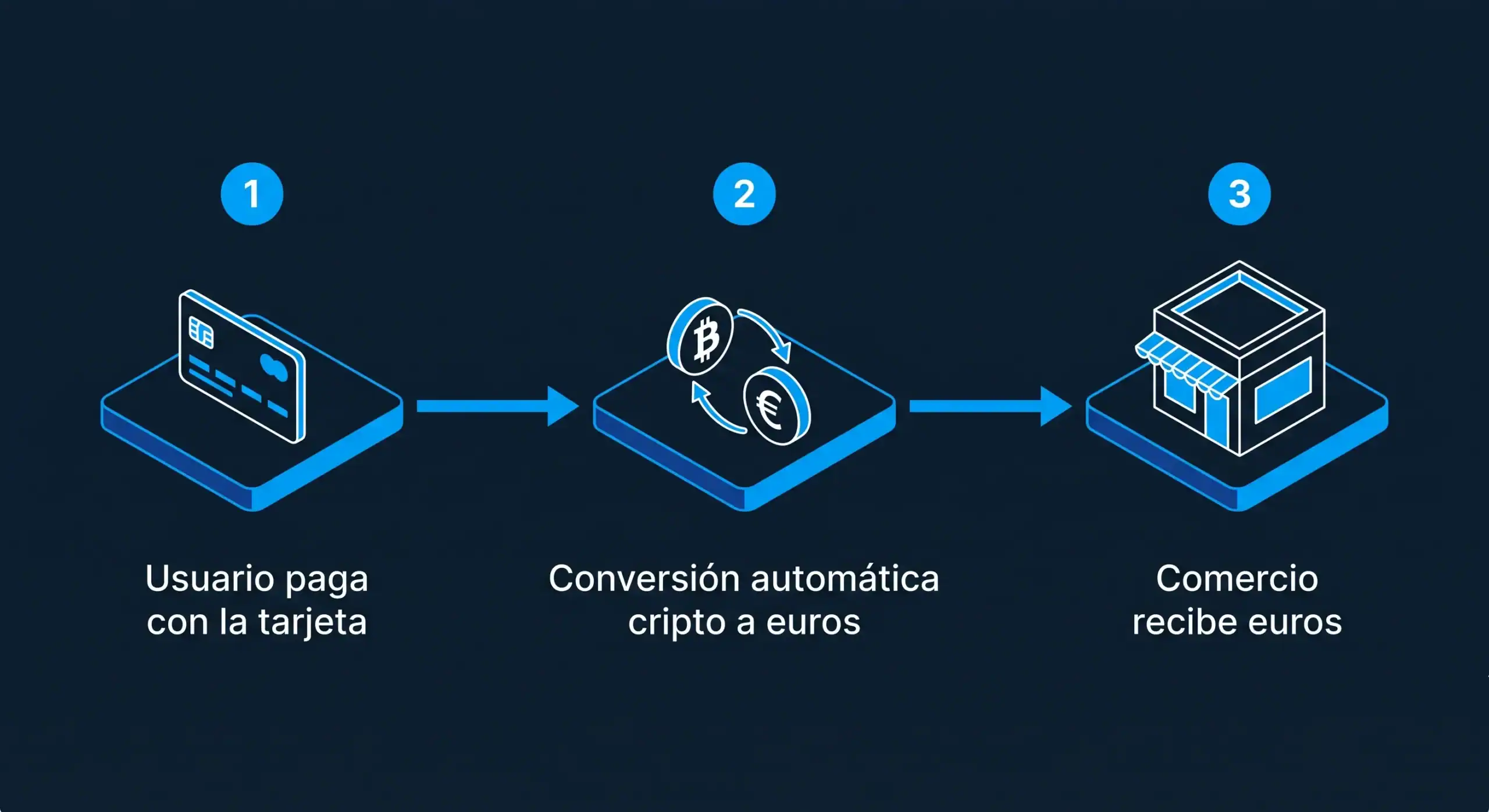
A crypto card is a payment card—physical or virtual—linked to a user's cryptocurrency balance, allowing them to pay at any merchant that accepts cards on the associated network. Unlike transferring cryptocurrencies directly to another wallet, the merchant never receives digital assets: they receive euros, just like any other card purchase. The difference lies in the origin of those euros, which come from an automatic conversion of the user's crypto balance.
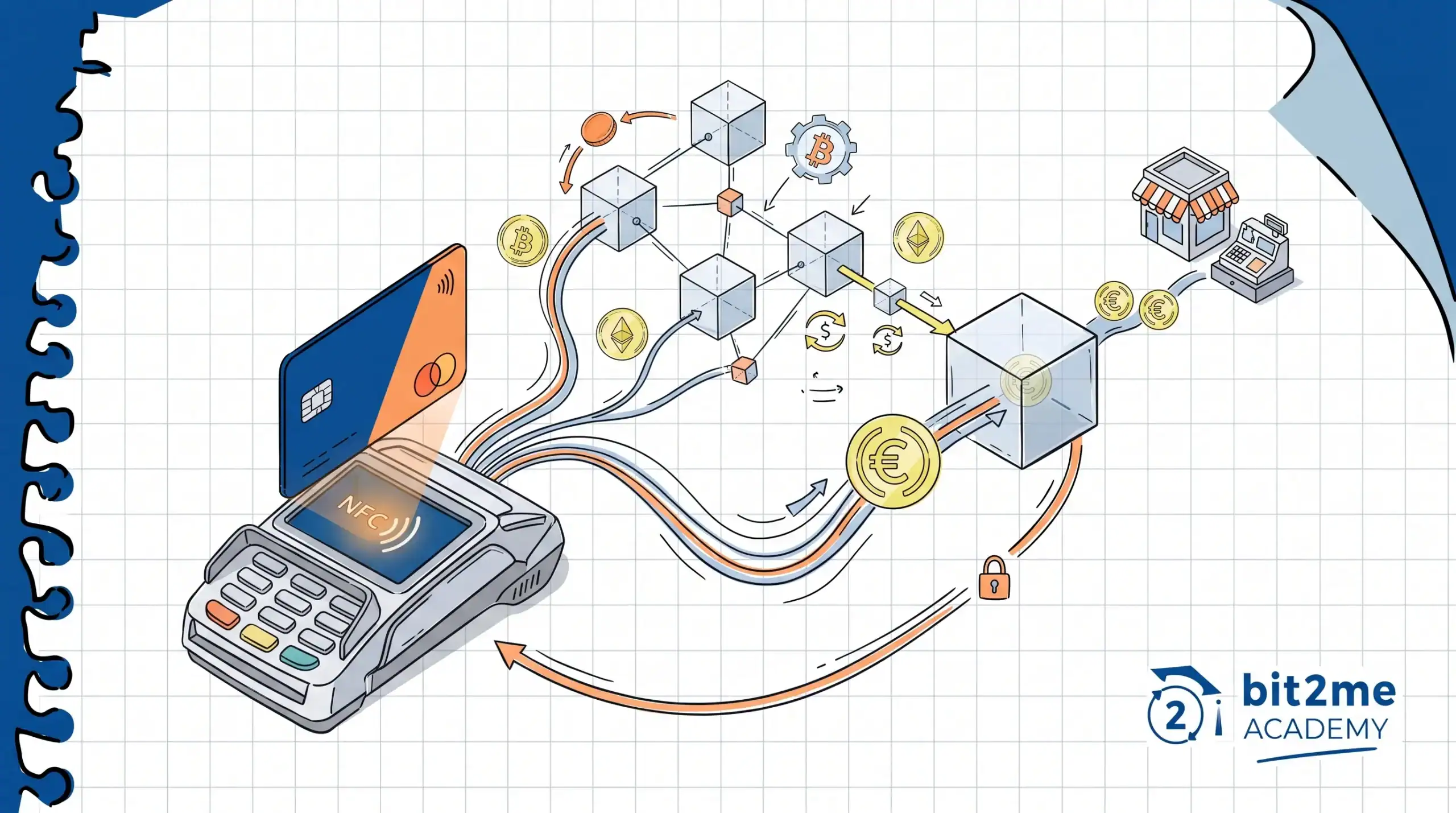
The technical mechanism is simple to understand, although it happens in seconds. When the user swipes their card through the card reader or confirms an online payment, the issuing platform instantly converts a portion of the chosen cryptocurrency into euros at the current exchange rate and sends those euros to the payment network to authorize the transaction. The user sees the cryptocurrency charge reflected in their transaction history, but the merchant receives payment in legal tender without any further action on their part.
This crypto-to-euro conversion is, in practice, the heart of this type of card: without it, it wouldn't be possible to use Bitcoin, Ether, or other digital assets at merchants that don't accept on-chain payments. The exchange rate applied to each transaction may include a margin or a conversion fee, depending on the issuer's terms. In an upcoming guide from this same cluster, we'll delve deeper into how the crypto-to-euro conversion works when paying, providing more details on each step of the process.
Regulatory framework: the role of the issuing electronic money entity
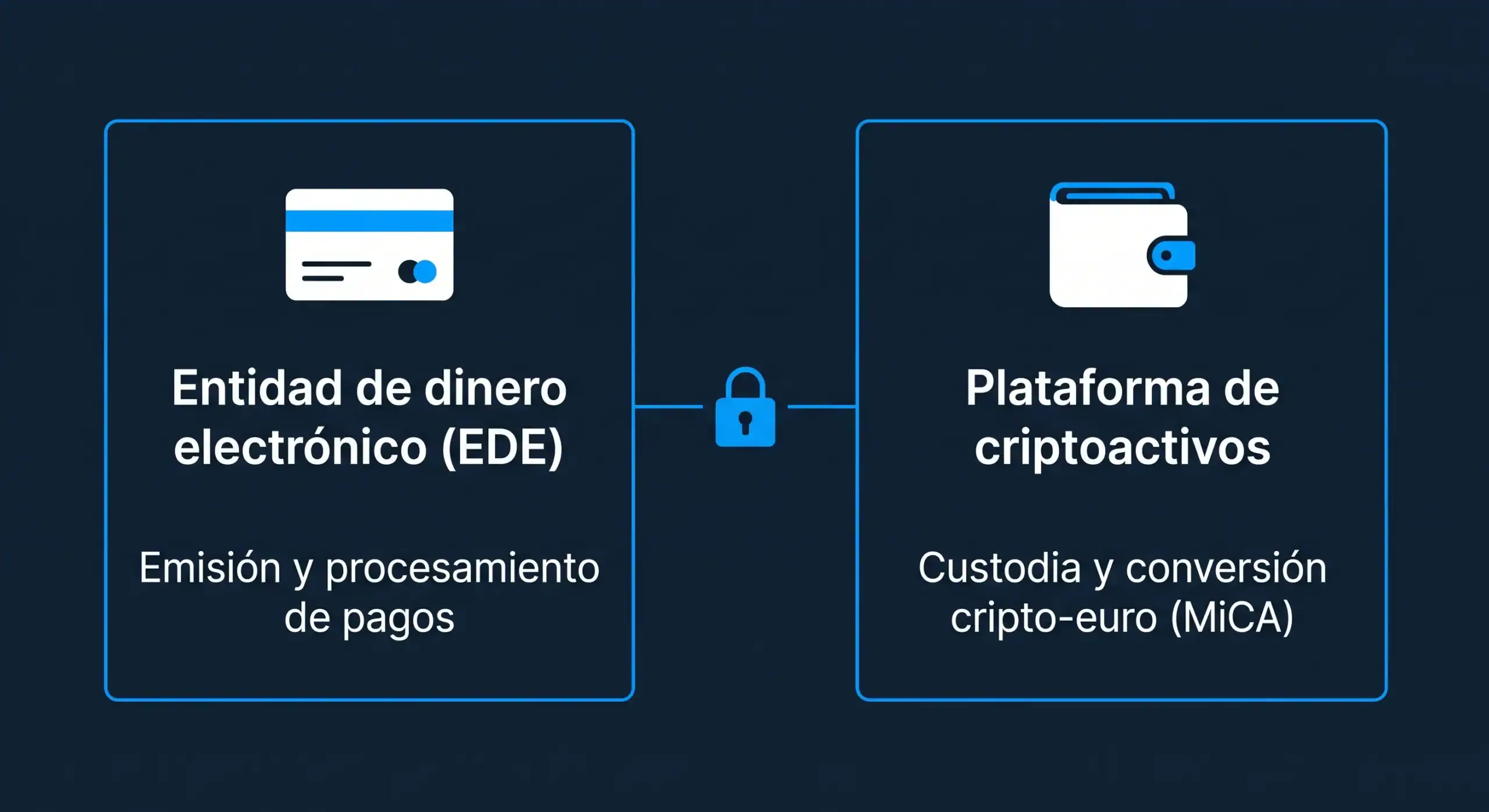
This card is not issued directly by the crypto platform that the user sees in their app, but by an electronic money institution (EMI) authorized to issue payment instruments and process transactions. This separation of roles is common in the sector: the crypto platform manages the digital asset and its conversion, while the EMI manages the payment instrument itself.
About our card and account payment service provider: PECUNIA CARDS EDE, SLU., is an Electronic Money Institution supervised by the Bank of Spain and registered under number CSB 6707, whose trade name is “PECUNPAY”. PECUNIA CARDS EDE, SLU. is the issuer and manager of the card and payment account of Bit2MeIf you have any problems related to the card's operation, you can contact the payment service provider at the following email address: customerservice@pecuniacards.es×This regulatory architecture is not a minor detail, because it determines who is responsible for what. The issuance and processing of payments are subject to the regulations governing payment services and electronic money in force in the European Union, while the crypto component—the custody and conversion of the user's digital assets—falls under Regulation (EU) 2023/1114 on markets in crypto-assets, known as MiCA, which has been in force in Spain since its implementation in 2024. Both frameworks coexist in the same product because this instrument combines, by design, a traditional means of payment with a crypto-asset service.
For the user, in practice, this translates into concrete guarantees: the issuing entity is subject to supervision and capital requirements, and the platform offering the crypto-to-euro conversion must operate as an authorized crypto-asset service provider in its jurisdiction. It's important to remember that this regulatory framework applies in Spain and the rest of the European Union, and that conditions may vary in other jurisdictions. The very existence of a framework like MiCA does not eliminate the risk associated with the value of crypto assets, which remains the user's responsibility to understand before trading them.

Main Cryptocurrencies Course
Basic levelBit2Me Academy We bring you a new course where you will learn everything you need to know about the most important cryptocurrencies that exist today.
Empezar ahora ›Debit, prepaid, physical or virtual: the types of cards
Not all crypto cards work the same way or have the same format, and this variety is one of the first decisions any user should make. The most common distinction is between crypto debit cards and prepaid cards: the former directly uses the available balance in the user's account at the time of payment, while the latter requires loading a specific amount beforehand. Both models exist in today's cryptocurrency card market, and the choice depends primarily on how much control the user wants over their spending.
The choice between debit and prepaid also has practical implications beyond spending control. With the debit model, the user doesn't need to anticipate how much they're going to spend because the card checks the available balance with each transaction, which is more convenient for everyday use. With the prepaid model, on the other hand, the user decides in advance how much to allocate to current expenses, which can be helpful for those who prefer to keep their overall crypto balance separate from the amount reserved for daily purchases.
The second important distinction is between a physical card and a virtual card. A physical card is the plastic or metal card you receive by mail and use just like any bank card, at card readers and ATMs. A virtual card, on the other hand, is generated instantly within the app and is mainly used for online payments or added to mobile payment wallets, without waiting for any physical delivery.
Each format has a clear use case: the virtual card solves the immediate need to pay online the same day it's requested, while the physical card is essential for businesses without a mobile payment terminal or for withdrawing cash from an ATM. Neither format is inherently superior, and the decision depends on the payment channel the user uses most frequently.
Many users end up combining both formats: a virtual card to start using immediately and a physical card for everyday use in stores. This guide doesn't delve into a detailed comparison between debit and prepaid, or between virtual and physical cards, because future guides in this same series will analyze in more detail what to look for before choosing this type of product, the difference between virtual and physical cards, and how a crypto debit card works internally.
Cashback and rewards when you pay with this card
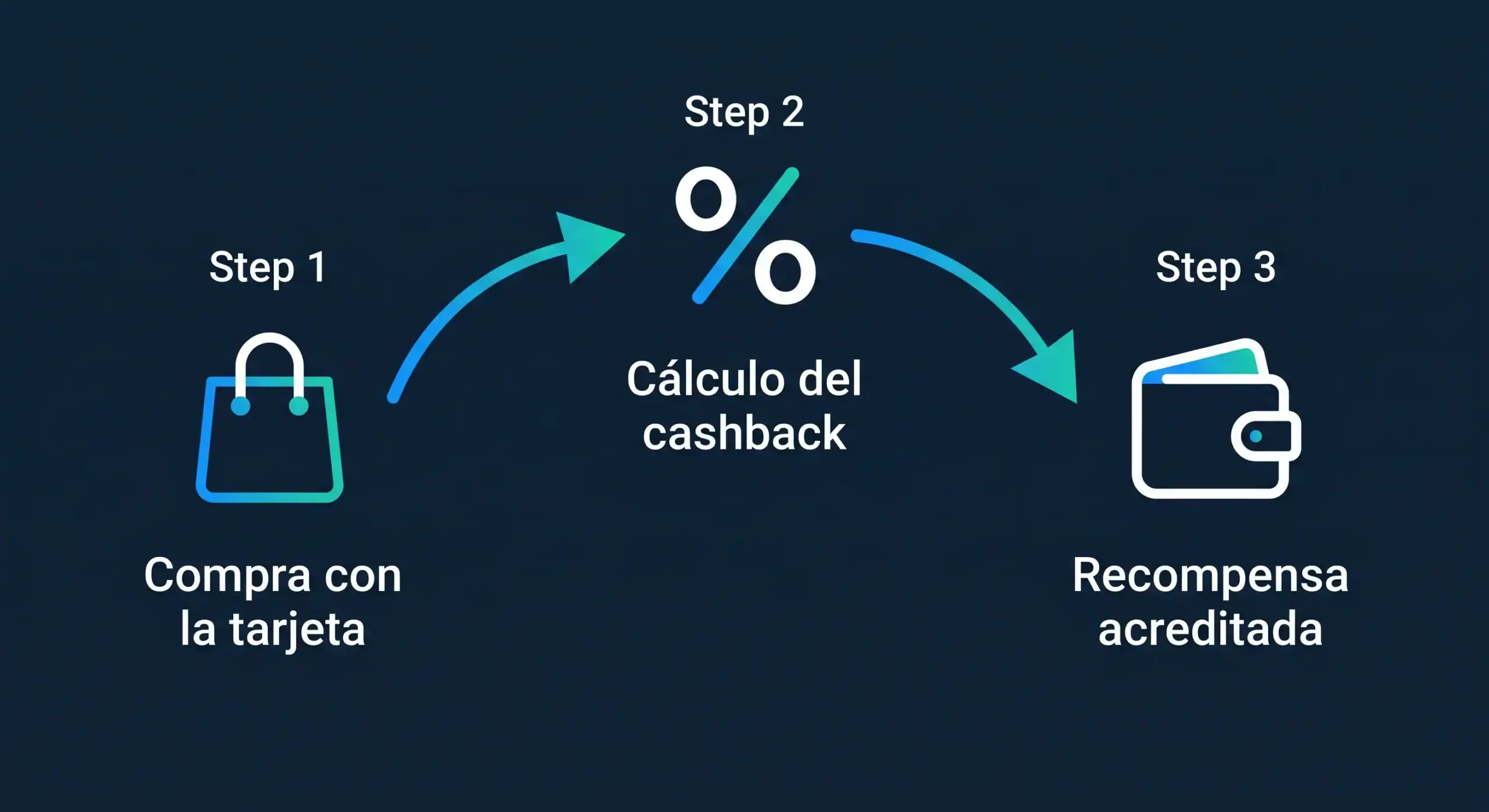
Cashback is one of the features users most often compare when evaluating this type of card, because it converts a portion of everyday spending into additional returns. The typical mechanism involves returning a percentage of each purchase amount, usually in the platform's own cryptocurrency or in the asset chosen by the user, credited after the transaction is confirmed.
Along with cashback, some crypto cards include additional rewards tied to different levels of usage or balance maintained on the platform, such as discounts on fees or other benefits within the ecosystem. These conditions change fairly frequently because platforms adjust their reward programs to keep them sustainable, so a percentage seen in an advertisement months ago may not match the current rate. Fees applicable to the card, such as maintenance, conversion, and ATM withdrawal fees, should also be considered.
It's worth treating cashback as an added benefit, not the sole deciding factor. A card with an attractive cashback percentage but high fees in other areas might not be the best overall option. In an upcoming guide from this same series, we'll delve deeper into crypto cashback, with examples of how it's calculated and in what format it's received.
Card security: what you should watch out for
The security of this type of card combines the standard measures of any payment card with the specific features of the cryptocurrency ecosystem. On the traditional side, it offers the same protections as a bank card: immediate blocking via the app in case of loss or theft, real-time notifications for every transaction, and, in many cases, two-factor authentication (2FA) for online payments. On the crypto side, security relies primarily on protecting access to the account and the app used to manage the card.
Enabling 2FA (two-factor authentication) on the linked account significantly reduces the risk of unauthorized access, even if someone obtains the password through a phishing attack. Setting daily or monthly spending limits directly from the app is another simple measure that limits the potential impact of fraudulent use. Regularly reviewing your transaction history allows you to quickly detect any unrecognized transactions, which is especially important because charges are deducted from your real cryptocurrency balance.
Most issuers also incorporate fraud monitoring systems that analyze unusual spending patterns, such as purchases in countries where the user doesn't typically operate or amounts that deviate from their usual behavior, and can block a suspicious transaction before it's completed. This monitoring layer works in parallel with the security measures configured by the user, and doesn't replace them. It's important to view both layers—the platform's and the user's—as complementary, not alternatives.
No payment system is risk-free, and this card is no exception: be wary of links received via email or text message that ask you to enter card details or account credentials—a common phishing technique specifically targeting cryptocurrency users. Never share the seed phrase of your associated wallet with anyone, not even someone claiming to be technical support for the platform. The combination of good user practices and the platform's own security measures reduces the actual risk of misuse, though it doesn't eliminate the risk entirely.
How to choose the right card for you?
With the objective criteria now identified, choosing your card becomes a matter of prioritizing based on your actual usage. If your priority is to start paying immediately without waiting for any delivery, a virtual card fulfills that need from day one. However, if you prefer to use it frequently in physical stores and at ATMs, the physical version remains essential. If you travel regularly, it's also worth checking how it handles currency conversion, an aspect we'll explore in more detail in an upcoming guide from this cluster dedicated to traveling with this type of product.
Another important factor is how much weight you give to cashback compared to other aspects like maintenance or ATM withdrawal fees. Someone who uses the card daily for small purchases can benefit more from accumulated cashback than someone who reserves it for occasional expenses, while for the latter, fixed fees are more of a concern. In any case, it's best to avoid decisions based solely on the headline of an advertising campaign and always check the terms and conditions in the official documentation.
Once you've compared the options with the table above and decided which type of card best suits your spending habits, the next step is simple: you can order a card from the app. Bit2Me and complete the standard identity verification required for any regulated financial product. The application process doesn't require advanced technical knowledge, but it's advisable to know beforehand which cryptocurrency you'll primarily use to fund your payments. In upcoming guides from this series, we'll also delve deeper into how to pay with cryptocurrencies in everyday life, for those who already have the card and want to get the most out of it.
Crypto cards have moved beyond being a niche experiment and have become an everyday way to use your existing crypto assets without manual conversions or additional transfers. Understanding how the conversion works at checkout, who regulates the transaction, and what objective criteria to compare puts you in a better position to make an informed choice, going beyond the cashback advertised in headlines. If you already know which type of card suits your spending style, applying for a card is the natural next step to start using your crypto assets in the physical world.

Frequently Asked Questions about Crypto Cards
What exactly is this type of card?
It's a payment card, physical or virtual, linked to a user's cryptocurrency balance, which automatically converts that balance to euros at the time of each payment. The merchant always receives euros, never cryptocurrency directly. It works at any establishment that accepts cards from the partner network.
How does the conversion from crypto to euros work when paying?
Once the payment is confirmed, the platform instantly converts the required amount of the chosen cryptocurrency to euros at the current exchange rate. These euros are then sent to the payment network to authorize the transaction, without any further action required from the merchant. The process happens automatically in seconds.
Who actually issues this card?
It is issued by an authorized electronic money institution (EMI), responsible for the regulated aspects of issuance and payment processing. In the case of Bit2MeThe card is issued in collaboration with PECUNPAY, while the crypto platform manages the custody and conversion of the user's digital assets.
Is a crypto debit card the same as a crypto prepaid card?
No. A crypto debit card directly uses the available balance in the user's account at the time of payment, while a prepaid card requires loading an amount beforehand. Both models exist in the current cryptocurrency card market and are detailed in a specific guide for this sector.
How does the cashback on this card work?
Cashback returns a percentage of the purchase amount, usually in the platform's cryptocurrency or the asset chosen by the user, after the transaction is confirmed. The applicable percentage may vary depending on each provider's official terms and conditions. It's always advisable to check the updated documentation before making a decision.
Is a card linked to crypto assets safe?
It combines the usual protections of any payment card—instant blocking, real-time notifications, 2FA—with the added need to protect access to the associated crypto account. No payment system is risk-free, and it's advisable to apply good security practices such as never sharing your wallet seed phrase. The combination of platform measures and user habits reduces risk, although it doesn't eliminate it entirely.
What happens if I lose my card or it gets stolen?
You can block it immediately from the app, just like with any traditional bank card. The associated cryptocurrency balance is not lost, as it remains in the user's account and not on the physical card itself. Replacing the card may incur a fee, which you should check in the current terms and conditions.
How does this card differ from paying directly with cryptocurrencies from a wallet?
Paying directly from a wallet requires the merchant to accept cryptocurrencies as a form of payment, which is uncommon outside of specific cases. This card overcomes that limitation because it automatically converts the balance to euros, allowing you to pay at any merchant that accepts traditional cards. In practice, it bridges the gap between your crypto balance and everyday spending.
Do I need to have crypto assets beforehand to apply for this card?
Yes, this type of card is designed for users who already own or will acquire cryptocurrencies on the issuing platform, as the balance used to fund payments comes from those assets. The application process includes the standard identity verification required for any regulated financial product. Once approved, you can order the card and begin using it after completing the process.
What is the current state of crypto card regulation in Spain?
Since 2024, the MiCA Regulation has governed crypto-asset services throughout the European Union, including Spain, while the issuance of the card as a payment instrument follows electronic money regulations through the corresponding issuing entity. This combined framework offers supervisory guarantees, although it does not eliminate the risk associated with the value of crypto-assets. It is always advisable to review the updated regulatory information of each provider before making a transaction.


«Investment in cryptoassets is not fully regulated, may not be suitable for retail investors due to high volatility and there is a risk of losing all invested amounts»
Share this article!Continue learning

Investment strategy: what it is and how to create your own in 5 steps
Learn what an investment strategy is and how to create your own in 5 steps: objective, horizon, risk profile, DCA, buy-and-hold and index investing.
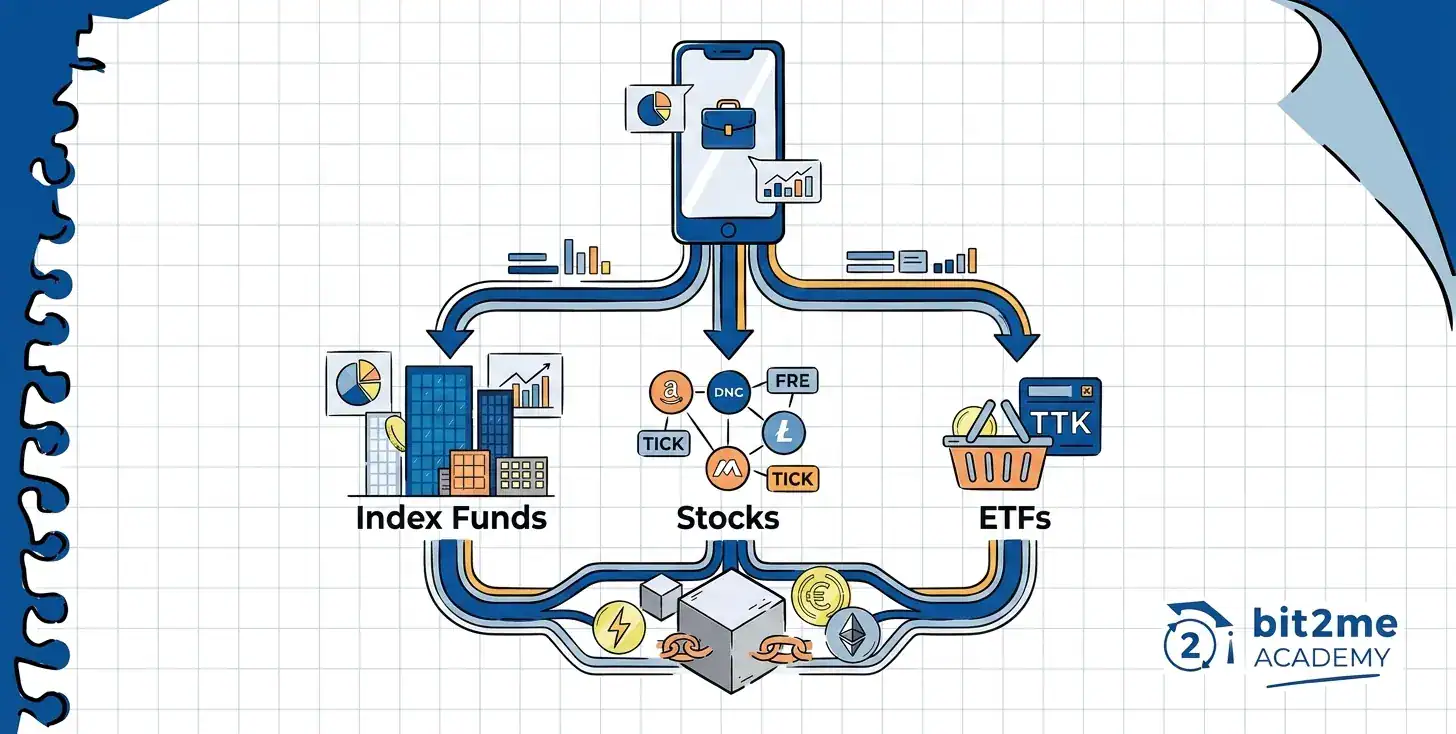
Invest in index funds, stocks, and ETFs from a single app
Discover how to invest in index funds, buy shares online and choose ETFs in Spain from a single app, with a comparative table of costs and taxes.

Dividends and tax withholding: how much do you really keep?
Understand how the 19% withholding tax on dividends works in Spain, international double taxation, and how to recover the excess in your tax return.
Dividends: how to earn income by investing in stocks
Dividends are the portion of profits that a company distributes to its shareholders. Discover how they work, the ex-dividend date, and withholding tax.