Dividends and tax withholding: how much do you really keep?
Essential Points
- When you receive a dividend, the tax authorities — and sometimes the company's country of origin — take a portion before the money reaches your account.
- Spanish withholding tax is an advance payment of 19% (reference 2025), not the final tax: in the Income Tax return it is adjusted according to your actual savings base brackets.
- If the dividend comes from a foreign company, double taxation treaties prevent you from paying twice on the same income.
- A small detail, such as filing form W-8BEN or knowing about Model 720, can change how much money you recover or fail to recover.
Receiving a dividend should be cause for celebration, but many investors are surprised when they check the actual amount they've received. Between Spanish withholding tax, withholding tax at source from the foreign company, and income tax brackets, dividend taxation in Spain is more complex than it first appears. Understanding this process—from the gross dividend to the net amount you see in your account—is the only way to anticipate how much the Spanish tax authorities will take and how much you can recover.
This article explains how withholding tax works in Spain, how dividends are taxed on your income tax return, what international double taxation is, and how it's addressed through treaties signed with countries like the United States, France, and Germany. We'll also cover how to recover excess foreign withholding tax, when filing Form 720 is mandatory, and several practical examples to help you calculate your actual tax liability on dividends, whether domestic or foreign.
What is withholding tax and how does it work in Spain?
Withholding tax is an advance payment that the paying company, or the broker acting as intermediary, deducts from the gross dividend before the money reaches your account. This amount doesn't disappear: the intermediary pays it directly to the tax authorities on your behalf, as an advance payment of the income tax you will have to settle later.
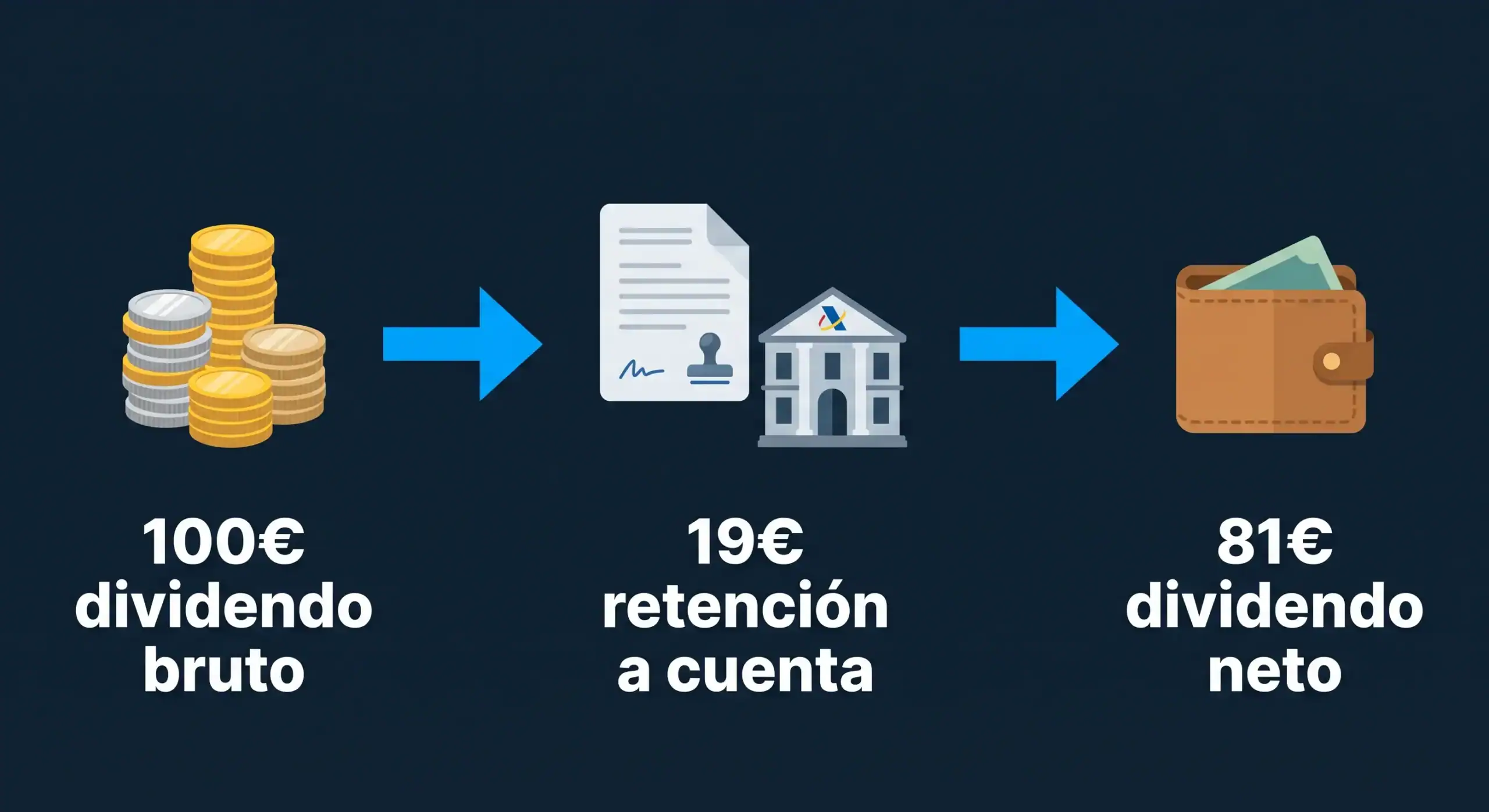
In Spain, the withholding tax on dividends is 19% according to the regulations in force in 2025 (it's advisable to verify if this will continue in 2026 before making any decisions). If a company distributes €100 gross in dividends, you receive €81 net in your account, while the remaining €19 goes directly to the Tax Agency as an advance payment towards your tax return.
It's crucial to understand that this withholding is an advance payment, not the final tax. When you file your tax return, the tax authorities adjust the amount according to your actual income brackets for savings: you may have to pay more, or you may receive a refund of part of the withheld amount.
If your dividends come from Spanish companies, you don't have to manage anything manually. The broker or financial intermediary is legally obligated to withhold the corresponding percentage and declare it to the Tax Agency on your behalf, so your only task comes when it's time to file your tax return.
How dividends are taxed in your income tax return
Dividends are not taxed like regular income: they form part of the savings income base for personal income tax purposes, just like capital gains from selling shares, funds, or other assets. This means they are added to your other savings income to calculate the effective tax rate you ultimately pay.
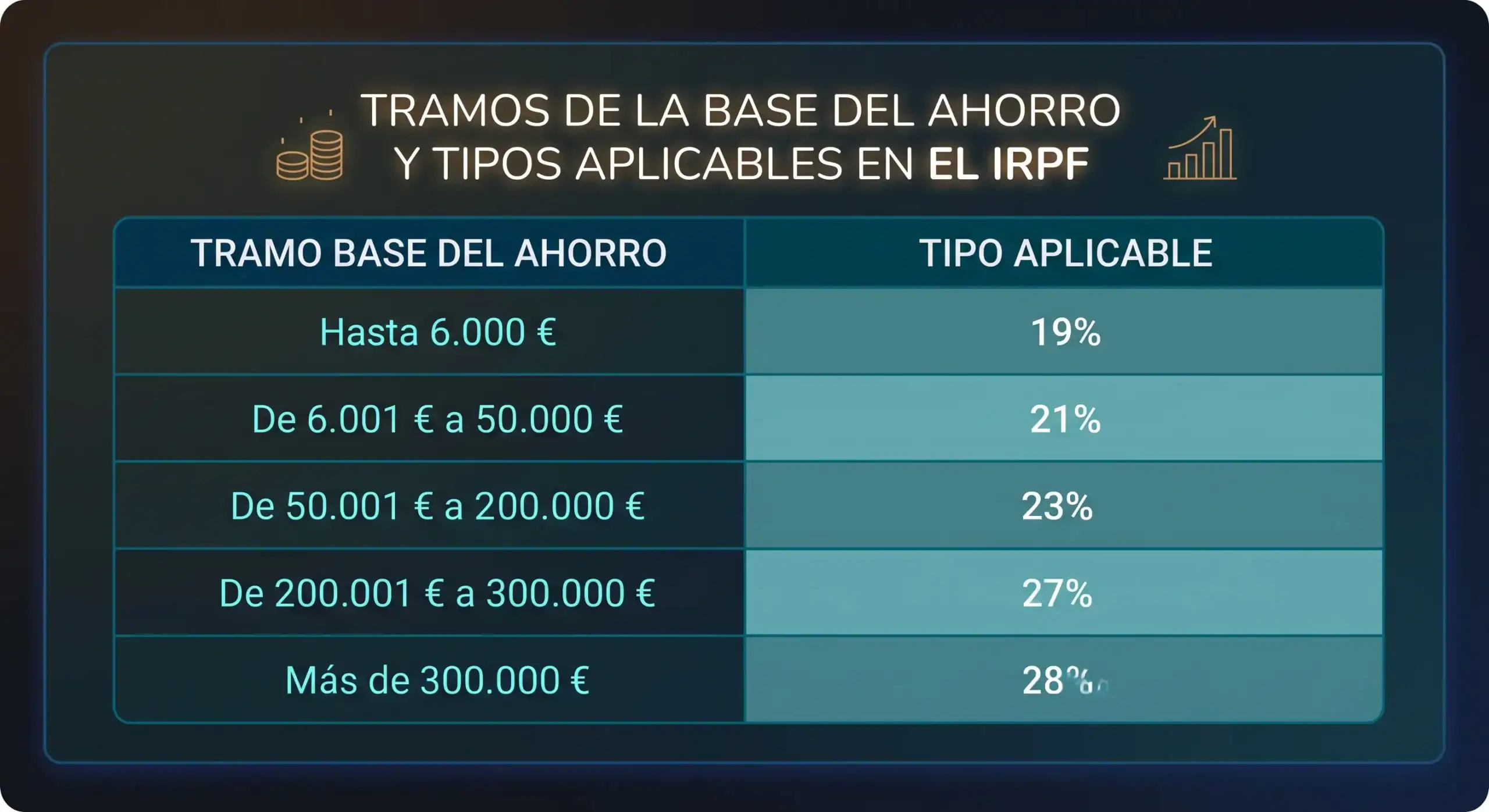
These tax brackets correspond to the regulations in force in 2025; it's advisable to verify whether they remain unchanged in 2026 before making your calculations. The 19% withholding tax applied when you receive the dividend covers exactly the first bracket, so if your total savings income—dividends plus capital gains—exceeds €6.000, a portion of that income will be taxed at higher rates.
Another important point: dividends from listed companies are not currently exempt from any tax breaks, following the elimination of the exemption on the first €1.500. Before assuming this will be final for 2026, confirm with a tax advisor or on the Spanish Tax Agency's website whether any changes have been made.

Main Cryptocurrencies Course
Basic levelBit2Me Academy We bring you a new course where you will learn everything you need to know about the most important cryptocurrencies that exist today.
Empezar ahora ›International double taxation: What is it and why does it exist?
When you buy shares in a Spanish company and receive a dividend, only one tax authority is involved: the Spanish one. But if you invest in a foreign company—imagine you own Apple shares—the situation becomes more complicated, because the United States, as the company's country of origin, also withholds its share before the money crosses the Atlantic.
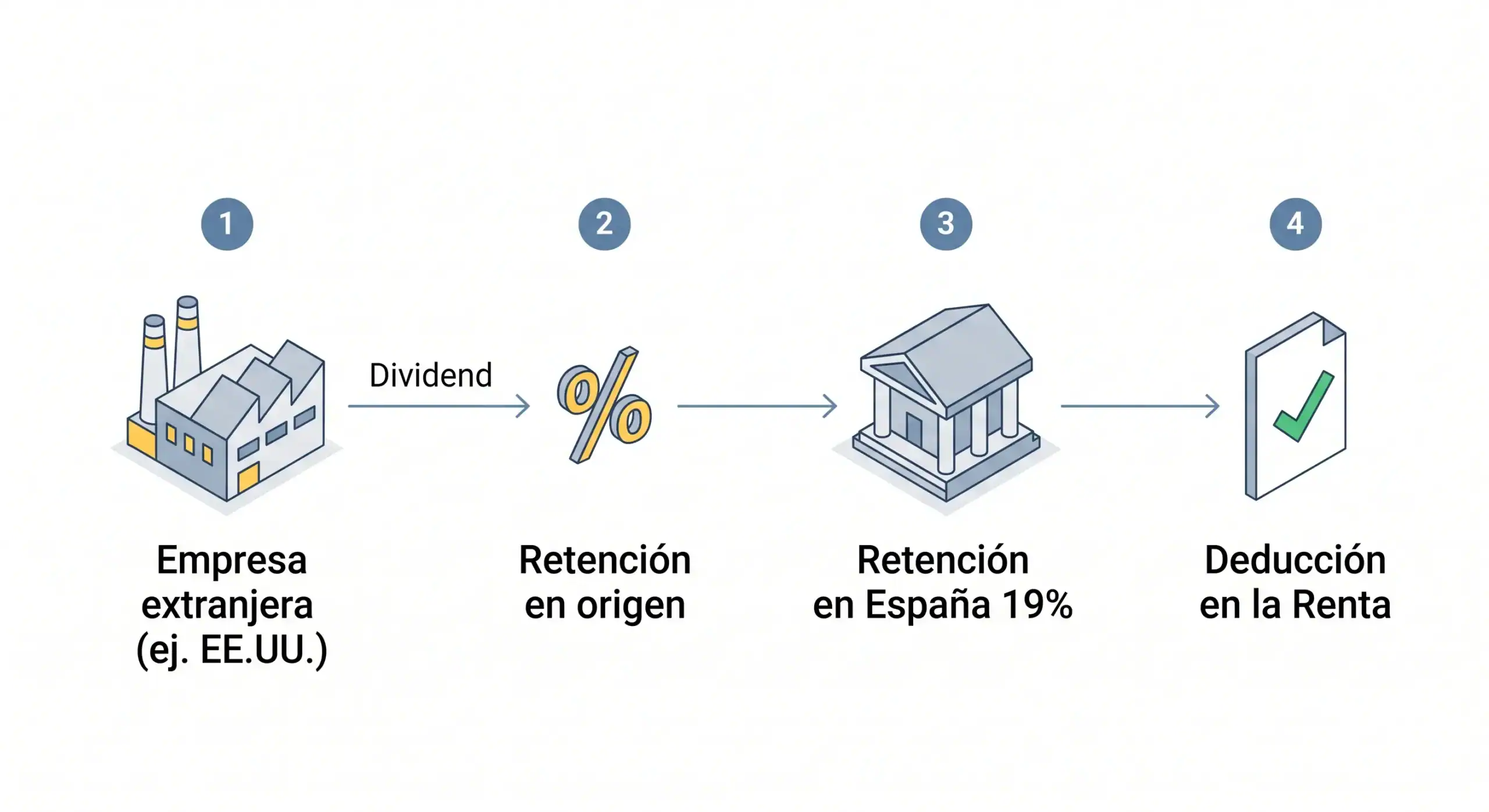
International double taxation occurs precisely here: the country where the company is headquartered withholds a percentage of the dividend at source, and then, when the money arrives in Spain, the Spanish Tax Agency applies its own withholding tax of 19%. Without any corrective mechanism, that same dividend would be taxed twice on the same income.
This happens because each country exercises its fiscal sovereignty over income generated within its borders. The United States considers Apple's dividend to be income generated within its territory, and Spain considers that, since you are a tax resident there, it should also be taxed on your tax return.
The solution lies in the double taxation agreements (DTAs) that Spain has signed with dozens of countries. These agreements limit how much the country of origin can withhold and, furthermore, allow you to deduct from your income tax what you have already paid abroad. If there were no agreement with the country in question, you could end up paying significantly more than the effective 19% tax on that dividend.
How to recover excess foreign withholding tax on income tax
Spain regulates the deduction for international double taxation precisely to prevent you from paying taxes twice on the same income. In practice, you can deduct the lower of these two amounts from your income tax liability: the amount withheld abroad according to the applicable tax treaty, or the amount you would have paid in Spain on that same income.
An illustrative example helps to understand this. Imagine a gross dividend of €1.000 from an American company: the United States withholds 15% under the applicable tax treaty, which is €150, so your broker receives €850. Spain then applies its 19% withholding tax on that €850, approximately €161,50, resulting in a net amount of €688,50 in your account.
In your tax return, you declare the full gross dividend of €1.000 and deduct both the US withholding tax (€150) and the Spanish withholding tax (€161,50). If your effective tax rate on savings income is 19%, the corresponding tax liability would be €190. Since the total withheld (€311,50) exceeds this amount, the Spanish Tax Agency will refund you the difference. Remember that this is a simplified and illustrative example, and the actual result depends on your complete tax situation.
These amounts are reflected in Form 100 through the "withholdings and payments on account" and "deduction for international double taxation" boxes. Please note an important warning: if the foreign broker withheld more than the maximum allowed under the tax treaty, the Spanish Tax Agency will not refund the excess. You must claim it directly from the country of origin through its own administrative procedures.
Form 720: when it is mandatory and what thresholds apply
Form 720 is an informational return, not a tax: you don't pay anything to file it, but the Tax Agency requires you to report certain assets and rights you hold abroad if you exceed certain thresholds. It affects three different categories of assets.
The three categories that can be declared are bank accounts in foreign financial institutions, securities, rights, insurance and income deposited or managed outside of Spain, and real estate located abroad.
The threshold that triggers the obligation is €50.000 per category, calculated on the balance as of December 31st or the average balance of the last quarter; verify its validity, as there have been recent regulatory changes that should be confirmed with an advisor. The filing period runs, in principle, from January 1st to March 31st of the year following the tax year being declared, although it is advisable to check that this schedule is still in effect before filing the return.
Once you've filed your initial return, you only need to file another one if the value of any category increases by more than €20.000 compared to your last return. Form 720 was the subject of a ruling by the Court of Justice of the European Union in January 2022, which deemed the original penalty system disproportionate. The penalties were modified as a result of this ruling, so it's advisable to check the current regulations before making any assumptions. Form 720 hasn't disappeared: it still exists; only the penalty system has been modified.
Who is exempt? Investors with assets held abroad below €50.000 in each category, and generally those who invest through Spanish platforms that hold assets within Spain, because in that case there are technically no "assets abroad" to declare. Even so, it's advisable to confirm with an advisor how custody is handled in your specific case before ruling out the obligation.
The regulations for Form 720 have undergone significant changes in recent years. Consult a tax advisor to confirm your obligation.
Practical examples: what you actually get from a foreign dividend
To complete the picture, let's look at three scenarios that integrate all of the above with concrete figures.
Case 1 — Dividend from a Spanish company (no double taxation)
Gross dividend: €500. Withholding tax in Spain at 19%: €95. Net payment: €405. In your income tax return, if your effective tax rate is 19%, the tax due on this dividend is also €95, so the withholding tax matches exactly what it should be: you neither pay more nor receive a refund for this specific dividend.
Case 2 — Dividend from an American company (with CDI and W-8BEN filed)
Gross dividend: €500. US withholding tax (15%): €75, so the broker receives €425. Additional withholding tax in Spain (19% on €425): €80,75, leaving a net amount of €344,25. You declare the gross €500 on your tax return; the tax due at 19% would be €95, but since the total withheld amounts to €155,75 (€75 plus €80,75), the Spanish Tax Agency refunds you €60,75 on this dividend.
Case 3 — Dividend from American company (without W-8BEN, 30% withholding)
Gross dividend: €500. US withholding tax without the certificate applied (30%): €150, so the broker only receives €350. On your tax return, you can only deduct €95, which is what you would have paid in Spain, so you would have to recover the €55 withheld in the United States, not in Spain. The moral of the story is simple: submitting the W-8BEN form to the broker significantly changes the final result.
Illustrative example. Amounts are approximate and do not include other savings income. Consult a tax advisor for your specific situation.
If after seeing these numbers you want to start building your portfolio of funds and stocks, you can do so from Bit2Me Invest, with the support of InbestMe, an entity supervised by the CNMV.

Frequently asked questions about dividends and withholdings
How much tax does the Spanish Tax Agency withhold on dividends?
The tax authorities apply a 19% withholding tax on the gross dividend, according to the regulations in force in 2025. This withholding is an advance payment: when you file your tax return, it is adjusted according to your actual savings income brackets, so you may have to pay more or receive a refund.
What is double taxation on dividends?
This occurs when the company distributing the dividend is located abroad: that country withholds taxes at source, and Spain also applies its own withholding tax when the money arrives. Double taxation agreements limit withholding at source and allow taxpayers to deduct payments made abroad from their income tax return.
What is a double taxation agreement and what is it for?
It is a bilateral agreement between Spain and another country that sets the maximum withholding tax rate for dividends received by a Spanish tax resident. It also establishes the deduction mechanism to prevent this income from being taxed twice.
How do I recover the withholding tax on US dividends?
Submitting Form W-8BEN to your broker reduces the US withholding tax from 30% to 15% thanks to the double taxation treaty. Additionally, you must correctly declare the international double taxation deduction on your Spanish tax return to recover any excess tax paid against your Spanish tax liability.
What happens if I don't submit form W-8BEN?
Your broker will apply the standard 30% withholding tax at source instead of the 15% stipulated in the Spanish-American tax treaty. In Spain, you can only deduct what you would have paid here, so you would have to claim any excess withheld directly in the United States.
When am I required to submit Form 720?
When the value of your assets or rights abroad, in any of the three categories (accounts, securities, or real estate), exceeds the €50.000 threshold. If you invest through a Spanish platform that holds the assets in Spain, consult an advisor to see if this obligation applies to you.
What happens if I fail to file Form 720 when I am required to do so?
The penalty regime has changed following the ruling by the Court of Justice of the European Union in January 2022, which deemed the previous penalties disproportionate. Even so, it remains an obligation, so it's advisable to confirm your situation with a tax advisor rather than assuming it has been abolished.
Are dividends from investment funds taxed the same as those from stocks?
Yes, dividends or returns distributed by investment funds are taxed as savings income at the same rate as stock dividends. The difference usually lies in how and when they are distributed, not in the applicable tax rate.
How does the withholding tax on Spanish dividends differ from that on foreign dividends?
A Spanish dividend is only subject to one withholding tax, the Spanish one, of 19%. A foreign dividend is first subject to withholding tax at source in the country of the company, adjusted by the applicable double taxation agreement, and then to Spanish withholding tax on the amount actually received by the broker.
Will dividend taxation still be in effect in Spain in 2026?
The general dividend tax scheme in Spain—withholding tax, tax brackets for savings income, and double taxation relief—remains the same, but the specific percentages may be updated each year. Before assuming the figures in this article are correct for 2026, verify their validity with the Spanish Tax Agency (AEAT) or a tax advisor.


«Investment in cryptoassets is not fully regulated, may not be suitable for retail investors due to high volatility and there is a risk of losing all invested amounts»
Share this article!Continue learning
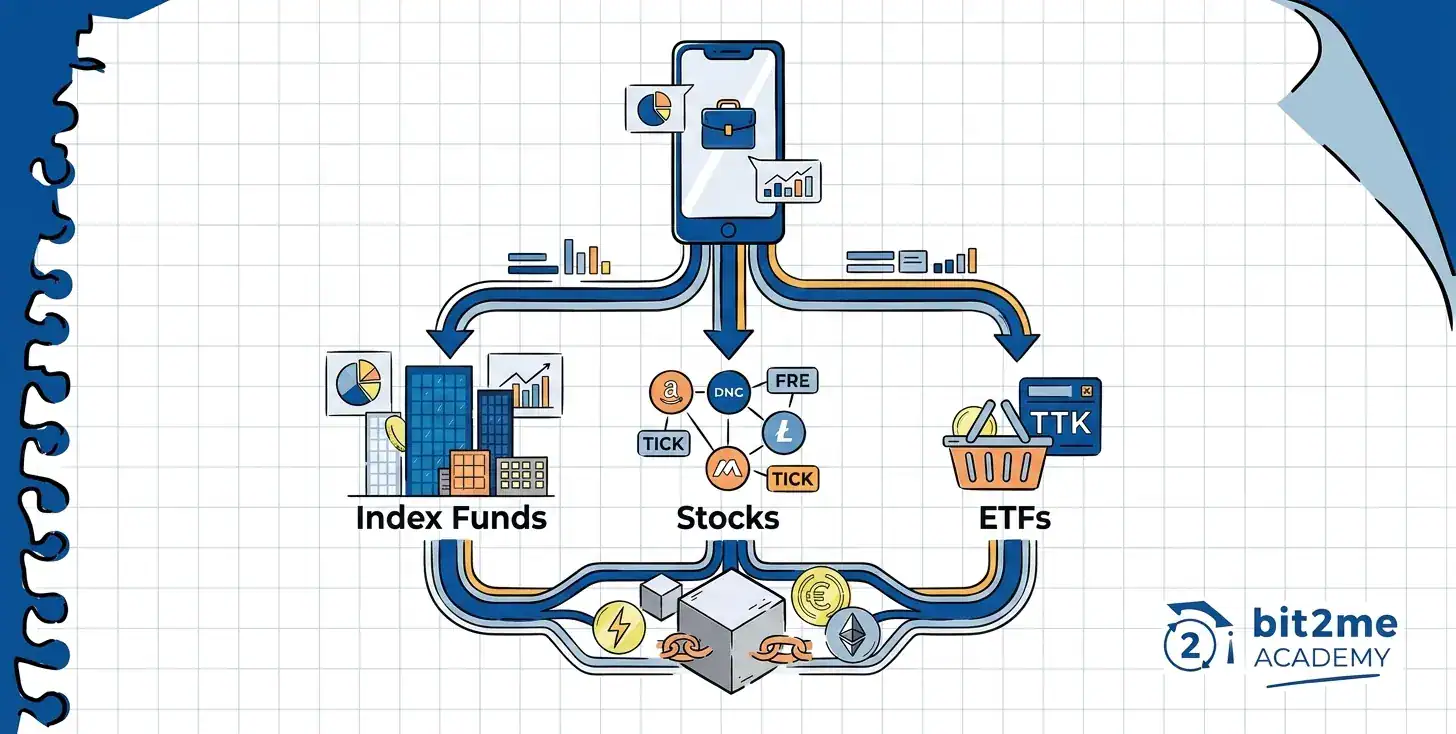
Invest in index funds, stocks, and ETFs from a single app
Discover how to invest in index funds, buy shares online and choose ETFs in Spain from a single app, with a comparative table of costs and taxes.

Crypto card in Spain: how it works and what you should know before choosing yours
Discover how a crypto card works in Spain: conversion when paying, regulatory framework, types, cashback, security and key criteria for choosing one.

Dividends: how to earn income by investing in stocks
Dividends are the portion of profits that a company distributes to its shareholders. Discover how they work, the ex-dividend date, and withholding tax.
Loans using cryptocurrencies as collateral: the complete guide
Complete guide to lending with cryptocurrencies as collateral: how it works, LTV, liquidation risk, taxation, and a comparison table vs. selling.