Diversifying a crypto portfolio with traditional assets: why and how
Essential Points
- A 100% crypto portfolio has a very high risk profile: Bitcoin's historical volatility exceeds 50-80% annualized, which can be unsustainable in the long term.
- Combining crypto assets with index funds and fixed income reduces overall volatility without having to sell what you already own.
- Bit2Me It allows you to manage both parts —crypto assets and traditional funds— from the same platform, without duplicating accounts or processes.
- The correlation between crypto assets and traditional assets is not constant: in times of panic, it tends to rise, limiting the diversification effect just when you need it most.
Anyone who has experienced a crypto market bear market knows exactly what this is about. Watching a portfolio plummet by 60% or more in a matter of months isn't just an emotional blow: it can force hasty decisions, like selling at rock bottom to preserve liquidity. The problem isn't owning crypto assets. The problem is having required crypto assets, without any counterweight to cushion the hardest blows.
In this article, we analyze why diversifying a crypto portfolio by adding traditional assets is one of the most rational financial decisions an experienced holder can make. We explain which assets make sense, in what proportions, and how to do it. Bit2Me without abandoning the ecosystem you already know. If you'd like to review the fundamentals of diversification first, we explain them in detail in our article. Diversification: Don't put all your eggs in one basket.
Why does diversification reduce the risk in your portfolio?
Bitcoin has experienced periods of decline of 70-80% from its all-time highs. Ethereum's declines have been even more pronounced. This doesn't make cryptocurrencies bad assets; it makes them highly volatile assets that, if they comprise 100% of a portfolio, leave no room for maneuver when the market turns.
The logic behind diversification is simple: if you add assets whose behavior isn't perfectly synchronized with that of your cryptocurrencies, the overall volatility of your portfolio decreases, even if the expected return doesn't decrease proportionally. The key concept here is correlation. When the correlation between two assets is low, they move relatively independently; when one falls, the other doesn't necessarily follow suit. Combining assets with low mutual correlation is the technical definition of effective diversification.
The correlation between Bitcoin and global equity indices (S&P 500, MSCI World) has historically fluctuated. In calm periods, this correlation has been relatively low, providing some protection. However, during episodes of widespread panic (such as the March 2020 crash or the 2022 collapses), the correlation has tended to increase significantly, reducing the buffering effect. This doesn't invalidate diversification; it simply means that the best asset for diversifying a crypto portfolio is not another risky asset, but rather assets with lower structural correlation, such as fixed income or money market funds.
Are you the investor who should diversify their crypto portfolio?
Before getting into assets and proportions, it's a good idea to do a quick assessment. Ask yourself these questions:
Do you have more than 70% of your investable assets in cryptocurrencies? Did the last bear market cause you to lose sleep or make decisions you later regretted? Do you have liquidity goals over a three- to five-year horizon that you can't tie to crypto volatility?
If you answered yes to any of these questions, this article is for you. It's not a critique of your portfolio—it's the starting point of a normal process of financial maturity. More sophisticated investors, family offices, and pension funds with crypto exposure don't have 100% of their holdings in that asset. They combine it with assets that offer stability during times when crypto falters.
Signs your portfolio needs rebalancing
There are specific indicators that suggest your portfolio needs more diversification:
- Concentración excesiva: Even if you own BTC, ETH, and a dozen altcoins, if they are all cryptocurrencies, their correlation with each other is high. Owning many different cryptocurrencies is not the same as diversifying across asset classes.
- Absence of uncorrelated assets: If no component of your portfolio behaves in a stable or countercyclical way with respect to crypto, any widespread correction will impact you equally across the board.
- Incompatible timeframe objectives: Needing liquidity in two years and having it in assets with 50-80% annualized volatility is a structural mismatch between your profile and your portfolio.
- Tolerance for actual risk lower than theoretical risk: Many investors believe they have a high risk tolerance until they see their positions lose 60% of their value. If that scenario makes you doubt your decisions, your actual risk tolerance is lower than you thought.
Which traditional assets best complement a crypto portfolio?
Not all traditional assets are equally useful as a complement to a crypto portfolio. The key is to look for assets with low structural correlation and different behavior during times of market stress.
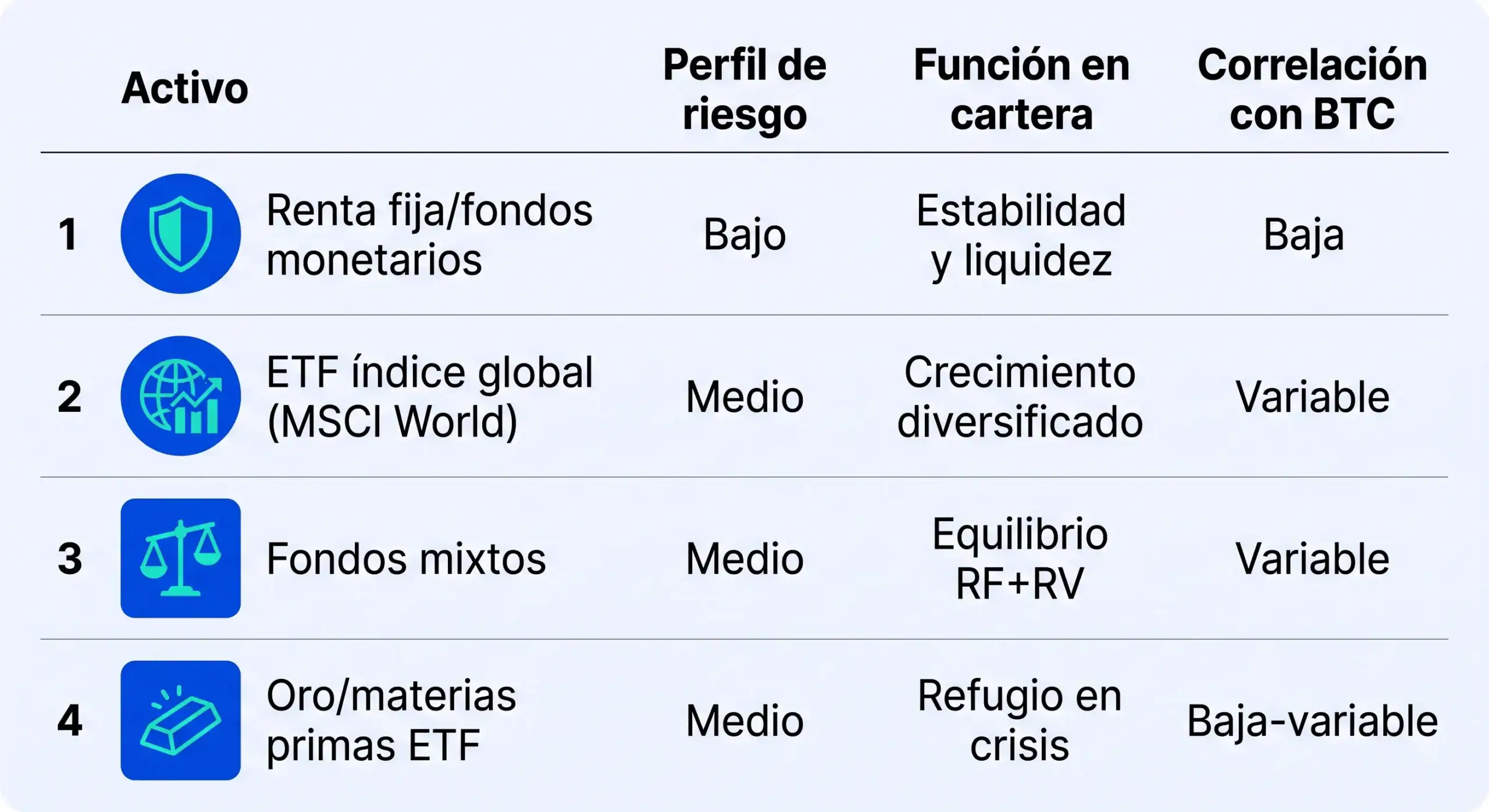
These are the four categories that make the most sense to complement a cryptocurrency portfolio:
- Fixed income and money market funds. They are the category with the lowest risk and the lowest historical correlation with Bitcoin. Money market funds act as a cash equivalent with some return, ideal for the more conservative part of a portfolio. High-quality government bond funds offer stability during times of panic and have historically acted as a safe haven when equities fall sharply. If you want to explore the different types of funds available, we explain it in [link/section/etc.]. What is an investment fund? A complete guide to understanding it from scratch.
- Global index ETFs (MSCI World, S&P 500). They offer equity exposure with extreme diversification: the MSCI World includes approximately 1.500 companies from 23 developed countries in a single product. Their correlation with crypto assets is variable, but structurally different: while the companies in the index generate real profits, crypto assets primarily respond to supply and demand dynamics. They are the cornerstone of the long-term growth component. You can learn more about how they work in our How an ETF works internally: replication, TER, and liquidity.
- Mixed funds. They already integrate equities and fixed income in varying proportions, simplifying management for those who don't want to choose between separate asset classes. There are conservative, moderate, and aggressive mixed funds, depending on the weight of each component. They are especially useful for those who want to build the traditional part of their portfolio with a single holding.
- Gold and commodities through ETFs. Gold has historically acted as a safe haven during times of financial crisis and geopolitical uncertainty. Its correlation with Bitcoin is low during normal market periods. Some refer to Bitcoin as "digital gold," although its empirical behavior still differs considerably from that of the precious metal during times of stress.
Main Cryptocurrencies Course
Basic levelBit2Me Academy We bring you a new course where you will learn everything you need to know about the most important cryptocurrencies that exist today.
Empezar ahora ›How much weight should you give to each part of your wallet?
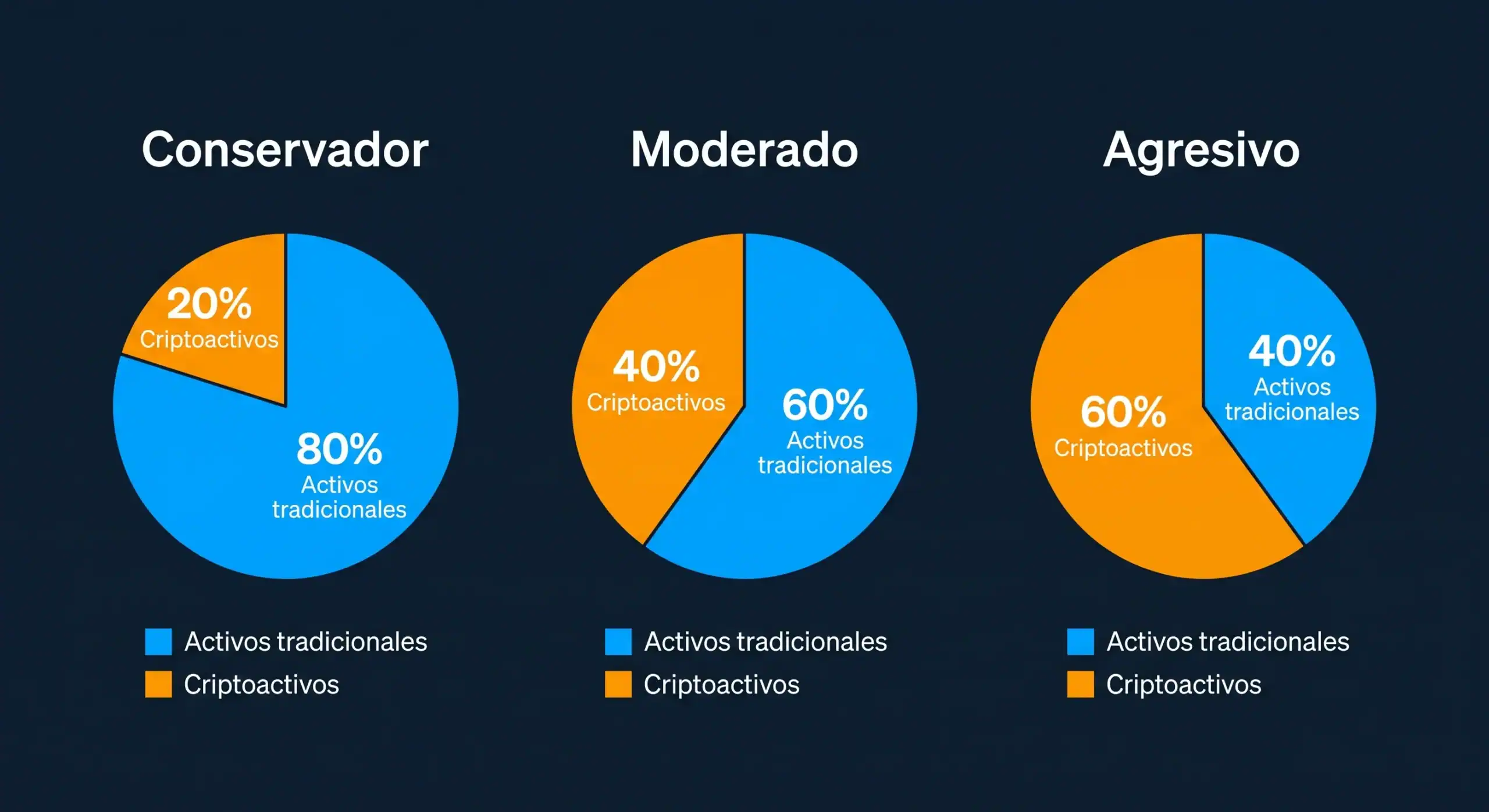
There is no universal allocation. The appropriate ratio between cryptocurrencies and traditional assets depends on your time horizon, your actual risk tolerance, and your specific goals. However, there are illustrative references that can guide you.
- Conservative profile (20% crypto assets / 80% traditional assets). Suitable for those who want to maintain exposure to crypto assets as a smaller part of a stability-oriented portfolio. The majority is allocated to fixed income and money market funds, with some global equities. This profile has the lowest overall volatility.
- Moderate profile (40% crypto assets / 60% traditional assets). Balance the potential of crypto assets with a sufficient buffer of uncorrelated assets. The traditional portion can be divided between global equities and fixed income. This is the most common profile among those who already have experience in crypto and want to add stability without abandoning their primary exposure.
- Aggressive profile (60% crypto assets / 40% traditional assets). It maintains cryptocurrencies as the majority of the portfolio, adding traditional assets as a minimum buffer. The traditional component is typically primarily global equities. It is only suitable for investors with a long-term investment horizon, a high tolerance for risk, and no need for liquidity in the medium term.
None of these profiles are suitable for everyone. The suitability test of Bit2Me Invest is the best starting point to find the distribution that fits your actual situation.
How to build your mixed portfolio from Bit2Me Step by Step
The biggest practical obstacle to diversification has always been the same: having to manage two parallel worlds with different platforms, accounts, and processes. Bit2Me Remove that obstacle.
- Step 1: Define your target distribution. Based on the profile you've identified (or the suitability test results), decide what percentage will be allocated to cryptocurrencies and what percentage to traditional assets. This is the only step that requires personal reflection before taking action.
- Step 2: Manage your crypto assets from Bit2Me. If you are already a user of Bit2MeYour existing crypto assets form the basis of the crypto portion of your wallet. You can continue to acquire and hold crypto assets through the platform's usual services.
- Step 3: Open your account at Bit2Me Invest for the funds and ETFs section. Bit2Me Invest, through Bit2Me Stocks SL, as an affiliated agent of InbestMe, an entity supervised by the CNMV (Spanish National Securities Market Commission), gives you access to index funds, ETFs, and mixed funds with minimum investments of €1. All management takes place within the same platform you already use.
- Step 4: Review and rebalance periodically. Over time, market movements shift the weight of each block relative to your target allocation. If cryptocurrencies rise significantly, their relative weight increases, and the portfolio becomes more aggressive than planned. Reviewing the allocation once a year or after significant market movements—selling some of the best-performing assets and adding to the worst-performing ones—maintains the risk profile you established in step 1.

Frequently asked questions about diversifying your crypto portfolio
What does it mean to diversify a crypto portfolio with traditional assets?
This means adding other types of financial assets to your cryptocurrency portfolio—such as index funds, ETFs, or fixed income—whose performance isn't perfectly synchronized with that of cryptocurrencies. The goal is to reduce the overall volatility of the portfolio without having to sell the cryptocurrencies you already hold. It's about building a balance between the potential of digital assets and the stability of traditional financial instruments.
Why is it not enough to have many different crypto assets?
Because almost all crypto assets share the same risk profile and are highly correlated with each other. In the bear markets of 2018 or 2022, virtually all crypto assets fell together regardless of their individual characteristics. Holding BTC, ETH, and ten other altcoins does not reduce asset class risk: it simplifies risk within the same class, but it does not diversify it across classes.
Which traditional assets have the lowest correlation with Bitcoin?
Historically, the assets with the lowest structural correlation to Bitcoin have been high-quality government bonds and money market funds. Gold has also shown a relatively low correlation during normal market periods. Global equity ETFs (MSCI World, S&P 500) have a variable correlation with cryptocurrencies: low during calm periods and higher during periods of stress. Mixed funds combine several of these elements into a single holding.
How much of my portfolio should be crypto assets and how much traditional assets?
There is no universal answer. It depends on your time horizon, your actual risk tolerance, and your liquidity needs. As educational references—not as advice—a conservative profile might be close to 20% in crypto assets and 80% in traditional assets; a moderate profile, around 40/60; and an aggressive profile, 60/40. The suitability test of Bit2Me Invest is the best starting point to find the distribution that fits your actual situation.
How can I start diversifying my crypto portfolio from Bit2Me?
The process has four steps: define your target distribution according to your profile, maintain your existing crypto assets within the platform, open your account in Bit2Me Invest in the funds and ETFs section, and review the allocation periodically to keep the weight of each block close to your target. All management takes place within the same platform.
What tax advantages does the funds portion have compared to crypto assets?
In Spain, investment funds (not ETFs) offer a tax advantage that cryptocurrencies don't: you can transfer from one fund to another without the change being taxed as a capital gain. This allows you to rebalance the fund portion of your portfolio without immediate tax implications. Capital gains from cryptocurrencies, on the other hand, are taxed upon sale. This difference in tax treatment is relevant when designing your rebalancing strategy.
What happens to the crypto-stock market correlation during times of crisis?
In episodes of market panic, the correlation between cryptocurrencies and traditional risk assets (equities) tends to increase. This reduces the diversification effect at the worst possible time. Therefore, the most effective assets as a counterbalance during stressful periods are lower-risk assets: quality fixed income and money market funds. Global equities diversify within the risk spectrum, but they don't always protect against cryptocurrencies.
How often should I rebalance my mixed portfolio?
Rebalancing too frequently has a significant tax cost in Spain, especially if you sell crypto assets at a profit. An annual review, or when the actual allocation deviates by more than 10% from the target, is usually sufficient to maintain the risk profile without accumulating unnecessary tax costs. Investment funds allow rebalancing through transfers without immediate taxation, making them particularly efficient for adjusting the traditional portion of the portfolio.
What regulatory oversight covers the funds portion in Bit2Me Invest?
The funds and ETFs section of Bit2Me Invest operates through Bit2Me Stocks SL, as a tied agent of InbestMe, an entity supervised by the CNMV (National Securities Market Commission), means that investment in funds from Bit2Me It is subject to Spanish and European securities market regulations, including MiFID II protections and the FOGAIN framework for asset custody. The crypto component follows the MiCA regulatory framework, in force in the European Union since 2024.
Is there a risk of losing all the money by diversifying in this way?
Diversification reduces risk, but it doesn't eliminate it. Equity funds can lose value if global markets fall. Cryptocurrencies can lose value sharply—and the risk of losing everything invested in cryptocurrencies is real. Fixed income and money market funds are the lowest-risk assets in a portfolio, but they don't offer guaranteed returns either. Well-diversified portfolios reduce the likelihood of concentrated, catastrophic losses, but they don't make any portfolio risk-free.


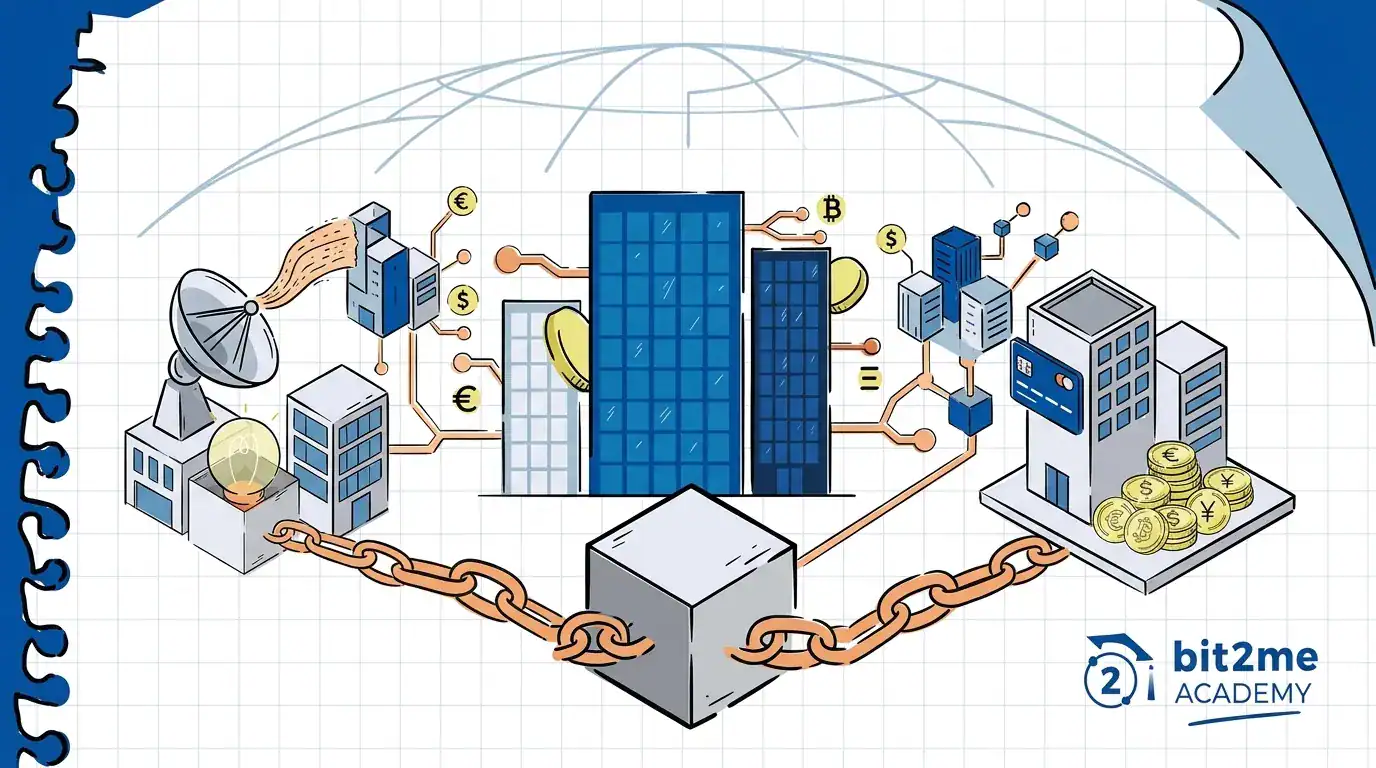
«Investment in cryptoassets is not fully regulated, may not be suitable for retail investors due to high volatility and there is a risk of losing all invested amounts»
Share this article!Continue learning

Investment strategy: what it is and how to create your own in 5 steps
Learn what an investment strategy is and how to create your own in 5 steps: objective, horizon, risk profile, DCA, buy-and-hold and index investing.
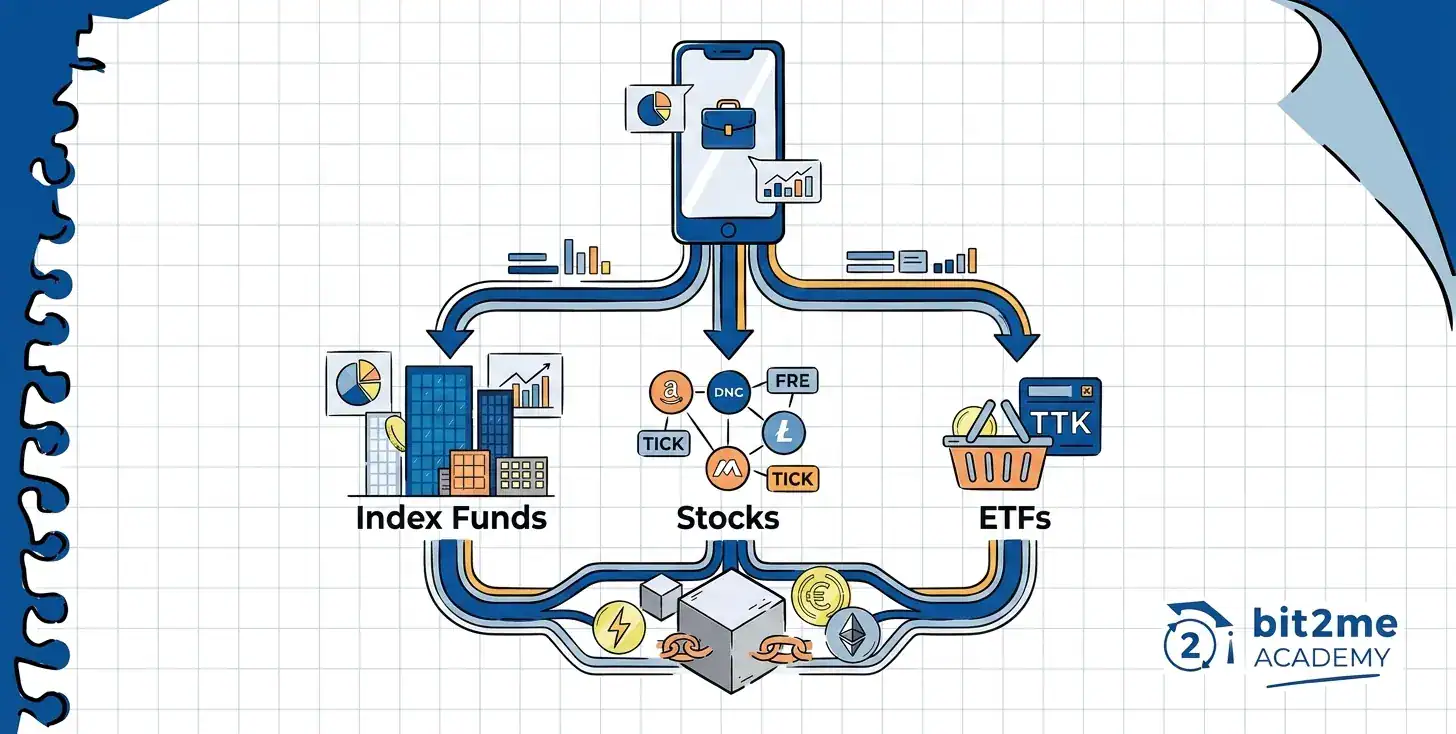
Invest in index funds, stocks, and ETFs from a single app
Discover how to invest in index funds, buy shares online and choose ETFs in Spain from a single app, with a comparative table of costs and taxes.
Crypto card in Spain: how it works and what you should know before choosing yours
Discover how a crypto card works in Spain: conversion when paying, regulatory framework, types, cashback, security and key criteria for choosing one.
Dividends and tax withholding: how much do you really keep?
Understand how the 19% withholding tax on dividends works in Spain, international double taxation, and how to recover the excess in your tax return.