Dividends: how to earn income by investing in stocks
Essential Points
- A dividend is the portion of profits that a company distributes to its shareholders, although no company is obligated to pay it.
- Everything revolves around the ex-dividend date: buy it before that date and you get paid; buy it on or after that date and you don't get paid.
- The dividend yield measures what percentage of the share price you receive annually in dividends, although a very high yield can be a bad sign.
- In Spain, the tax authorities withhold part of the dividend before it reaches your account, and then adjust it in your tax return.
Earning money simply for holding a stock in your portfolio sounds almost too good to be true, but that's exactly what dividends have been doing for centuries. Many novice investors have heard of them as a way to generate passive income, but they aren't entirely clear on what dividends are, when they are paid, or why some companies pay them and others don't.
In this article we explain, step by step, the complete mechanism: what a dividend is, how the dividend calendar works and that ex-dividend date that is so confusing at first, how it is calculated dividend yield and how much the tax authorities withhold when the money reaches your account. By the end, you'll know exactly what to expect the next time a stock in your portfolio pays dividends.
Important: This article is for educational and informational purposes only. The content does not constitute financial, legal, or tax advice. Cryptocurrencies are high-risk assets and their value can fluctuate significantly. Consult a qualified professional before making any acquisition or participation decisions.×What is a dividend?
A dividend is the portion of profits that a company decides to distribute to its shareholders, instead of reinvesting it entirely in the business. We say "decides" because that's the first key point to understand: paying dividends is neither a legal obligation nor an automatic consequence of being profitable. Each company sets its own dividend policy based on its results, investment plans, and current stage of development.
This means that not all stocks pay dividends, and those that do can reduce or even eliminate them if the business situation changes. When you buy a share of a dividend-paying company, you become one of the people entitled to receive that proportional share of the profit, based on the number of shares you own.
The figure you will see associated with each distribution is the dividend per share (DPS): The result of dividing the total amount the company allocates to dividends by the number of shares outstanding. If a company distributes €100 million and has 200 million shares outstanding, the dividend per share is €0,50.The more shares you own, the greater the total amount you will receive, even though the DPA is the same for all shareholders.
The payment frequency varies depending on the market and the company itself. In the United States, quarterly distributions are very common, while in Spain and the rest of Europe, semi-annual or annual payments predominate, sometimes with an advance payment and a final payment. Neither of these schedules is inherently better or worse: they simply reflect the culture of each market and how each company organizes its communication with shareholders.
Main Cryptocurrencies Course
Basic levelBit2Me Academy We bring you a new course where you will learn everything you need to know about the most important cryptocurrencies that exist today.
Empezar ahora ›The dividend calendar: the four dates that matter
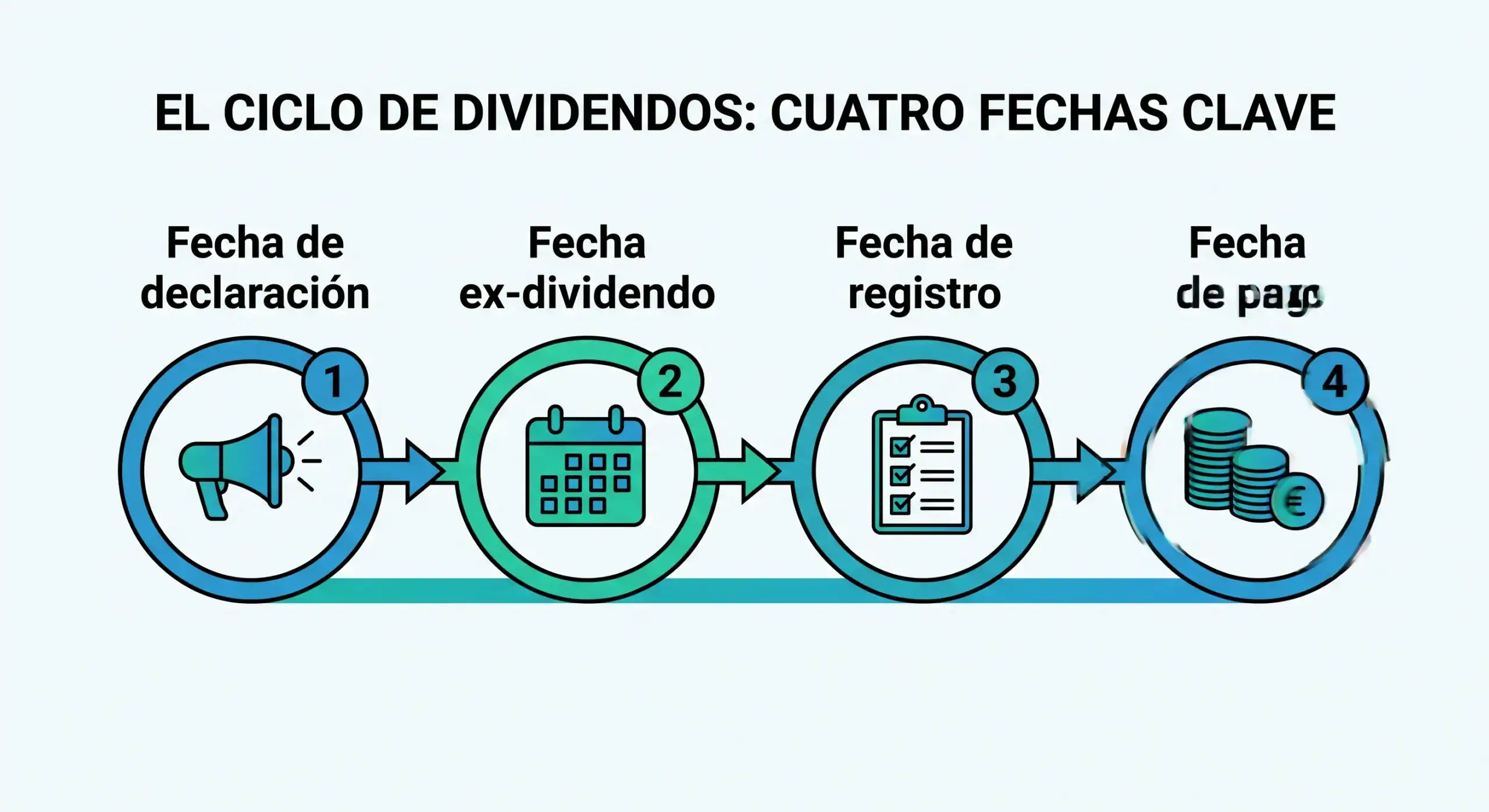
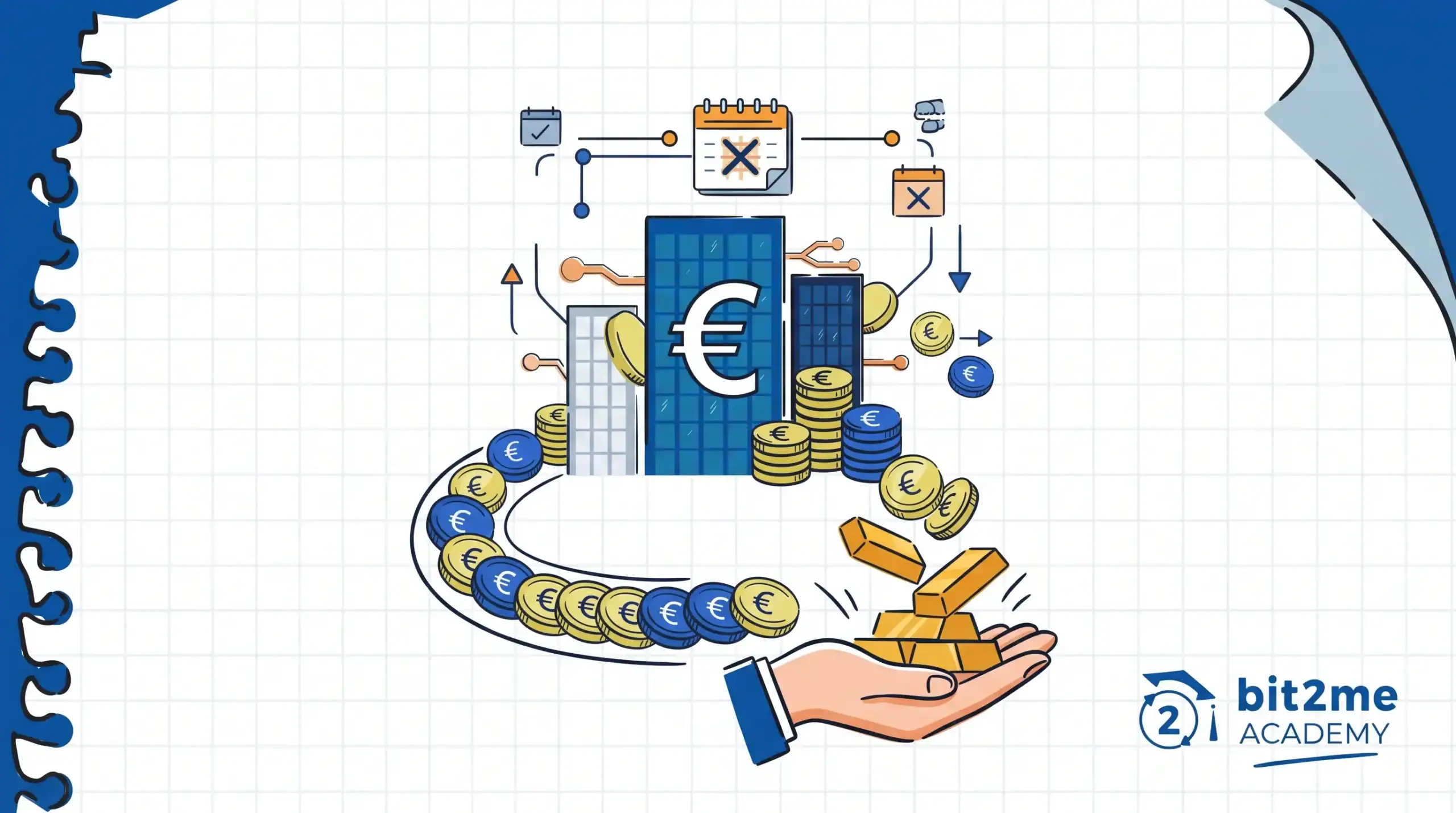
If there's one concept that often confuses those new to dividend investing, it's understanding exactly when to hold a stock to collect the dividend. The complete dividend cycle always revolves around four dates, and understanding them well saves you the disappointment of buying a stock on the wrong day.
The first is the declaration dateThe dividend announcement is the moment when the company officially announces that it will pay a dividend, how much it will distribute per share, and the dates on which everything else will take place. It is the starting point of the cycle and usually coincides with the presentation of results or the shareholders' meeting.
The second, and most important for you as an investor, is the ex-dividend date (or ex-date). This is the deadline: if you buy the stock before the ex-dividend date, you are entitled to receive that dividend. If you buy the stock on or after the ex-dividend date, you will not receive that specific payment, although you will receive subsequent dividends if the company continues to distribute them.
The third one is the registration dateThe ex-dividend date is the moment when the company officially closes the list of shareholders entitled to receive payment. In practice, this usually coincides with the next business day following the ex-dividend date, due to how stock market transactions are settled. And the fourth is the Payment date, the day the dividend finally arrives in your account, with the corresponding tax withholding already applied.
An illustrative example helps solidify the idea. Imagine a fictional company announces that the ex-dividend date for its next payment is Tuesday the 15th. To be entitled to that dividend, you need to have purchased the stock no later than Monday the 14th. If you buy on Tuesday the 15th or later, that specific payment will not be yours, even though the stock will still be yours for the next distribution. Note that this example uses generic dates only to illustrate the mechanism, not an actual company or dividend.
What is dividend yield and how to interpret it?
Once you understand when the dividend is paid, the next natural question is what that payment actually represents. To answer this, we use the dividend yield, also called dividend return: it measures what percentage the annual dividend per share represents of the current share price.
The formula is simple: divide the annual dividend per share by the share price and multiply the result by 100. If a company pays €1 in annual dividends and its share price is €20, the dividend yield is 5%. Remember that this is an illustrative example with rounded figures to explain the calculation, not a recommendation or forecast for any specific stock.
Here's the nuance that distinguishes a novice investor from a more experienced one: a very high dividend yield isn't always good news. The yield is calculated based on the current share price, so if that price falls sharply, the yield automatically rises even if the company hasn't increased its dividend by a single euro. An unusually high yield might actually reflect the market anticipating future problems for that company, not be a gift.
Therefore, it's advisable to consider dividend yield in conjunction with other data, such as the dividend's historical performance or the strength of the company's results, and never in isolation. A sustained 3% yield over several years can be healthier than a sudden 12% yield following a stock market crash.
Withholding tax on dividends in Spain
When the dividend arrives in your account, it already includes a deduction: in Spain, dividends received by individuals are subject to income tax withholding as part of their savings income. This withholding is applied automatically before the money appears in your account, so the amount you see is the net amount after the deduction.
The current income tax brackets for savings are as follows: 19% up to €6.000, 21% between €6.001 and €50.000, 23% between €50.001 and €200.000, 27% between €200.001 and €300.000, and 28% above €300.001. For the vast majority of beginner investors, the total amount of savings income for the year does not exceed the first bracket, so in practice, they are taxed at 19%.
That withholding isn't the final word: in your tax return, the amount withheld is adjusted using the actual marginal tax rate that applies to you based on your total savings income for the year. Depending on your situation, this could result in a refund if too much was withheld, or a supplementary payment if too little was withheld.
Keep in mind that these tax brackets are for guidance only and may change with future tax reforms, so it's advisable to verify them before making decisions based on them. For specific questions about your particular situation, it's best to consult a tax advisor. If you'd like to learn more about exactly how dividends are taxed and what strategies exist to optimize this aspect, we have a specific article dedicated to dividend withholding tax and how much you actually keep after it's applied.
Not all companies pay dividends: when does dividend investing make sense?
It's easy to assume all stocks work the same way, but the reality is much more varied. High-growth companies—tech, biotech, and many young, expanding businesses—typically reinvest virtually all their profits back into the business rather than distributing them. For shareholders in these types of companies, the value comes not so much from the dividend as from the stock's appreciation as the business grows.
At the other end of the spectrum are mature companies with stable businesses and less need for large growth investments: sectors such as utilities (public service companies like electricity or water), banking, consumer staples, and telecommunications have historically been the largest dividend payers. This isn't a hard and fast rule, nor a guarantee that it will continue to be the case, but it helps explain why some stocks pay dividends regularly while others almost never do.
Dividend investing makes sense, especially when the goal is to generate regular income: retirees seeking recurring cash flow, investors looking to supplement other income, or anyone who prefers to receive a tangible portion of the profit rather than simply waiting for the share price to rise. However, it's not the only possible strategy, nor is it necessarily the most suitable for everyone: someone focused on long-term growth might prefer companies that reinvest all their profits.
The important thing is to choose your strategy based on your objective, not the other way around. If you want to understand exactly what a stock is and what other rights a shareholder has besides receiving dividends, we recommend reviewing our article on what a stock is and the rights it grants. And if dividends are precisely the central element of your strategy, we have a separate article dedicated to how to build passive income through dividend investing, with more details on stock selection and monitoring.
Collect dividends from Bit2Me Invest
Everything we've explained so far—the calendar, yield, retention—only makes sense when you can put it into practice. From Bit2Me Invest You can access shares of companies that pay dividends, with one important distinction: these are real shares, not CFDs or derivatives based on the price. This difference matters because real shares are entitled to dividends, while a CFD only replicates the price movement without giving you that portion of the company's profit.
As with any investment product, it's important to be clear about who is behind it. Bit2Me Stocks SL acts as a tied agent for InbestMe, an entity supervised by the CNMV under MiFID II, which manages the regulated trading of funds, shares and ETFs within the app. Bit2MeThis means that when you buy a share through Bit2Me Invest, you do it within a regulated framework, with the guarantees and information obligations required by Spanish regulations.
Start investing in dividend-paying stocks from the same app you already use for the rest of your finances, without having to open an account with a different broker or manage separate platforms.
No company is obligated to maintain its dividend over time, so before building a portfolio with the income it generates in mind, always review the results and dividend policy of each company on your own, or with the help of a professional if needed.
Dividends make shareholders recipients of regular income, one of the oldest ways to generate revenue from financial assets, and it will likely remain so for a long time. Understanding the four stages of the dividend cycle, knowing how to interpret dividend yield without being dazzled by a high number, and being clear about how much is taxed along the way is what separates those who collect dividends wisely from those who simply receive them as a side effect of owning shares. With this foundation, you can decide whether you want to delve deeper into the tax implications or how to build a comprehensive dividend strategy, and move on to the next step that best suits your needs.

Frequently asked questions about dividends
What are dividends and why do companies distribute them?
Dividends are the portion of profits that a company chooses to distribute to its shareholders instead of reinvesting them in the business. Companies distribute them as a way to reward those who have invested their money in the company, especially when they no longer need to reinvest all the profits to continue growing. It is not a legal obligation, but rather a decision made by each company based on its situation and dividend policy.
How do stock dividends work in Spain compared to the United States?
The underlying mechanism is the same in both markets: there is a declaration date, an ex-dividend date, a record date, and a payment date. The main difference lies in the frequency: quarterly payments predominate in the United States, while semi-annual or annual payments are more common in Spain and much of Europe.
What is the ex-dividend date and why is it so important?
The ex-dividend date is the day after which, if you buy the stock, you are no longer entitled to receive the next dividend. It is the most important date on the dividend calendar because it precisely determines who receives that specific payment and who does not. Buying a day before or a day after that date can mean the difference between receiving the dividend and waiting for the next distribution.
How can I find out when a company is going to pay a dividend?
Listed companies announce their dividend payments on the declaration date, usually alongside their earnings report or at their annual general meeting. This information is typically available in the company's investor relations section and on the dividend calendar of the platform where you hold your shares. Checking this calendar regularly is the easiest way to avoid missing important ex-dividend dates.
How is the dividend yield of a stock calculated?
The dividend yield is calculated by dividing the annual dividend per share by the current share price and multiplying the result by 100. For example, a share that pays €1 in annual dividends and is trading at €20 has a dividend yield of 5%. This is a useful metric for comparing stocks, but it's important not to focus solely on the percentage without also considering the overall health of the business.
How much tax is withheld from dividends in Spain?
Dividends are taxed as part of your savings income, with rates ranging from 19% to 28% depending on your total annual savings income. Withholding is applied automatically before the money reaches your account and is then adjusted in your tax return based on your actual marginal tax rate. For most beginner investors, the applicable rate is usually 19%.
Is it safe to invest solely for the dividend?
No dividend is guaranteed: a company can reduce, suspend, or eliminate it if its results worsen, just as its share price can fall. Building an entire strategy around a single criterion, such as the dividend, concentrates the risk on the future decisions of those specific companies. Therefore, it's advisable to consider the dividend as one component of a diversified portfolio, not as the sole variable to consider.
What happens if a company stops paying dividends?
If a company reduces or eliminates its dividend, investors stop receiving that regular income starting with the next payment cycle, and the market usually reacts by adjusting the share price to reflect the change in expectations. This doesn't necessarily mean the company is in serious trouble; sometimes it prioritizes reinvesting profits back into the business. In any case, it's a signal worth analyzing along with the company's other results.
How does a dividend differ from the appreciation of the stock?
A dividend is a regular cash payment you receive while holding the stock, while appreciation is the increase in the stock's price over time, which only becomes real profit when you sell it. Some companies prioritize dividends, others appreciation, and many combine both in varying proportions. Choosing between one or the other—or combining them—depends on whether you're looking for regular income or long-term growth.
Does dividend investing make sense today?
Yes, it remains a valid strategy for those seeking to generate regular income from their stocks, although it's neither the only nor necessarily the most suitable for all investors. Its relevance depends less on market conditions than on each investor's personal objective: supplementing income, planning for retirement, or simply preferring to receive a portion of the profit in a tangible way. As with any investment strategy, it's advisable to review it periodically and adapt it to your individual circumstances.


«Investment in cryptoassets is not fully regulated, may not be suitable for retail investors due to high volatility and there is a risk of losing all invested amounts»
Share this article!Continue learning
Investment strategy: what it is and how to create your own in 5 steps
Learn what an investment strategy is and how to create your own in 5 steps: objective, horizon, risk profile, DCA, buy-and-hold and index investing.
Invest in index funds, stocks, and ETFs from a single app
Discover how to invest in index funds, buy shares online and choose ETFs in Spain from a single app, with a comparative table of costs and taxes.

Crypto card in Spain: how it works and what you should know before choosing yours
Discover how a crypto card works in Spain: conversion when paying, regulatory framework, types, cashback, security and key criteria for choosing one.
Dividends and tax withholding: how much do you really keep?
Understand how the 19% withholding tax on dividends works in Spain, international double taxation, and how to recover the excess in your tax return.