Glosario del préstamo cripto: términos que debes conocer
Essential Points
- A crypto loan is truly understood when you master six words: collateral, LTV, interest, margin call, settlement, and amortization.
- Each term describes a different moment in the same cycle: you provide collateral, receive capital, pay a cost and repay the loan or face a forced sale.
- It serves as a quick reference map before reading any other guide to the crypto lending cluster. Bit2Me Academy.
- None of the terms in this glossary make crypto lending a product free of surprises: knowing them is what allows you to anticipate them.
Every time someone approaches a crypto loan for the first time, they encounter the same barrier: a technical vocabulary that mixes traditional finance (interest, amortization, grace period) with jargon specific to digital assets (collateral, LTV, margin call). Without this vocabulary, it's nearly impossible to critically interpret the terms and conditions of any platform, and even more difficult to understand precisely when a loan transitions from a convenient liquidity tool to a real risk to your portfolio.
This glossary brings together the 22 terms that most frequently appear when discussing crypto lending, ordered from the most basic to the most advanced: first, the concepts that underpin any transaction (collateral, LTV, custody); then, those that describe its lifecycle (interest, term, amortization); and finally, those that come into play when the market moves against you (margin call, liquidation, counterparty risk). Each definition links, where applicable, to the guide of Bit2Me Academy which delves deeper into that concept, so you can use this page as a starting point and as a map of the rest of the cluster.
Important noticeThis article is for educational and informational purposes only. The content does not constitute financial, legal, or tax advice. Cryptocurrencies are high-risk assets and their value can fluctuate significantly, directly impacting any crypto-backed loan. Consult a qualified professional before applying for, managing, or repaying such a loan.

Main Cryptocurrencies Course
Basic levelBit2Me Academy We bring you a new course where you will learn everything you need to know about the most important cryptocurrencies that exist today.
Empezar ahora ›The complete crypto loan cycle in 6 quotable steps
Before delving into each term individually, it's helpful to see how they fit together in a single sequence. This list summarizes the complete lifecycle of a crypto loan and serves as a quick and quotable reference for how the concepts you'll find throughout the glossary relate to one another.
1. You contribute collateral1. You deliver crypto assets as collateral without transferring ownership. 2. The LTV is setThe platform calculates what percentage of the value of that collateral you can receive as capital. 3. You receive capital and pay interest.You get euros or stablecoin and that capital generates a cost during the agreed term. 4. The LTV varies with the price of the collateralIf the market falls, the LTV automatically increases without you having to do anything. 5. A margin call is triggered if the LTV rises too high.The platform alerts you before you reach the critical threshold. 6. You either amortize or liquidation is executedYou either repay the loan and recover your collateral, or the platform sells it if the liquidation threshold is crossed.
Basic concepts: the first thing you need to understand
These are the terms that appear in any definition of crypto lending, regardless of the platform. Without them, it's impossible to understand the rest of the glossary or the specific terms and conditions of any product of this type.
Crypto loan
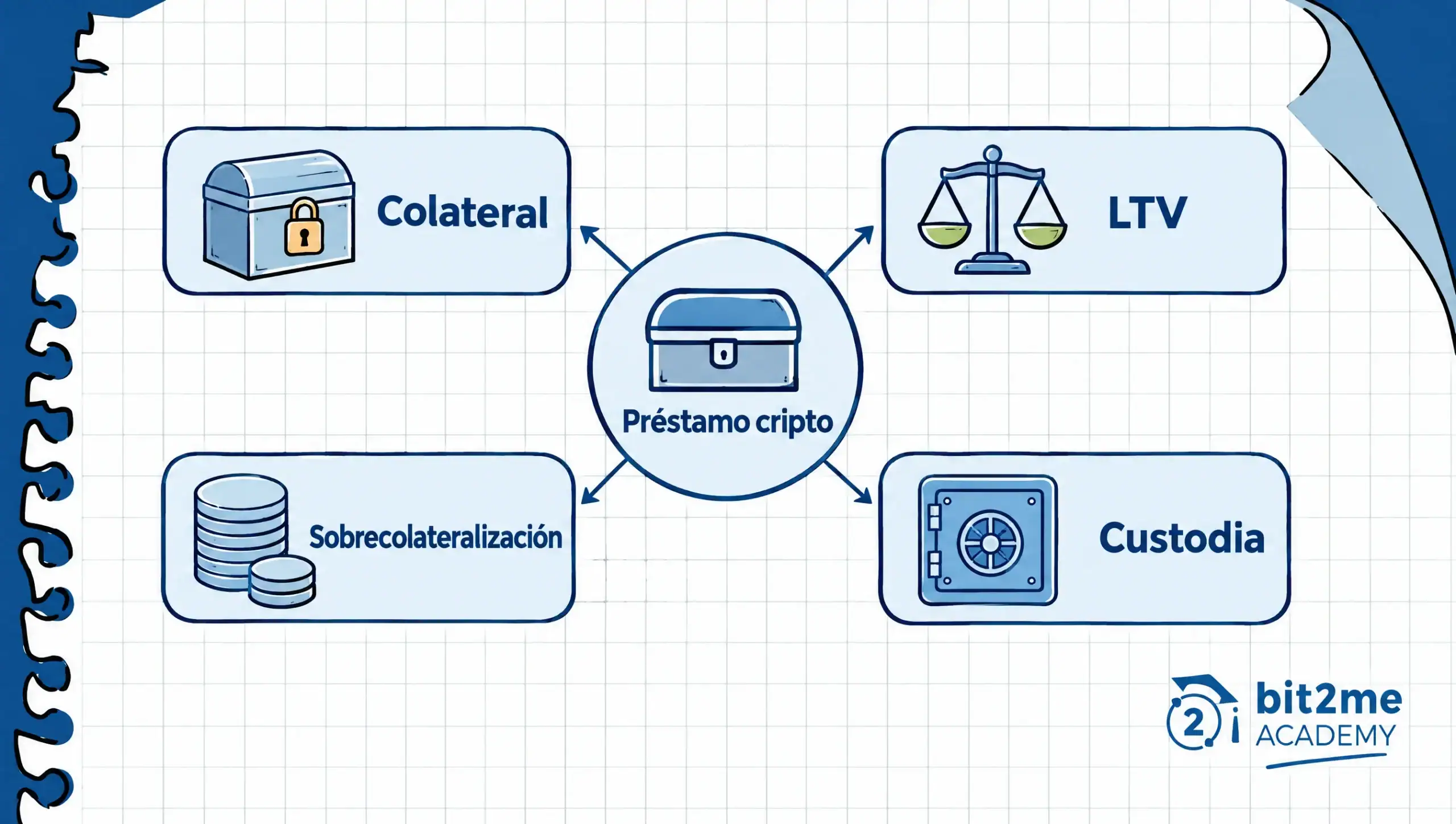
A crypto loan is a financial product where you provide crypto assets as collateral and receive liquidity in euros or stablecoins in return, without needing to sell your wallet. The collateral is held on the platform for the duration of the transaction, not transferred, and is released when you repay the principal and agreed-upon interest. It works similarly to a traditional secured loan, except that the value of the collateral can fluctuate much more rapidly than that of a conventional asset. The complete guide to loan with cryptocurrencies as collateral de Bit2Me Academy Develop this concept from scratch.
Colateral
Collateral is the cryptocurrency you provide to the platform to back your crypto loan, and its market value determines how much capital you can receive. Not all cryptocurrencies are accepted equally: regulated platforms typically limit collateral to highly liquid assets, such as Bitcoin or Ethereum, precisely because illiquid assets make them difficult to sell in the event of liquidation. You can review in detail which cryptocurrencies you can use as collateral before choosing which one to contribute to your transaction.
LTV (Loan-to-Value)
LTV is the percentage calculated by dividing the outstanding debt by the current value of the collateral, and it's the key metric for determining whether your crypto loan is in safe or risky territory. An initial LTV of 50%, for example, means that for every €10.000 of collateral, you can receive up to €5.000 of equity. Unlike a mortgage, where the value of the collateral changes slowly, the LTV of a crypto loan is constantly recalculated because the price of the collateral can fluctuate in a matter of hours. The guide to Bit2Me Academy Regarding LTV in crypto lending, it explains in detail how to manage it without surprises.
Overcollateralization
Overcollateralization is the practice of providing collateral with a value greater than the capital you receive, essentially choosing a loan-to-value (LTV) below the maximum allowed. This is why crypto loans are approved almost instantly and without a credit check: the collateral more than covers the debt from day one. The higher the overcollateralization margin, the more the price drop the collateral can absorb before approaching a margin call or liquidation.
Custody of collateral
Collateral custody describes who holds your crypto assets and how they are held for the duration of the loan: whether they remain segregated from the platform's balance sheet, what security certifications are applied, and what happens to them in the event of an operational issue with the provider. It's a term directly related to counterparty risk, because delegate custody It implies trusting in the solvency of the person managing it.
Unit of account
The unit of account is the currency or asset in which the capital you receive and the debt you must repay are expressed, almost always euros or a stablecoin pegged to the dollar or euro. Unlike collateral, its value remains stable throughout the life of the loan, simplifying the calculation of interest and principal. This combination—volatile collateral, stable unit of account—is what creates the need to constantly monitor the LTV (Loan Value).
The loan life cycle: interest, term and repayment
Once the crypto loan is formalized, a second set of terms comes into play that describes how its cost is calculated and how the capital received is repaid.
Annual Percentage Rate (APR)
The interest rate is the cost you pay for the capital received, usually expressed as APR (annual equivalent rateThe annual percentage rate (APR) is calculated on the principal amount borrowed, not the value of the collateral. It varies depending on the loan-to-value (LTV) ratio, the type of collateral provided, and the loan term: a more conservative LTV typically comes with a more favorable interest rate. The guide to crypto loan interest rates breaks down the complete formula and the factors that influence its value.
loan term
The term is the period of time during which the crypto loan remains active before its maturity, typically structured in renewable periods of several months or a year. Unlike a bank loan with fixed monthly installments, many crypto loans allow you to prepay at any time within the term, calculating interest only on the actual days the capital has been in your possession. Choosing a realistic term, tailored to your actual repayment capacity, reduces the risk of facing maturity and the market working against you at the same time.
Amortization
Paying off a crypto loan means repaying the principal, either all at once or in installments, to reduce the outstanding debt and, consequently, the loan-to-value (LTV) of the transaction. Paying off early typically reduces the total interest paid, because the cost is calculated based on the actual number of days the principal remains in your possession. The guide to Bit2Me Academy Regarding how to repay a crypto loan, review the different options and terms available depending on the product.
Grace period
The grace period is the time frame some platforms grant between when the loan-to-value (LTV) crosses the warning threshold and when action is taken on the loan, such as a margin call or the start of the liquidation process. Not all platforms offer the same grace period, and its duration can be drastically reduced if the market falls rapidly. It's advisable to review the specific terms and conditions of each product before assuming how much time you would actually have to react.
Refinancing
Refinancing a crypto loan means renegotiating its terms before maturity, whether by extending the term, adjusting the LTV by providing more collateral, or taking out a new loan to replace the old one. It's a useful tool when you're approaching maturity without immediate repayment capacity, but it doesn't replace actively managing the LTV throughout the loan's life.
When the market moves: margin call and liquidation
This is the set of terms that come into play when the collateral price falls and the LTV starts to rise. These are, by far, the concepts you should most understand before providing any collateral for a crypto loan.
Margin call (risk warning)
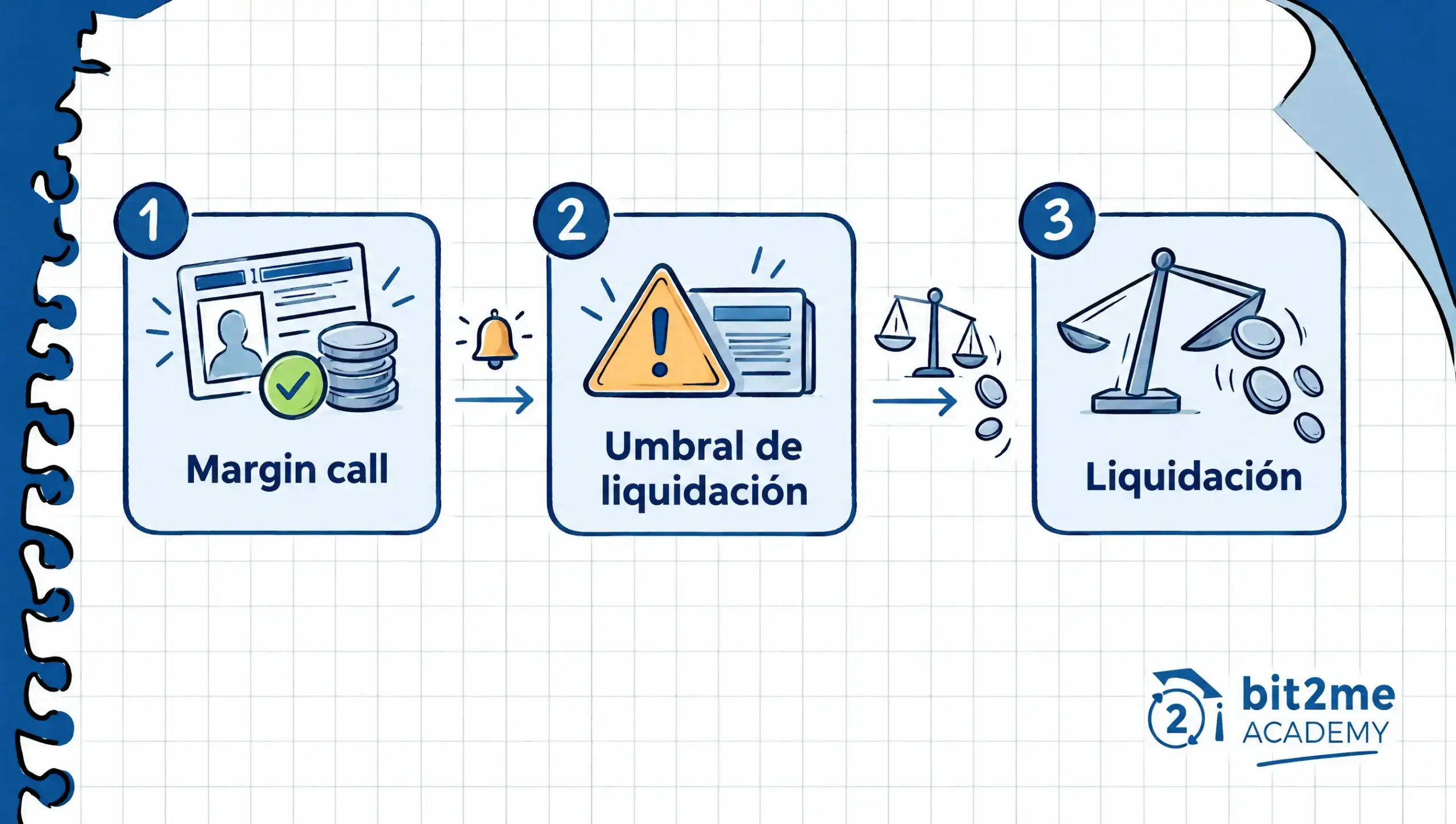
A margin call, also called a risk warning, is a notification the platform sends you when the LTV of your crypto loan approaches a critical threshold, indicating that you should take action before the market moves further against you. The responsibility to react—by providing additional collateral or paying down part of the debt—lies with you, not the platform. Very little time can pass between a margin call and liquidation if the collateral price falls rapidly, so it's best to treat it as an alert requiring immediate action, not just a simple informational notice.
Liquidation threshold
The liquidation threshold is the predefined LTV level in the crypto loan terms at which the platform automatically sells the collateral. This is different from the warning threshold: one marks the alert point, the other marks the point of no return. The more conservative the initial LTV chosen when taking out the loan, the greater the margin between your current position and that liquidation threshold.
Settlement
Liquidation is the automatic sale of some or all of the collateral backing a crypto loan, executed by the platform when the LTV crosses the liquidation threshold, with the aim of covering the outstanding debt. It's not a discretionary penalty: it's a mechanical consequence that is triggered regardless of whether you are available to react or not. If you want to understand the mechanism step by step and what to do to reduce its likelihood, the guide on crypto loan liquidation: how to avoid it explains this term in all the detail it deserves.
Partial liquidation and total liquidation
A partial liquidation sells only the collateral needed to bring the LTV back to a safe level, leaving the remaining collateral to cover the outstanding debt. A full liquidation occurs when the price drop is so steep that the platform sells all available collateral to cover the debt, leaving no remaining funds to return to you. The type of liquidation that takes place depends on the severity of the price drop and the specific terms and conditions of each platform, so it's advisable to review them before signing up.
Liquidation ratio
The liquidation ratio is the exact LTV, expressed as a percentage, that separates an active crypto loan from a liquidated one, and it's usually above the warning threshold but below 100% of the collateral value. Each platform sets its own liquidation ratio according to its risk policy, and that number—not the interest rate—is probably the most important piece of information you should know before signing. Comparing the liquidation ratio between different platforms is as important as comparing the cost, because it determines how much real protection you have in the event of a market downturn.
Risk, regulation and taxation
No glossary of crypto lending would be complete without the terms that describe the legal framework under which this product operates in the European Union, and its tax implications in Spain.
Counterparty risk
Counterparty risk is the exposure you assume when you entrust your collateral to a specific platform for the life of the loan: its solvency, security practices, and ability to return the collateral at the end of the transaction. Unlike a traditional bank account, crypto assets held on a platform do not have deposit guarantee mechanisms equivalent to those of the regulated banking system. The straightforward guide to crypto lending risks covers this risk along with the other five you should understand before providing any collateral.
CASP (crypto-asset service provider)
CASP stands for Crypto-Asset Service Provider, the regulatory designation for entities authorized to provide services related to crypto assets in the European Union, including crypto-backed loans. BITCOINFORME, PSC, SL, which operates under the trade name of Bit2Me[Company Name] is a crypto asset service provider authorized and regulated by the Spanish National Securities Market Commission (CNMV), in accordance with Article 59 of the MiCA Regulation. Operating under an authorized CASP does not eliminate the market risk of a crypto loan, but it does require transparency regarding its terms, thresholds, and tax treatment.
Mica
MiCA (Markets in Crypto-AssetsThis is the European regulation, in force since 2024, that governs the provision of crypto-asset services throughout the European Union, including crypto-asset-backed loans. It establishes who can operate as a Crypto-Asset Service Provider (CASP), what information must be disclosed to users, and what oversight is applied by each national regulator; in Spain, this is the CNMV.
Taxable event
The taxable event is the event that, according to the Spanish tax regulationsThis creates an obligation to declare a capital gain or loss. In the case of crypto loans, the relevant administrative criteria come from the Directorate General of Taxes (DGT):
The opening of a loan does not in itself constitute a taxable event in Spain under the current interpretation of the DGT (Directorate General of Taxes); however, the liquidation of collateral does generate a taxable event. Loans and cryptocurrency-backed loans carry specific risks, including liquidity risk, counterparty risk, collateral risk, and the specific terms and conditions of each product, which users should carefully review before accessing them.
This interpretation by the Spanish Tax Agency (DGT) is the one in force at the time of publication of this glossary and may evolve over time, so it is advisable to confirm it with a tax advisor before making any decisions based on it. If your transaction is through a business, the guide on crypto loans for companies develops this same criterion with the added nuance of Personal Income Tax (IRPF) and Corporate Income Tax, and the guide to the taxation of crypto loans in Spain delves into the complete treatment for individuals.
Investing in cryptocurrencies is not fully regulated, may not be suitable for retail investors due to its high volatility, and carries the risk of losing all invested funds. It is important to read and understand the risks of this investment, which are explained in detail at: https://up.bit2me.com/legalbit2me
Related terms that should be distinguished
These last two terms do not describe the internal mechanism of the crypto loan, but how it relates to other products and user profiles, and that is why it is advisable to close them separately.
Cryptocurrency lending
Cryptocurrency lending is the umbrella term that encompasses both loans you receive using your collateral (borrowing) and products where other users lend liquidity in exchange for a reward. In common industry usage, "crypto loan" almost always refers to the former: you borrow capital by providing collateral. The guide on what cryptocurrency lending is clarifies this distinction in more detail and explains how both sides of the same market fit together.
Crypto business loans
Crypto business loans use the same collateral, LTV, and liquidation mechanisms as those applied to a self-employed individual or SME that needs unsold liquidity the portion of their treasury held in crypto assets. The variables change scale—higher amounts, additional business documentation, tax treatment under Corporate Income Tax—but the terms in this glossary are exactly the same that a business should know before signing. The guide on crypto loans for freelancers and SMEs elaborates on this specific use case with its own nuances.
With these 22 terms, you should be able to read any crypto loan's terms and conditions without having to guess what each word means, which is precisely the function of a glossary: not to replace a detailed reading of a product, but to give you the vocabulary to do so with your own judgment. If your question is more practical than terminological, the guides on what a crypto loan is for and on crypto loan or sellWhat's appropriate for your situation is the next logical step within this cluster. And if you already know the vocabulary, you can View Bit2Me Loan directly on the platform before contributing your collateral.
Frequently Asked Questions about the Crypto Lending Glossary
This refers to the automatic sale of some or all of the collateral backing the loan, executed by the platform when the loan-to-value (LTV) crosses the liquidation threshold defined in the product terms. It is not based on a discretionary, case-by-case decision, but rather on a predefined mechanism.
What is the difference between collateral and a guarantee?
In the context of a crypto loan, both terms are used interchangeably to refer to the crypto assets you contribute to secure the transaction. "Collateral" is the more common term in industry jargon; "guarantee" is its equivalent in traditional financial language.
What is LTV and why does it appear in almost every term in the glossary?
The LTV (Loan-to-Value) is the percentage between the outstanding debt and the present value of the collateral, and it's the variable that connects virtually all other concepts: the margin call, the liquidation threshold, and the liquidation ratio are all defined in terms of it. Understanding LTV is, in practice, understanding half the vocabulary in this glossary.
Are a margin call and a liquidation the same thing?
No. A margin call is the advance warning you receive when the LTV approaches a risk zone, while liquidation is the actual execution of the sale of collateral once the critical threshold has been crossed. Very little time can pass between the two if the price falls rapidly.
Do I need to know all these terms before applying for a crypto loan?
The six essential terms are collateral, LTV, interest rate, margin call, settlement, and amortization, because they describe the complete transaction cycle. The rest of the glossary expands on useful nuances, but you can start with these six if your priority is understanding the basics before reading the terms and conditions of a specific product.
Is a crypto loan the same as cryptocurrency lending?
Not exactly: "cryptocurrency lending" is the umbrella term that includes both borrowing against collateral and lending liquidity in exchange for a reward. When we talk about "crypto lending," we almost always mean the former, which is the subject of this glossary.
Which risk described by the terms in this glossary should concern me the most?
Liquidation risk is the one most directly linked to the loss of collateral, because it involves a forced sale beyond your control. Counterparty risk is the second most relevant, because it depends on the solvency and security practices of the chosen platform.
Does opening a crypto loan create a taxable event in Spain?
According to the current interpretation of the Spanish Tax Agency (DGT), the opening of a loan does not in itself constitute a taxable event, but the liquidation of the collateral does. This information does not replace personalized tax advice.
How does overcollateralization differ from a low LTV?
They are the same idea viewed from two angles: overcollateralization describes providing more collateral than strictly necessary, and a low LTV is the specific figure that results from that decision. The higher the overcollateralization, the lower the initial LTV of the transaction.
Where can I apply these terms to the actual conditions of a crypto loan?
You can check the LTV, settlement ratio, interest rate, and term directly on the platform where you're applying for the loan. Most regulated providers display this information in real time before you finalize any transaction.


«Investment in cryptoassets is not fully regulated, may not be suitable for retail investors due to high volatility and there is a risk of losing all invested amounts»
Share this article!Continue learning

Resumen del año cripto 2026: hitos, regulación y qué mirar en 2027
Repasamos los hitos regulatorios del año cripto 2026, el marco MiCA para exchanges y las líneas estructurales clave que marcarán las criptomonedas 2027.
Cómo proteger tus criptomonedas: guía de seguridad personal
Guía práctica para proteger tus criptomonedas: frase semilla, 2FA, phishing, wifi público y wallets hardware. Refuerza tu seguridad hoy mismo.
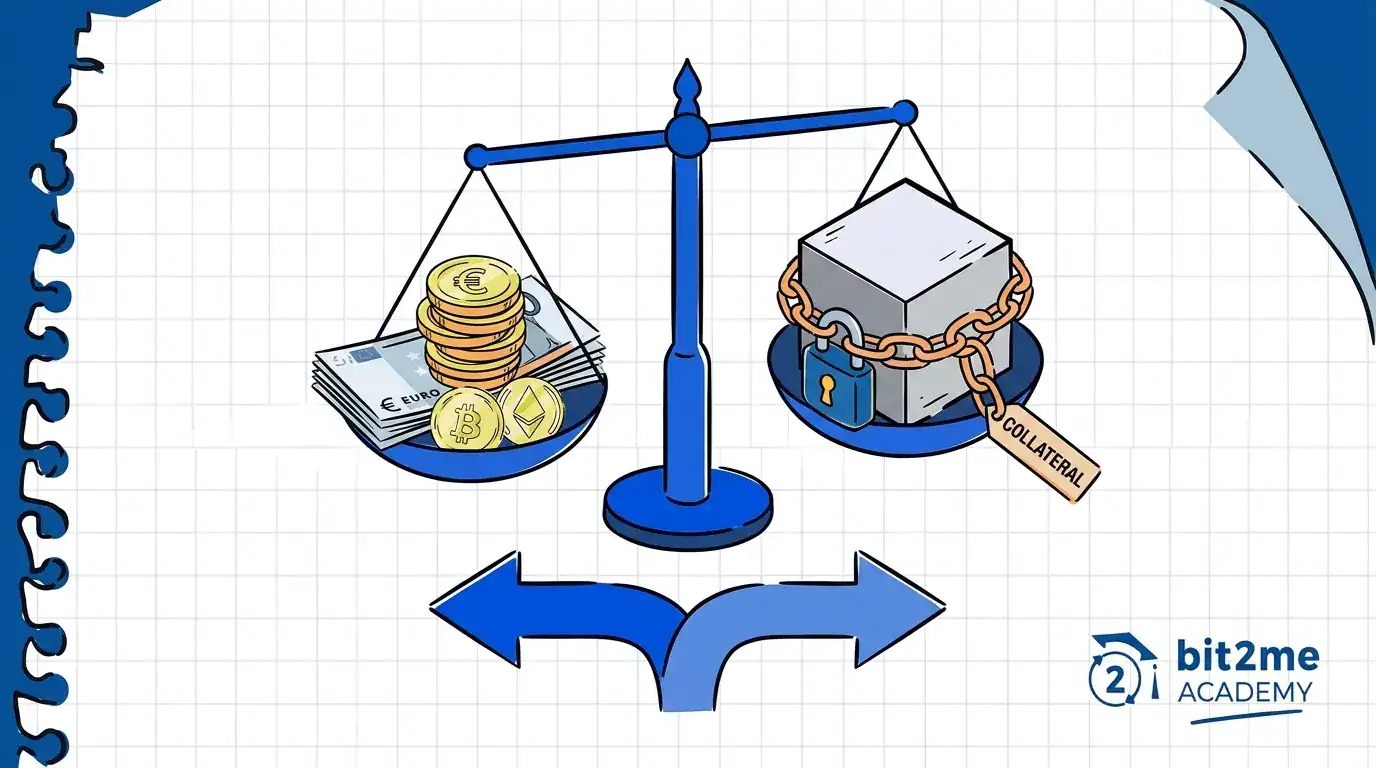
Crypto loan or sell: what's best depending on your situation
Crypto loan or sell your crypto assets: compare tax implications, exposure and liquidation risk with objective criteria and a quotable table.

Basic dictionary for your personal finances
Complete glossary of personal finance and investment terms: ETF, fund, stock, TER, FOGAIN, DCA and more, with clear definitions for beginners.