Qué es el KYC y por qué lo pide un exchange regulado
- KYC is the process by which a regulated exchange confirms your identity before allowing you to buy or sell crypto assets.
- It works in levels: the more complete your verification, the more features you unlock within the platform.
- It exists because anti-money laundering regulations require any authorized supplier to know who their customer is.
- The surprise for many newbies: an exchange NOT asking for KYC is not a convenience, it's the clearest warning sign of all.
If you've just registered with an exchange and it's asking for a photo of your ID, a selfie, and perhaps proof of address, it's not a whim or a pointless bureaucratic formality. It's the moment the platform applies its KYC process, a mandatory step for any cryptocurrency service provider operating in a regulated manner within the European Union. And while at first glance it might seem like an annoying hassle just when you're about to start trading, understanding what's behind it completely changes your perspective.
In this article, you'll understand what KYC is and where the term comes from, why a regulated exchange is required to request it, what documentation they typically ask for, and the difference between basic and advanced verification levels. We'll also see why the absence of this process on a platform should be far more concerning than reassuring—something many novice users interpret in the exact opposite way.
Important noticeThis article is for educational and informational purposes only. The content does not constitute financial, legal, or tax advice. Cryptocurrencies are high-risk assets and their value can fluctuate significantly. Consult a qualified professional before making any acquisition or participation decisions.
Main Cryptocurrencies Course
Basic levelBit2Me Academy We bring you a new course where you will learn everything you need to know about the most important cryptocurrencies that exist today.
Empezar ahora ›What is KYC (Know Your Customer) and where does the term come from?
KYC, or Know Your Customer, is the process by which a regulated exchange confirms your identity before allowing you to trade normally on the platform. The acronym comes from the traditional banking sector, where banks have been required for decades to identify their customers before opening an account, and the cryptocurrency ecosystem has inherited this same identification logic.
Think of it as the digital equivalent of showing your ID when opening a traditional bank account. No one lets you manage money anonymously in a regulated environment, and cryptocurrencies are no exception, despite the sector's initial association with anonymity. exchange If it complies with the regulations, it will ask you to confirm your real identity, with your name, your document and, in many cases, a real-time photo of you that is automatically compared to the one on your document.
This process isn't meant to make your life difficult or slow down your first purchase on a whim. It's about ensuring the platform knows, at all times, who is behind each account operating within its system—something essential for detecting suspicious activity and cooperating with authorities when required by law. The sooner you understand this logic, the easier it will be to see KYC as a natural part of registering on a platform. platform wouldnot as an obstacle placed there to bother you.
Why a regulated exchange is required to ask you for KYC
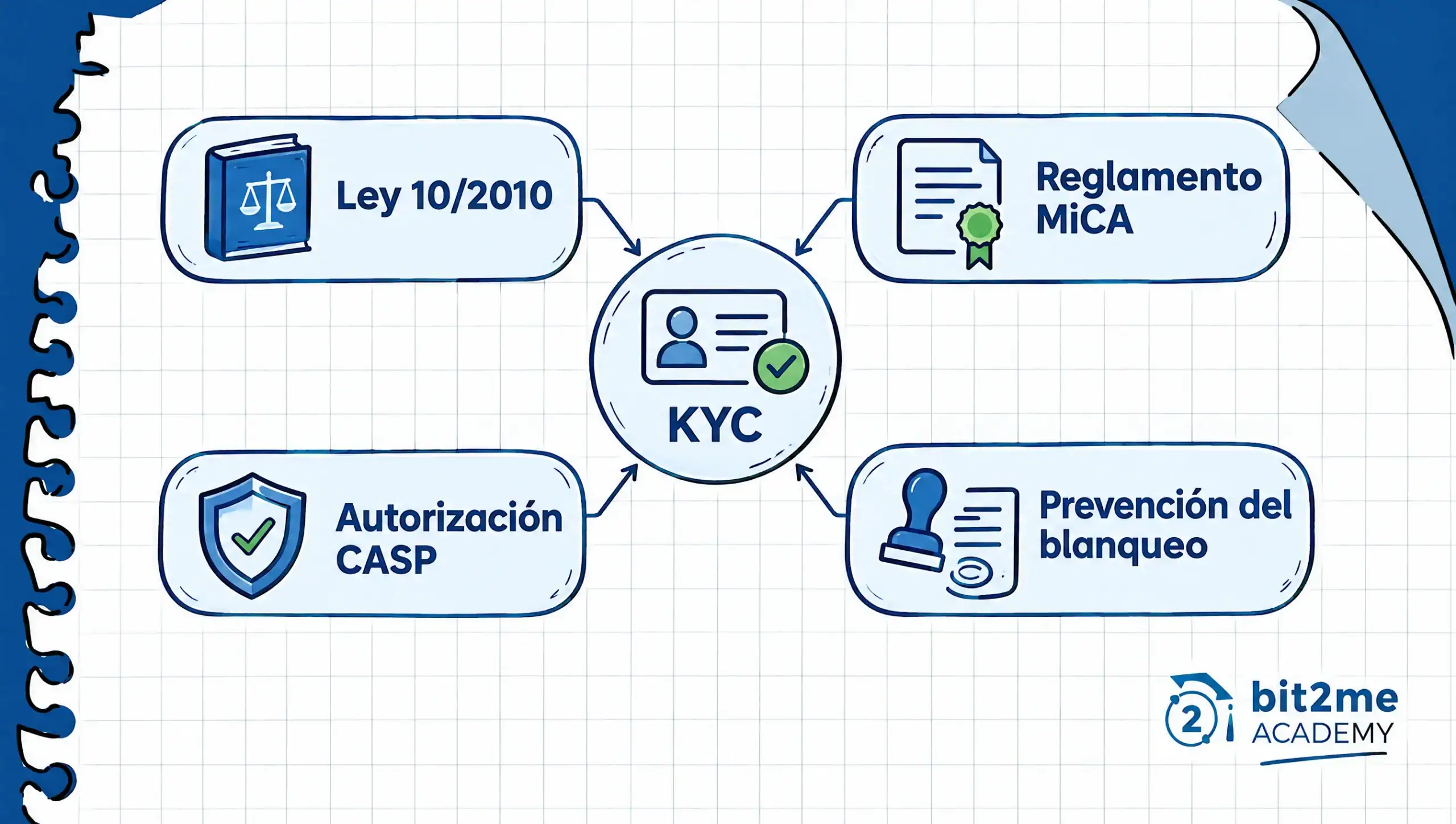
The reason they ask for KYC is not an arbitrary business decision by each platform, but a legal obligation arising from the anti-money laundering regulations of capital and the financing of terrorism. In Spain, this obligation is specified through Law 10/2010, which requires so-called "obligated entities" to properly identify their clients before establishing a business relationship with them. Exchanges and other cryptocurrency service providers fall squarely into this category.
This base is added to the MiCA Regulation (Markets in Crypto-Assets)The MiCA, in force throughout the European Union, requires any entity wishing to operate as a CASP (Crypto-Asset Service Provider) or PSC (Crypto-Asset Service Provider) to have robust internal governance and risk management systems, which explicitly include anti-money laundering measures. An exchange without a valid CASP authorization under MiCA cannot legally operate in the European Union, and a CASP authorization is not granted without robust customer verification policies. KYC is, quite literally, one of the pillars upon which this authorization rests.
If you want to delve deeper into exactly what that authorization entails and how you can verify for yourself whether a platform truly has it, in Bit2Me Academy You have a complete guide on exchanges regulated under MiCAwhere we explain the authorization process step by step. That article and this one complement each other: one explains how to verify the platform's license, and this one explains why the platform requires you to verify yourself.
In other words, KYC isn't a marketing gimmick or an artificial barrier. It's the direct consequence of the platform you entrust with your funds. is supervised by a regulatorHave auditable corporate governance policies and be accountable to an authority if something goes wrong. When you understand this, the question changes from "why are they asking so much of me?" to "what would I be willing to accept if they weren't asking it of me?"
What documentation does a regulated exchange usually require?
The exact documentation required may vary slightly depending on the platform and your country of residence, but most identity verification processes in the industry follow a fairly similar pattern. Knowing this beforehand helps you have everything ready and complete your registration without unnecessary back and forth.
- A valid official identity document, such as a national identity card, passport or driver's license, depending on what each platform accepts.
- A proof of life or biometric verification, usually a selfie or short video that is automatically compared to the photo on the document.
- A recent proof of address, such as a utility bill or bank statement, is especially useful when you want to access higher levels of verification.
- In certain cases, information about the origin of the funds you are going to trade, especially if you are going to move larger amounts than usual.
This last category often raises more questions among novice users because it seems more intrusive than the previous ones. In reality, it follows the same logic: if an exchange cannot explain the origin of a particular client's funds, it cannot fulfill its obligation to prevent money laundering. It's not about distrusting you personally, but about applying the same standard to all users equally, without exceptions based on how trustworthy someone appears at first glance.
Verification levels: Basic KYC vs. Advanced KYC
Most regulated exchanges don't apply a single verification level to all their users, but rather a tiered structure that unlocks functionality as you provide more information. This tiered approach makes sense: the more activity you anticipate on the platform, the more assurance the provider needs about your identity and the origin of your funds.
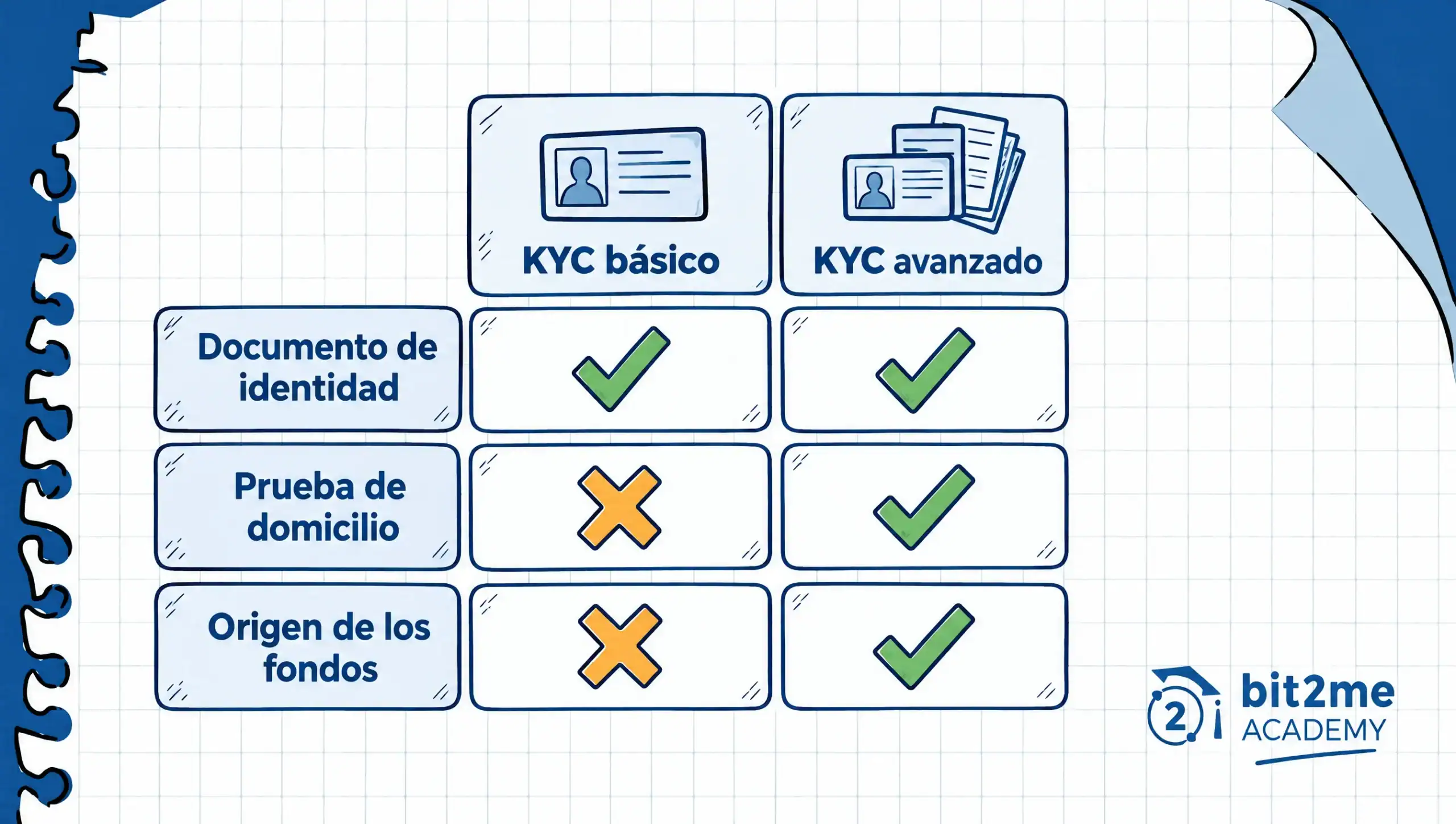
A basic verification level is usually resolved with your ID and biometric verification, and typically allows you to start buying and selling cryptocurrencies with relatively modest daily or monthly transaction limits. This level is designed for beginners who want to try the platform without having to provide all their documentation at once. An advanced level, on the other hand, usually adds proof of address and, in some cases, additional information about the source of funds, in exchange for significantly higher transaction limits and access to additional platform features.
This tiered structure is not exclusive to a particular exchangeRather, it's a common approach across the industry, although the specific limits of each level vary from platform to platform and may change over time depending on the provider's risk policy. The important thing for you as a novice user is to understand the underlying logic: it's not that the platform "distrusts" you more at the basic level, but rather that it adjusts the due diligence level to the actual operations you indicate you will undertake.
Current status: KYC under the MiCA framework in the European Union
Since the authorization regime for crypto asset service providers provided for in MiCA Fully applicable throughout the European Union, the requirement for robust identity verification processes is no longer subject to the individual discretion of each exchange but is now a continuously monitored requirement. The transitional periods that allowed some entities to operate under the previous anti-money laundering regime without full CASP authorization have ended in Spain and the other Member States as of the publication date of this article (December 2026).
This means that, in practice, any platform that currently requires you to complete a rigorous KYC process is doing so within a supervised framework, not on its own initiative and subject to revocation. This section will be updated if there are relevant changes to the verification criteria required at the European level, as the regulatory framework for crypto assets continues to evolve.
Why the absence of KYC on an exchange is a red flag, not an advantage
It's common, especially at the beginning, for a novice user to welcome a platform that allows them to start trading with minimal documentation. It gives the impression of speed, convenience, and even greater privacy. The reality is quite the opposite: a platform that doesn't implement KYC (Know Your Customer) procedures seriously almost certainly lacks a valid CASP (Computer-Aided Service Provider) authorization under MiCA (Microsoft Central America), and this shifts all the regulatory risk directly onto you as the user.
Without a robust exchange identity verification process, there is no external guarantee that your funds are segregated There is no guarantee of the company's own assets being protected, nor is there a formal complaint procedure with a regulator if something goes wrong. Furthermore, platforms operating in this gray area are often forced, sooner or later, to abruptly cease operations in the European Union, leaving their users with tight deadlines to recover or migrate their assets. This pattern has been repeated throughout the sector and almost always begins the same way: a platform that promised "no paperwork" and ended up generating precisely the urgent paperwork that no one wants to deal with under pressure.
This isn't about automatically assuming bad faith on every platform with lax verification processes, but rather about understanding a simple rule: the less an exchange asks of you to allow you to trade, the less accountable it is if things go wrong. A rigorous KYC process isn't an inconvenience you tolerate for nothing; it's the visible consequence of having a regulator ensuring the platform fulfills its obligations to you.
How to complete your identity verification step by step
If you're already at the registration stage and want to get your account ready without going back and forth, it's best to follow a clear order so that the process moves forward without unnecessary interruptions.
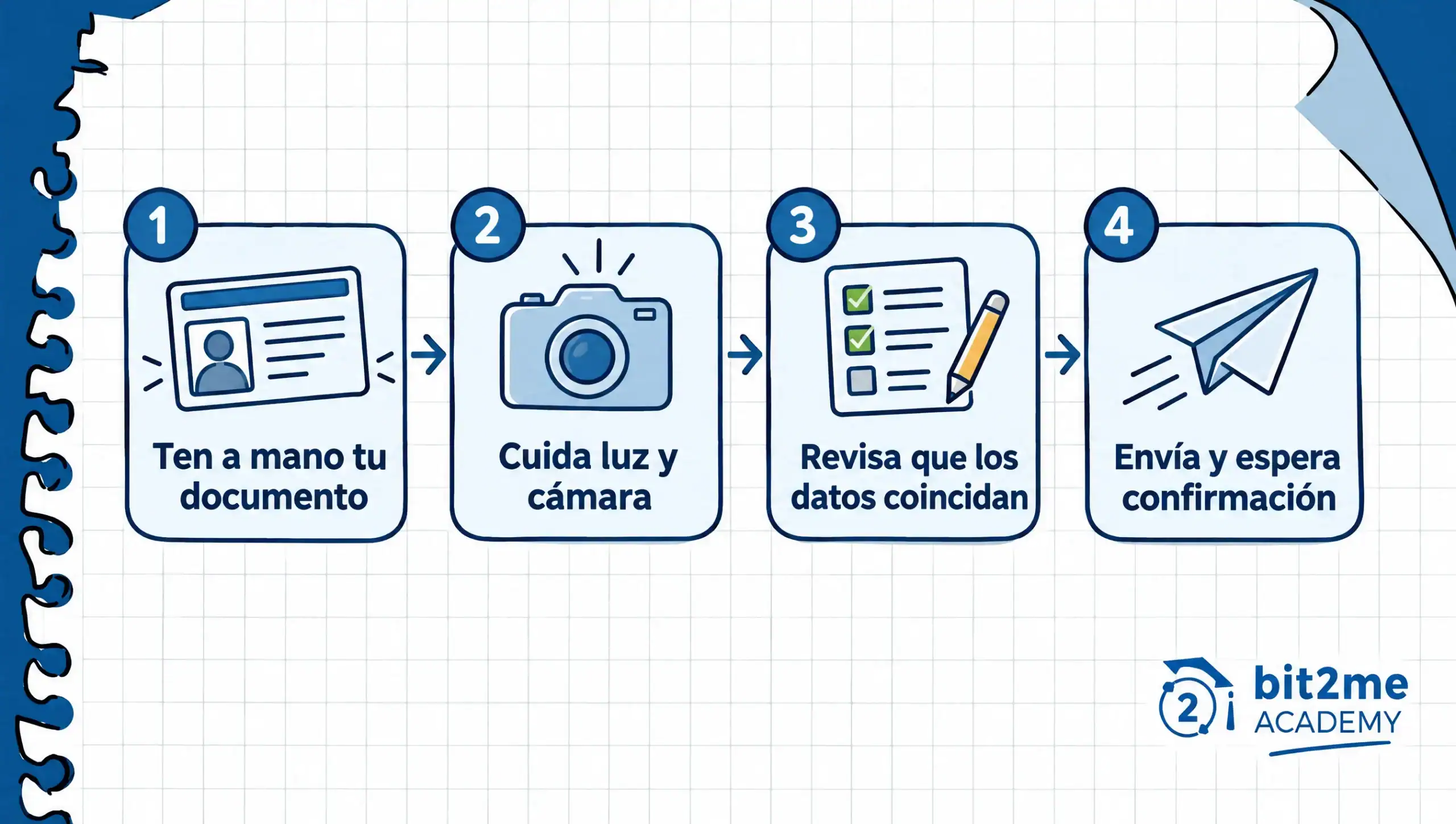
- Have your valid ID document ready before starting the registration, to avoid having to pause the process halfway through.
- Make sure you have good lighting and a stable camera for biometric verification, as a blurry photo is usually the most common cause of rejections that force you to repeat the step.
- If your verification level requires it, also prepare recent proof of address, ideally from the last three months.
- Please check that the information you enter matches exactly the information in your document, including accents and surnames, as discrepancies are usually the most frequent cause of delays.
- Submit the request and wait for confirmation; most basic verification processes are resolved in minutes, although some specific cases may require a slightly longer manual review.
Following this order doesn't eliminate the platform's verification process, but it significantly reduces the likelihood of having to repeat any steps. If you haven't already, completing the verification now, calmly and with the correct documentation at hand, will allow you to operate smoothly as soon as you decide to. make your first purchase.
Legal notice regarding the risk of crypto assets
Investing in cryptocurrencies is not fully regulated, may not be suitable for retail investors due to its high volatility, and carries the risk of losing all invested funds. It is important to read and understand the risks of this investment, which are explained in detail at: https://up.bit2me.com/legalbit2me
Completing your KYC does not eliminate the risk associated with cryptocurrencies, nor does it constitute any kind of recommendation on what to buy or when to buy it. It is simply the administrative step that enables you to operate within a supervised environment, with the guarantees that such supervision entails.
Understanding what KYC is and why every regulated exchange requires it completely changes your experience of that first registration. It ceases to be a tedious form between you and your first purchase and becomes proof that the platform you've chosen is accountable to a regulator, not just its own marketing. The next time an app asks for your ID and a selfie before letting you trade, you'll know exactly why it's asking for it and what it's protecting you from.
Frequently Asked Questions about KYC
What exactly is KYC?
KYC (Know Your Customer) is the process by which a regulated exchange verifies your identity before allowing you to trade on the platform. It typically includes an identity document and biometric verification, and in some cases, proof of address. It's the digital equivalent of verifying your identity when opening a bank account at a traditional financial institution.
Why do I have to do KYC if I only want to buy a small amount?
The requirement to verify your identity doesn't depend on the amount you want to trade, but rather on anti-money laundering regulations that apply to any authorized cryptocurrency service provider. It doesn't matter if your first purchase is small: the exchange must know who you are before opening your account.
What documents do I need to complete my identity verification on an exchange?
You'll typically need a valid government-issued ID and real-time biometric verification, such as a selfie or short video. For higher verification levels, you'll often also be asked for recent proof of address and, in some cases, information about the source of your funds.
How long does the KYC process usually take?
Basic verification is usually completed in minutes if the documents are clear and the information exactly matches your identity. Cases requiring manual review, such as discrepancies in the information or additional documentation, may take longer.
Is it safe to share my identity document with a regulated exchange?
An exchange authorized under MiCA is subject to strict data protection and cybersecurity obligations when handling this information. Even so, it's always advisable to verify that the platform is genuinely authorized before sharing your documents, which you can do by checking the relevant regulator's public registry.
What happens if an exchange doesn't ask me for KYC?
You should interpret this as a warning sign, not an advantage. A platform that doesn't implement a robust exchange identity verification process likely lacks valid CASP authorization under MiCA, shifting all regulatory risk to you as the user.
What is the difference between basic KYC and advanced KYC?
Basic KYC is usually completed with your ID and biometric verification, and grants access to lower trading limits. Advanced KYC typically adds proof of address and, in some cases, information about the source of funds, in exchange for higher trading limits.
Is the KYC process the same on all exchanges?
The underlying logic is the same across all regulated platforms, but the exact documents, levels, and specific limits may vary from one exchange to another. What remains constant is the regulatory obligation: to verify the true identity of each client before enabling their account.
Is KYC in cryptocurrencies different from that of a traditional bank?
The purpose is the same in both cases: to comply with anti-money laundering regulations by properly identifying the customer. The difference lies in the channel, since KYC for cryptocurrencies is usually completed entirely digitally, with automated biometric verification instead of an in-person visit to an office.
What is the current status of KYC under the MiCA regulations?
Since the MiCA authorization regime became fully applicable across the European Union, robust identity verification processes have ceased to be a voluntary practice and have become a requirement continuously monitored by the relevant regulator. The transitional periods that allowed businesses to operate without this requirement have now ended in all Member States as of the date of publication of this article.


«Investment in cryptoassets is not fully regulated, may not be suitable for retail investors due to high volatility and there is a risk of losing all invested amounts»
Share this article!Continue learning
Exchange vs wallet: diferencias y cuándo usar cada uno
Descubre la diferencia entre exchange y wallet, cuándo conviene usar cada uno y cómo combinarlos para comprar y guardar tus criptoactivos con seguridad.

Qué es el slashing y cómo te protege un CASP regulado
Qué es el slashing en staking, por qué penaliza a los validadores y cómo un CASP regulado bajo MiCA reduce el riesgo de errores operativos que lo provocan.
Staking institucional y nodos: infraestructura para empresas
Staking institucional para empresas: infraestructura HSM/MPC, riesgo de slashing y autorización CASP bajo MiCA para decidir externalizar o gestionar nodos.
ETF vs. investment fund: key differences and which one to choose depending on your situation
ETF vs investment fund: key differences and which one to choose depending on your situation and how to get the most out of both.