Cómo elegir proveedor cripto B2B: checklist para tu RFP
Essential Points
- Choosing a crypto provider for businesses no longer depends solely on price: licensing, custody, and SLAs are just as important as the final commission.
- A well-designed RFP (Request for Proposal) turns business promises into verifiable criteria with supporting documentation.
- It is useful for comparing suppliers objectively, without depending on the impression left by a demo or a sales call.
- The biggest risk is not choosing the wrong supplier, but not having any written criteria to compare the RFP responses against.
When a company decides to incorporate digital assets into its operations—whether for treasury, payments to suppliers, or services to its own customers—there comes a point when the decision ceases to be purely technical and becomes a formal purchasing process. This process typically takes the form of an RFP, the document with which a purchasing or technology department requests comparable proposals from several providers before signing a contract. The challenge lies in the fact that the market for cryptocurrency service providers is still young, heterogeneous in its level of regulation, and uses a commercial vocabulary that doesn't always facilitate direct comparison between candidates.
This article proposes a neutral evaluation framework: a set of objective criteria that any company can apply to any crypto vendor participating in its RFP, regardless of the sector, the size of the transaction, or the vendor ultimately selected. It does not compare brands or evaluate any competitor based on name. Instead, it explains what questions to ask, what documentation to require, and how to score responses so that the decision can be supported by a risk committee, an auditor, or the board of directors.
This article is part of the general guide to B2B solutions of Bit2Me AcademyThis document explains in detail the crypto services available to businesses. If your assessment specifically includes asset custody, it's advisable to supplement this checklist with the guide on institutional custody of crypto assets, which details the criteria for fund segregation and key governance in greater technical depth.
Risk Advisory (MiCA)Investing in cryptocurrencies is not fully regulated, may not be suitable for retail investors due to its high volatility, and carries the risk of losing all invested funds. It is important to read and understand the risks of this investment, which are explained in detail at: https://up.bit2me.com/legalbit2me
Main Cryptocurrencies Course
Basic levelBit2Me Academy We bring you a new course where you will learn everything you need to know about the most important cryptocurrencies that exist today.
Empezar ahora ›Why does a crypto vendor RFP need objective criteria?
A traditional fintech RFP has decades of experience: there are well-established templates, market benchmarks, and a stable regulatory vocabulary. The crypto-asset sector lacks this same foundation, creating a specific problem for the team drafting the RFP. If the questions are too broad (“How do you guarantee the security of the assets?”), each vendor will respond using language that best suits their needs, and the evaluation committee will end up comparing marketing rhetoric rather than verifiable facts.
The solution isn't to complicate the RFP, but to refine it. Each evaluation criterion should be translated into a question that only allows for one documented answer: an authorization number, an audit report, a specific contractual clause. This discipline is what separates a serious selection process from one that, in practice, is decided by the quality of the sales presentation of the last supplier who walked into the meeting room.
It is also advisable to establish the relative weight of each set of criteria beforehand, before receiving any proposals. If safety and regulatory licensing account for 40% of the total score and fees only 15%, this distribution should be included in the RFP document itself, not decided afterward based on which supplier has the best ranking. This is precisely the kind of rigor that prevents the final decision from being perceived as arbitrary when presented to finance management or the risk committee.
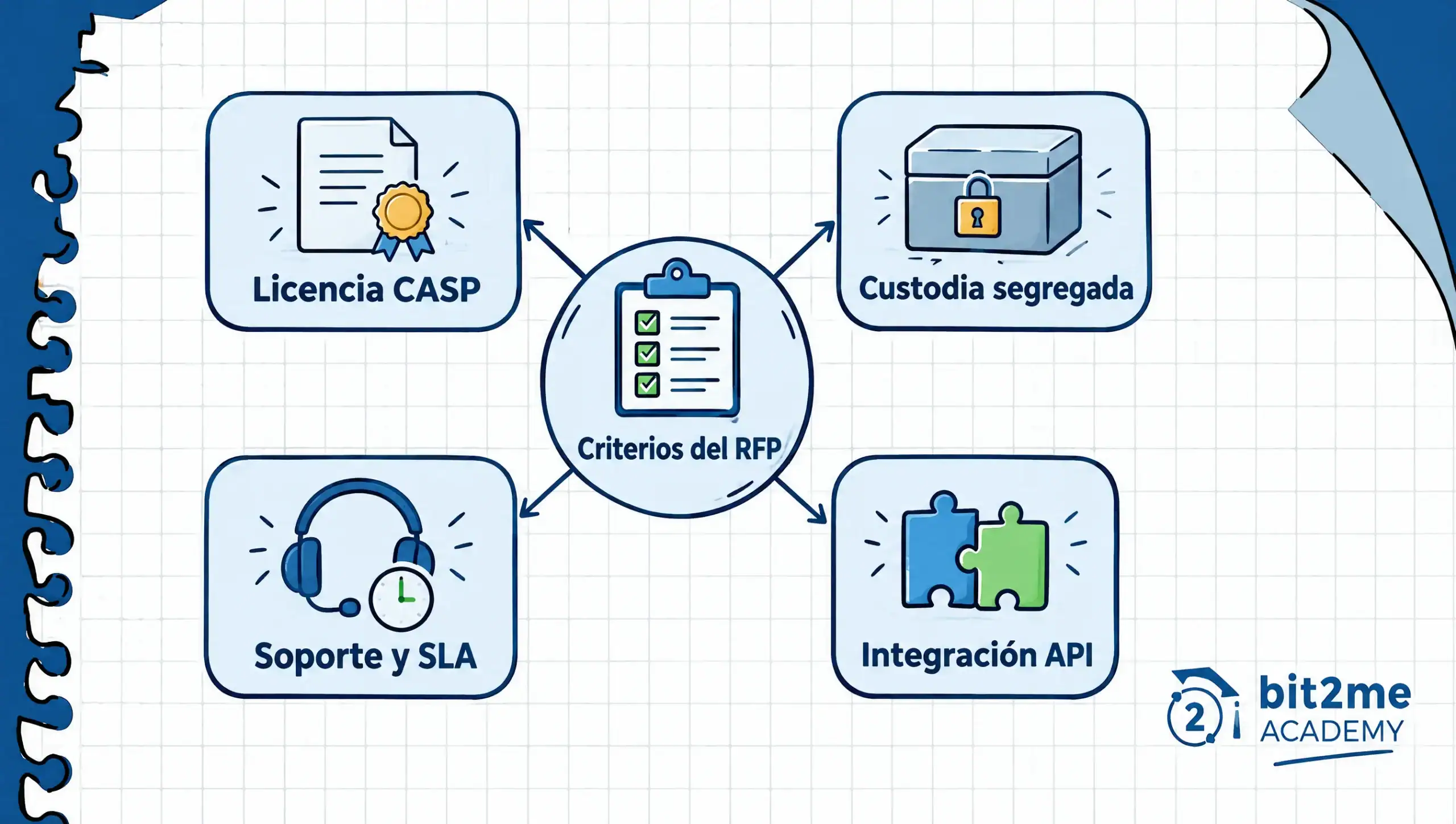
Regulatory licensing and authorization: the CASP filter under MiCA
The first filter in any RFP for selecting a crypto provider should be regulatory, not commercial. Within the European Union framework, the MiCA Regulation The Markets in Crypto-Assets Act establishes the CASP (Crypto-Asset Service Provider), an authorization that enables an entity to provide services such as custody, exchange, or order execution under the supervision of a competent authority. In Spain, that authority is the National Stock Market Commission (CNMV).
Simply asking “Are you regulated?” is insufficient, as the answer could refer to an informational registration, a partial authorization, or a license obtained in a jurisdiction with different oversight than the country where the company operates. The RFP should require the CASP authorization number, the issuing authority, the exact scope of services covered by that authorization, and whether the provider operates under a Community passport to provide services in the contracting company's country. A reputable provider should have no problem providing this documentation in a verifiable manner, including the public registry where it can be checked.
It is also advisable to inquire about the transitional regime, as MiCA includes an adaptation period during which some entities may operate under preliminary registrations while they complete their full authorization as a CASP (Computer-Assisted Service Provider). Knowing exactly what stage each RFP (Request for Proposal) candidate is at, and not just whether it is "in the process of being regulated," allows for anticipating service continuity risks if final authorization is delayed or not granted. This is also one of the few sections of this checklist that may become outdated over time as MiCA implementation progresses in each member country.
Security and custody: asset segregation and audits
Once the license is verified, the next set of objective criteria focuses on how the provider protects the company's funds. The most decisive criterion here is the segregation of assetsCorporate client funds must be kept separate from the provider's own balance sheet so that a financial problem at the provider does not affect the assets held in custody. The RFP should require an explicit description of this segregation, not a generic statement that "the funds are safe."
Along with segregation, it is reasonable to require evidence of external security audits and operational controls, such as SOC 2 reports, which certify that an independent third party has reviewed the supplier's internal processes. It is also advisable to inquire about the supplier's policy on cold storage versus hot custody: what percentage of assets are kept offline, how frequently are the movement thresholds between both modalities reviewed, and what multiple authorization mechanisms (multisignature or similar) are applied to the highest volume transactions.
A supplier unable to provide concrete documentation on these two points—verifiable segregation and a recent external audit—should be at a disadvantage compared to candidates who can, regardless of any other commercial advantages they offer. Safety is non-negotiable in a serious selection process, and this is precisely the type of criterion that a well-designed RFP frames as a closed question rather than leaving it to the subjective impression of the evaluation committee.
Support and SLA: what to require in writing
A service level agreement (SLA) is the document that translates support promises into legally binding commitments, and its absence in a crypto provider's proposal for businesses is itself a red flag. The RFP should request specific response times for each level of issue (critical, high, medium, low), support coverage hours, and whether there is a dedicated account manager or if contact is always handled through a generic customer service channel.
It's also advisable to ask about the platform's committed uptime, expressed as a percentage of the year, and about the contractual compensation stipulated if that percentage isn't met. A provider that offers a detailed SLA with clear penalties for non-compliance is assuming a real contractual obligation; one that only promises "priority support" without verifiable figures hasn't committed to anything enforceable in case of an incident.
For a company that integrates crypto services into critical processes —payments to suppliersWhether it's treasury operations or services for their own end customers, the SLA isn't just an administrative addendum; it's one of the documents that should carry the most weight in the final RFP score. Any unplanned disruption to these processes has a direct operational cost, and the SLA is the only contractual tool that allows for demanding a concrete response when that cost materializes.
Technical integrations: API, documentation, and implementation times
For most companies, the relationship with a B2B crypto partner goes beyond a simple web interface: it requires integrating their services into their own accounting systems, ERPs, or payment platforms via an API. The RFP should request access to the complete technical documentation before signing, not a generic description of a "robust and flexible API." Public, versioned documentation with verifiable code examples speaks volumes about the provider's technical maturity, far more than any marketing claim.
Other technical criteria worth including in the RFP are the availability of a sandbox environment to validate the integration before going into production, the API authentication model, request-per-minute limits (rate limits), and the change history in previous versions, which allows you to assess whether the vendor frequently introduces changes that break existing integrations. It's also advisable to ask about the average implementation time reported by other enterprise clients with a similar architecture to the evaluating company, and whether the vendor offers dedicated technical support during the integration phase.
A provider with a well-documented API and technical support during integration directly reduces project time and internal costs—a factor often underestimated when comparing proposals focused solely on commissions. Requesting early access to documentation, even before signing any contract, is a reasonable test that any reputable provider should be able to offer seamlessly.
Commission transparency: how to compare pricing structures
Comparing fees between crypto service providers seems, at first glance, to be the simplest criterion for an RFP, but in practice, it's one of the most prone to misleading comparisons if the question isn't standardized. A low exchange fee can be offset by high withdrawal fees, high minimum transaction amounts, or charges for additional services not listed in the initial trading table. The RFP should request a comprehensive fee table broken down by transaction type: exchange, withdrawal, deposit, custody, API usage, and any other services relevant to the company's projected volume.
It is equally important to ask if volume discounts exist, how they are calculated, and at what threshold they apply, as well as whether the commission structure can change during the contract's term and what notice period would be given for any changes. A company that signs a multi-year contract without such a price stability clause may find itself, in practice, renegotiating the financial terms every few months.
Commission transparency isn't about asking for the lowest price, but about requiring comparable pricing across suppliers under the same volume and service conditions. An RFP that forces each supplier to complete the same commission template, instead of accepting a free-form commercial proposal, is the only way to ensure a truly objective comparison.
Reputation and track record: what to check beyond marketing
The age of a crypto provider for businesses and its track record in the sector These are reasonable indicators of stability, but they should be verified with concrete data, not just what the company communicates in its marketing materials. The RFP can request the year of establishment, historical volume managed, number of active corporate clients per sector, and references from existing clients that the evaluation committee can contact directly.
It's also reasonable to ask about the history of relevant security incidents, how they were handled, and what changes were implemented after each one. No vendor with a long track record is immune to having managed incidents; what distinguishes a mature vendor is not the complete absence of incidents, but rather the transparency with which they communicate them and the robustness of the response plan they implemented. A candidate who denies ever having had any operational problems, without further explanation, deserves a follow-up question before proceeding further in the process.
Institutional backing and strategic alliances of the provider—such as institutional capital in its shareholding, technology partners, and agreements with regulated financial entities—also provide an indirect signal of stability, as long as these can be independently verified and are not limited to a logo on the corporate website. This set of criteria carries less weight than licensing or security, but it can be decisive when two candidates are tied in the rest of the evaluation.
Geographic coverage and dedicated B2B customer service
A company with operations in multiple countries needs to know, before signing a contract, whether the supplier can provide services in all those markets under the same authorization or if it requires separate local entities for each jurisdiction. The RFP should explicitly ask about the countries where the supplier is authorized to operate, whether there are product restrictions by country, and what happens operationally if the contracting company expands its operations into a new market during the contract period.
Along with geographical coverage, it is worth evaluating whether the provider offers a differentiated customer service structure for Corporative accountsThis contrasts with the generic support channel used by individual users. A B2B account manager with knowledge of the specific contract, direct escalation capabilities, and availability in the company's language and time zone substantially reduces day-to-day operational friction, especially during the first few months after signing.
Asking about the corporate onboarding process—what documentation is required, how long the KYB (Know Your Business) verification takes, and who on the provider's side supports this process—completes this set of criteria. A slow or unclear onboarding process is often a reliable indicator of what the operational relationship will be like once the contract is signed.
Complete checklist for your B2B crypto vendor RFP
The above criteria can be condensed into a checklist designed to be included verbatim in an RFP document or used as a guide in an evaluation meeting with each candidate. Each point should be answered with concrete documentation, not a verbal statement from the supplier's sales team.
- What is the provider's CASP authorization number, which authority issued it, and what services does it cover exactly?
- Are corporate client funds segregated from the supplier's own balance sheet, and can this be documented?
- Is there a recent external audit (SOC 2 or equivalent) available for review?
- What percentage of assets are held in cold storage versus hot storage?
- What response times and uptime does the written SLA guarantee, and what compensation is there if they are not met?
- Is there a dedicated account manager for B2B clients, or is support handled through a generic channel?
- Is the API's technical documentation public, versioned, and accessible before signing the contract?
- Is there a dedicated testing environment (sandbox) and technical support during the integration phase?
- Is the commission table broken down by type of transaction and is it comparable with that of other candidates under the same volume?
- Are there volume discounts and a price stability clause for the duration of the contract?
- Can the supplier provide verifiable references from active corporate clients in a similar sector?
- How did the vendor handle your most recent security incident and what changes did they implement afterward?
- In which countries is it authorized to operate, and what happens if the company expands its activity into a new market?
- How long does the KYB verification process take, and who from the provider accompanies it?
This list does not replace a full legal review of the contract or a specific risk analysis of each company, but it serves as a first-phase filter: any candidate who cannot provide documentation to most of these points should be excluded from the next round of the process, regardless of how attractive their commercial offer may be.
How to score RFP responses without bias?
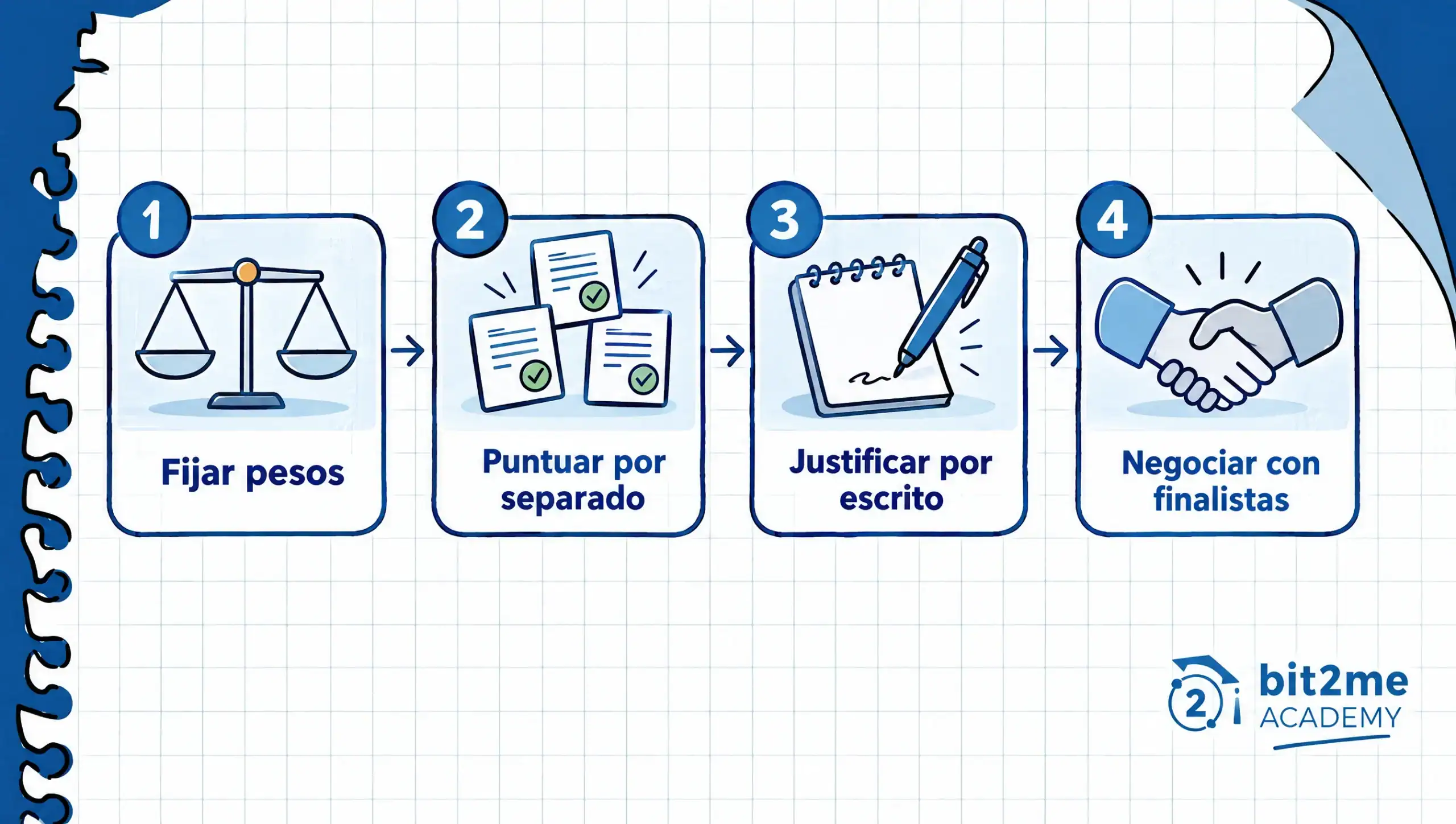
Gathering responses from multiple candidate vendors doesn't solve the selection process if there isn't an objective method for comparing them. The most common practice in financial technology procurement is to build a weighted scoring matrix: each set of criteria (regulation, security, SLA, technical integration, fees, reputation, coverage) is assigned a defined percentage weight before any proposals are received, and each candidate receives a numerical score for each set based on the quality and verifiability of their response.
It is important that the scores be assigned independently by several members of the committee before the results are shared, to reduce the bias of a single person with a good business relationship with a candidate influencing the final decision. It is also advisable to document the justification for each score, not just the number: if a supplier receives the highest security rating, the document should detail the specific evidence supporting that rating, so that the decision can be explained in any subsequent audit of the procurement process.
Once the scoring is finalized, it's reasonable to reserve a final negotiation phase with only the two or three top-ranked candidates, rather than negotiating in parallel with all RFP participants. This final phase allows for adjustments to SLAs or commissions based on an objectively compared basis, instead of introducing new variables that could distort the initial assessment.
Applying this framework of objective criteria does not guarantee that the process will be frictionless, but it does guarantee that the decision on which crypto provider companies to incorporate can be justified with documentation and not with the impression left by the last commercial demo. Bit2Me It offers crypto services for businesses—custody, payment processing, API integration, and dedicated B2B support—and could be one of the options your company considers within this framework, providing the regulatory and technical documentation that this checklist requires of any candidate. If your company is preparing an RFP and wants to compare these criteria with a specific case, the most direct approach is to contact the B2B team and request the documentation corresponding to each section of this checklist.
Frequently asked questions about choosing a crypto provider for businesses
What is an RFP and why is it used to choose a crypto business provider?
A Request for Proposal (RFP) is a formal document that a company uses to solicit comparable proposals from several vendors before deciding which one to work with. In the case of crypto vendors, it serves to translate criteria such as regulatory licensing, security, and SLAs into specific questions that each candidate must answer with verifiable documentation.
What are the most important criteria when choosing a crypto b2b partner?
The most heavily weighted criteria are typically regulatory authorization (CASP under MiCA), asset segregation, and security audits, followed by the support SLA and the quality of the API's technical documentation. Commissions and reputation round out the evaluation, but should not be the first filter in the process.
How do you verify that a crypto provider for businesses has CASP authorization?
The authorization number and the issuing supervisory authority are requested, and this information is verified in the public register of the competent authority, such as the CNMV in Spain. A supplier that cannot provide this verifiable information should not proceed in the selection process.
What should a good SLA from a crypto provider for businesses include?
It should include response times by incident level, a contractually guaranteed uptime percentage, and the contractual compensation stipulated if that percentage is not met. An SLA without verifiable figures does not represent an enforceable commitment in the event of an incident.
Is it safe to work with a crypto business provider that does not segregate customer assets from its balance sheet?
This is not a recommended practice, because in the event of financial difficulties for the supplier, the contracting company's assets could be affected. Asset segregation is one of the criteria that the RFP should verify with documentation before signing any contract.
What happens if the chosen provider changes its fees after the contract is signed?
It depends on the price stability clause agreed upon in the contract, which is precisely why the RFP should inquire about that clause before signing. Without that written commitment, the company is vulnerable to having its financial terms renegotiated at any time during the agreement's term.
How does evaluating a crypto asset service provider differ from evaluating a traditional technology provider?
The general principle is the same—objective criteria, verifiable documentation, and weighted comparison—but the crypto provider adds specific layers of regulatory risk and digital asset custody that don't exist with a conventional software provider. That's why the RFP needs dedicated sections on CASP licensing, asset segregation, and security audits.
How long does the process of selecting a crypto provider for businesses usually take?
There is no standard timeframe, as it depends on the number of candidates, the complexity of the planned technical integration, and how quickly each supplier submits the requested documentation. A well-structured process with predefined criteria usually progresses faster than one where the comparison is improvised on a proposal-by-proposal basis.
How are the responses of multiple suppliers in an RFP objectively scored?
A weighted scoring matrix is recommended, with a percentage weight assigned to each set of criteria before receiving any proposals, and with several committee members scoring independently before the results are compiled. Documenting the justification for each score in writing makes it easier to explain the decision in the event of a subsequent audit of the procurement process.
May Bit2Me How can I participate as a candidate in a company's RFP?
Yes, Bit2Me It offers crypto services for businesses and can provide the regulatory, security, and technical documentation described in this checklist as part of an RFP process. The B2B team can provide this documentation directly to companies evaluating vendors under this same criteria framework.


«Investment in cryptoassets is not fully regulated, may not be suitable for retail investors due to high volatility and there is a risk of losing all invested amounts»
Share this article!Continue learning
Traspaso de fondos en España: la ventaja fiscal que debes conocer
Descubre cómo el traspaso de fondos en España te permite cambiar de fondo sin tributar, y por qué los ETFs casi nunca gozan de esta ventaja fiscal.

DCA: qué es la compra periódica de criptomonedas y cómo automatizarla
Descubre qué es el DCA en criptomonedas: cómo funciona la compra periódica, qué límites reales tiene y cómo automatizarla paso a paso en la app de Bit2Me.

Cierre contable de fin de año con criptoactivos en balance
Cierre contable criptomonedas paso a paso: valoración, deterioro y documentación para el fin de ejercicio de tu empresa con criptoactivos en el balance.

Stablecoins para pagos internacionales B2B
Por qué las empresas usan stablecoins para pagos internacionales: liquidación rápida, menor volatilidad y la terminología MiCA EMT y ART explicada.