
Cierre contable de fin de año con criptoactivos en balance
Essential Points
- The closing of cryptocurrency accounts requires establishing the valuation criteria applicable to each position beforehand, not improvising it in the last days of the fiscal year.
- The choice between acquisition cost and fair value depends on how each crypto asset was classified, and determines whether impairment should be recognized.
- An orderly closure relies on traceable supporting documentation for auditing, not just the final accounting entry.
- The ICAC's criteria on crypto assets are still being defined, so no closing should be finalized without the validation of your accounting and tax advisor.
The accounting treatment of cryptocurrencies has become a recurring task for the accounting departments of Spanish companies that hold crypto assets on their balance sheets, whether as treasury reserves, as a result of customer payments, or as part of their regular operations. Unlike other balance sheet assets, crypto assets do not have a specific and definitive accounting standard in Spain, which forces each finance team to apply the general criteria of the Spanish General Accounting Plan by analogy and to stay informed about how the Institute of Accounting and Auditing (ICAC) is refining them.
This article outlines, step by step, the practical process of year-end closing for a Spanish company with crypto assets on its balance sheet: how to decide on the applicable valuation method, when to recognize an impairment loss, what supporting documentation should be prepared before the auditor arrives, and how to coordinate this closing with the tax team before filing the corporate income tax return. It is aimed at accounting and finance managers who are already dealing with this process or who will be tackling it for the first time in the upcoming year-end closing, and its objective is to organize the workflow, not to replace the professional judgment required in each specific case.
Risk warningInvesting in cryptocurrencies is not fully regulated, may not be suitable for retail investors due to its high volatility, and carries the risk of losing all invested funds. It is important to read and understand the risks of this investment, which are explained in detail at: https://up.bit2me.com/legalbit2me
This content is not tax or accounting advice.This document is for educational and informational purposes only, does not replace the advice of a certified accounting or tax advisor, and should not be used as the sole basis for closing annual accounts or preparing your company's corporate income tax return. The ICAC's and the Tax Agency's interpretation of crypto assets may evolve, so each company should validate its specific situation with a professional before closing its accounts.

Main Cryptocurrencies Course
Basic levelBit2Me Academy We bring you a new course where you will learn everything you need to know about the most important cryptocurrencies that exist today.
Empezar ahora ›Why does the cryptocurrency accounting close require different preparation?
Close the exercise with crypto assets on balance In essence, it's no different from closing with any other relevant asset: it requires valuation, documentation, and coordination with tax authorities. The practical difference lies in the fact that crypto assets combine high price volatility with an accounting framework that still relies on the analogous application of rules designed for other assets, leaving more room for interpretation than in more consolidated balance sheet items.
This combination has a direct consequence for the management team: the year-end closing cannot begin on the last day of the fiscal year. It requires anticipating, weeks in advance, which valuation criteria were applied during the year, whether those criteria remain consistent with the accounting classification of each position, and what documentation still needs to be gathered before the auditor or tax advisor requests it. The sooner these pieces are identified, the less improvisation the final closing will require.
It's also worth remembering that the previous accounting classification—inventory versus intangible assets—already influences many of the decisions made during the closing process. If your company hasn't yet resolved this classification for any of its positions, our guide on cryptocurrency accounting for businesses is recommended reading before proceeding with the closing steps that follow.
Valuation criteria to be applied at closing: acquisition cost or fair value
The first technical step in closing cryptocurrency accounts is to confirm which valuation method applies to each position according to its accounting classification, because this method determines how the asset is reflected in the balance sheet as of December 31. Generally speaking, and always subject to review of the specific case, the Spanish General Accounting Plan (Plan General de Contabilidad) offers two different references depending on the heading under which the cryptocurrency has been recorded.
When a cryptocurrency is classified as an intangible asset because the company holds it as a store of value without the intention of immediate sale, the usual starting point is the acquisition cost, with the possibility of recognizing impairment losses when the recoverable amount falls significantly below that cost. However, when the cryptocurrency is classified as inventory because it forms part of the company's ordinary trading activity, inventory standards consider other valuation benchmarks, including fair value, depending on the business model and the type of operations the company carries out.
This distinction is not merely academic: applying the wrong criteria can lead to a balance sheet that does not accurately reflect the company's financial position, with the risk of having to restate accounts that have already been closed. The ICAC (Spanish Accounting and Auditing Institute) has been publishing consultations that provide guidance on how to apply these general criteria to crypto assets, but this is an area of interpretation that is still developing. This is precisely the section of the article that requires specific review by your accounting advisor before applying it to your company's closing, given that the criteria may have evolved since the publication date of this article.
Regardless of the chosen criterion, the most important closing rule is consistency: if the company applied acquisition cost during the year, changing to fair value only at closing without documented justification weakens the reliability of the annual accounts in the eyes of an external auditor.
Steps for year-end accounting closing with crypto assets on balance
Once the applicable valuation criteria have been confirmed, the closing process itself can be organized as a sequence of specific steps. This sequence does not replace the opinion of your accounting advisor, but it does organize the internal work of the administration department before the external review takes place.
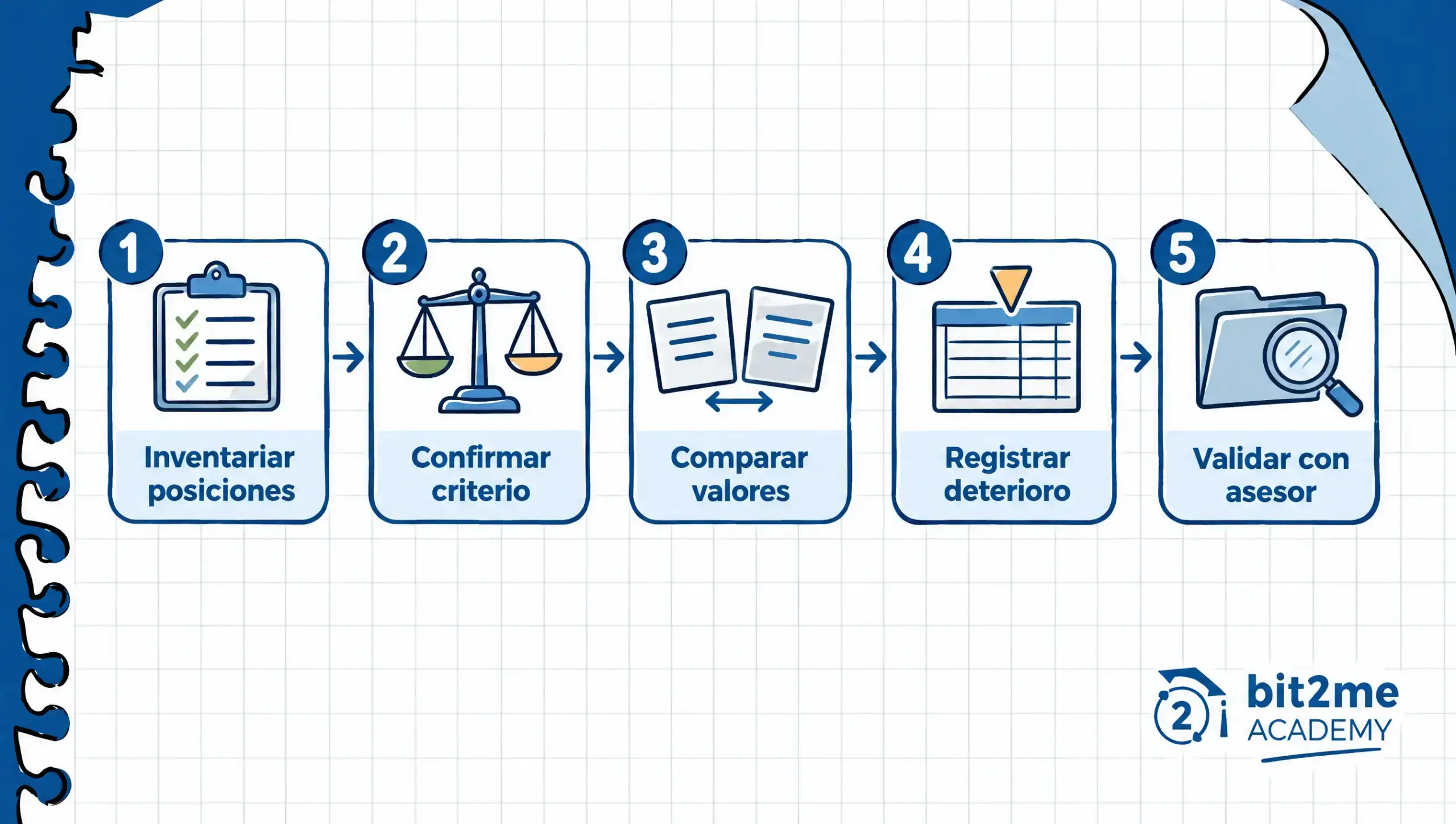
1. Inventory all positions in crypto assets as of December 31. Gather the exact balance of each cryptocurrency in each wallet or platform used by the company, with its assigned accounting classification (inventory or intangible fixed assets). 2. Confirm the current evaluation criteria for each position. Verify that the criteria applied during the period are still correct according to the accounting classification and that they have not changed without documented justification. 3. Obtain the reference market value as of the closing date. Record the exact source used—a specific exchange platform, a benchmark index—because that source must be verifiable to the auditor or the Tax Agency. 4. Compare the market value with the book value of each position. This comparison is the step that determines whether there is an indication of impairment that should be recognized at closing. 5. Record the impairment loss adjustment if applicable. When the recoverable amount is significantly below the carrying amount, impairment should be recognized according to the criteria applicable to the classification of the asset. 6. Gather supporting documentation for each transaction. Acquisitions, transfers between own wallets, customer payments Sales must be supported by their corresponding receipt and their equivalent value in euros at the time of the transaction. 7. Transfer the information to the tax team before the final closing. The accounting effect of each transaction—especially impairments and sales—must be shared with the person preparing the corporate income tax return, so that both criteria are coordinated. 8. Validate the set with the accounting and tax advisor before signing the accounts. No previous step replaces this final review, which is the one that confirms that the applied criterion conforms to the current interpretation of the ICAC and the tax regulations.
Following these steps in order reduces the risk of the closing becoming a last-minute race, and makes it easier for the external auditor to find a consistent documentary trail from the first day of the fiscal year to December 31.
Recognition of impairment losses at year-end
The impairment step deserves a separate explanation because it is often the one that generates the most questions within the management team itself. Recognizing an impairment means recording in the accounts that the recoverable value of a crypto asset has fallen significantly below its carrying amount, adjusting that value downwards with the corresponding effect on the income statement for the year.
The question the accounting team must ask itself is not only whether the price has fallen, but whether that fall constitutes an indication of significant and lasting impairment according to the criteria applicable to the asset's classification, and not merely a one-off fluctuation within the normal volatility of these markets. This assessment requires professional judgment on a case-by-case basis, because the boundary between normal volatility and an indication of impairment is not defined by a single figure applicable to all companies and all crypto assets.
Once recognized, impairment is not a decision made solely by the accounting department: as explained in our guide to crypto taxation for businessesThis accounting adjustment is usually transferred, with the specific provisions of the tax regulations, to the taxable base for Corporate Income Tax for the fiscal year. Therefore, step 7 of the previous sequence—transferring the information to the tax team before the final closing—is particularly relevant when an impairment loss has been recognized.
Documenting in writing the reasoning that led to recognizing or not recognizing an impairment in a specific period is a practice that any external auditor appreciates, because it allows them to understand the criteria applied without having to reconstruct it after the fact.
Supporting documentation required for the audit review
No valuation criterion, however well applied, can withstand an audit without supporting documentation. The closing of cryptocurrency accounts must include an organized file that the auditor can review without relying on verbal explanations from the management team.
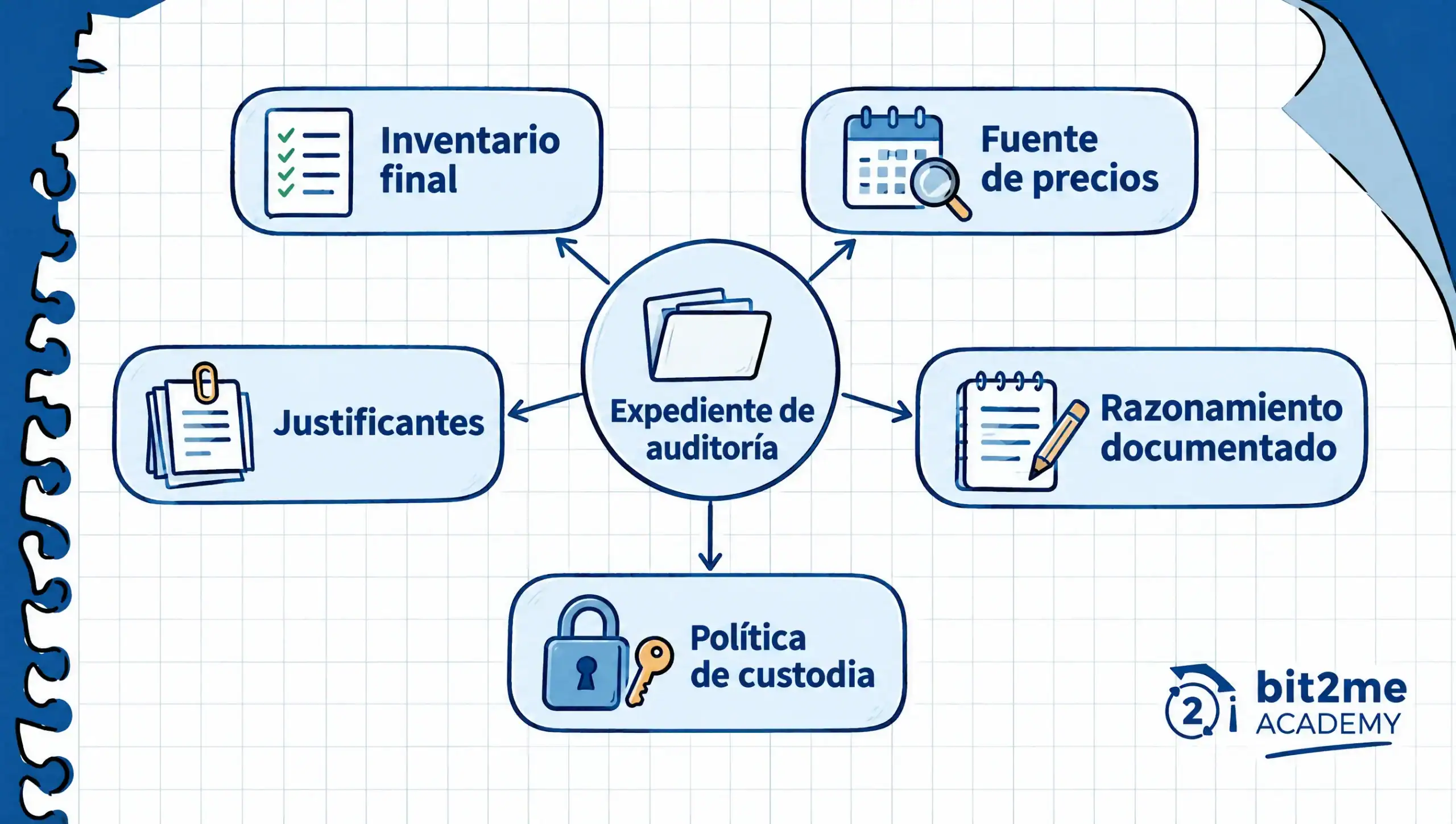
At a minimum, the following items should be prepared before the audit review begins:
- The final inventory of positions in crypto assets as of the closing date, with their accounting classification and their individual book value per position.
- The source and price history used to determine the reference market value in each relevant transaction of the year, including the exact closing date.
- The justification for each significant movement of the exercise: acquisitions, sales, transfers between own wallets and collections received from clients in crypto assets.
- The documented reasoning on the recognition or non-recognition of impairment losses, with reference to the accounting criteria applied.
- The company's internal custody policy, including who authorizes each transaction and who has access to the keys or credentials corresponding.
Such a file not only speeds up the audit review: it also reduces the risk of a difference of opinion becoming a qualification in the audit report, something that can have implications beyond the accounting department itself, especially if the company reports to investors or financing entities.
Coordination with the tax team for Corporate Income Tax
The closing of accounts and the preparation of the tax return Corporate tax These processes cannot proceed completely independently when crypto assets are on the balance sheet. Every relevant accounting decision at year-end—the valuation method applied, a recognized impairment, a sale executed in the final days of the fiscal year—has, with nuances specific to tax regulations, a reflection in the taxable base.
The most efficient way to manage this relationship is to establish a formal coordination point between the accounting and tax teams before the annual accounts are signed, not after. At this coordination point, it's advisable to review together which impairments have been recognized, which sales have occurred during the year, and how each has been valued, so that the tax team has all the necessary information before preparing their part of the tax return.
This coordination is also the ideal time to review whether any of the company's cryptocurrency holdings are held in custody outside of Spain, which may trigger additional reporting obligations that are addressed in more detail in our crypto tax guide for businesses. The sooner this information is shared between both teams, the less likely surprises are to arise in the days leading up to the tax return filing deadline.
Common mistakes when closing the fiscal year with crypto assets on the balance sheet
Some mistakes are frequently repeated when companies incorporate crypto assets into their balance sheets for the first time, and knowing them beforehand helps avoid them. The most common is leaving the final valuation until the last days of the fiscal year, when there is no longer time to resolve doubts with the accounting advisor or to gather documentation that should have been kept from the moment of each transaction.
Another common mistake is changing the valuation method from one period to the next without documented justification, usually because the new method produces a more favorable accounting result in the current year. This practice weakens the reliability of the annual accounts and often leads to direct questions from the external auditor, who expects to find consistency unless there is an objective and documented reason for the change.
A third common mistake is treating the accounting close and taxation as separate compartments, resolving one first and communicating the result to the other team almost as a final formality. As seen in the previous section, both processes run more smoothly when they are coordinated from the beginning of the close, not when they are linked at the end.
Why is it advisable to anticipate closure with professional support?
Everything described in this article consists of general internal organizational steps designed to ensure the management team has the information in order by year-end. None of these steps replace the validation of a specialized accounting and tax advisor, especially in an area where the ICAC's interpretation of crypto assets is still evolving and where a company may have specific sector or business model characteristics not covered by general guidelines.
Having this professional support before the closing date, and not just when signing the accounts, allows for adjustments to be anticipated that would otherwise be discovered during the audit, when correcting them is more costly in terms of time and resources. It also ensures that the chosen accounting criteria are consistent with the tax treatment that will be applied later in Corporate Income Tax.
If your company manages a growing volume of cryptocurrency transactions and wants to review how to structure its custody processesReconciliation and reporting in preparation for the upcoming closing, speak with the B2B team of Bit2Me It is a reasonable step to understand what tools already exist in the market and how they integrate with the criteria determined by your accounting and tax advisors.
The cryptocurrency year-end closing will continue to require this combination of internal organization and professional judgment as the regulatory framework continues to evolve. Starting to prepare for the next closing weeks in advance, documenting each valuation decision as it is made, is the most reliable way to avoid surprises when the audit or corporate tax season arrives.
Frequently asked questions about cryptocurrency accounting close
What is cryptocurrency accounting close?
This is the year-end process in which a company values its cryptocurrency holdings as of the closing date, recognizes any necessary value adjustments, and prepares the supporting documentation required for the audit and tax return. It combines accounting valuation criteria with prior coordination with the tax team.
What valuation criteria are applied to crypto assets at the end of the fiscal year?
It depends on the prior accounting classification of each item: intangible assets are usually valued at their acquisition cost, while inventories can be valued using criteria that include fair value, depending on the company's business model. The exact application should be confirmed with an accounting advisor, as the ICAC's interpretation on this matter is still evolving.
How do I know if I need to recognize an impairment loss in my crypto assets?
You should recognize an impairment when the recoverable value of a crypto asset falls significantly and permanently below its carrying amount, not just due to a one-off fluctuation within the normal market volatility. This distinction requires professional judgment on a case-by-case basis, in consultation with your accounting advisor.
What documentation do I need to prepare before the audit arrives?
At a minimum, the inventory of positions with their classification and book value, the pricing source used at the close, the supporting documentation for each transaction during the period, the rationale for recognized impairments, and the company's internal custody policy. Gathering these elements in advance avoids improvisation during the review.
When should I start preparing the accounting close for my crypto assets?
It's advisable to start weeks before December 31st, reviewing the valuation criteria applied throughout the year and gathering any outstanding documentation, rather than leaving it until the final days of the fiscal year. This proactive approach reduces the risk of errors and discrepancies with the auditor.
Is the accounting close for crypto assets the same for all companies?
No. It depends on how each company has classified its positions—inventory or intangible assets—and on the volume and type of operations it carries out, so the applicable criterion must be validated on a case-by-case basis with a specialized accounting advisor.
What is the relationship between the closing of accounts and the filing of the Corporate Income Tax return?
The accounting close determines how crypto assets are presented in the annual accounts, while the corporate income tax return transfers those same events—impairments, sales—to the taxable income for the year, with nuances specific to tax regulations. Therefore, the accounting and tax teams must coordinate before signing off on the accounts.
What happens if I change the evaluation criteria from one exercise to another?
A change in accounting policy without documented justification weakens the reliability of the annual accounts and usually raises questions from the external auditor during the review. Any change in accounting policy must be supported by an objective reason and documented in writing.
Do I need specific software for the accounting close of crypto assets?
It's not mandatory, but beyond a certain volume of transactions, tools that centralize transaction history and market values significantly simplify the preparation of closing reports and supporting documentation for audits. Many companies combine these tools with regular reviews from their accounting advisor.
What is the current status of the ICAC's accounting criteria on crypto assets?
The Institute of Accounting and Auditing has been publishing consultations that guide the application of the general criteria of the General Accounting Plan to crypto assets, in an area that is still undergoing interpretive development. Therefore, any company should verify with a specialized accounting advisor the criteria in force at the specific time of its year-end.


«Investment in cryptoassets is not fully regulated, may not be suitable for retail investors due to high volatility and there is a risk of losing all invested amounts»
Share this article!Continue learning

Traspaso de fondos en España: la ventaja fiscal que debes conocer
Descubre cómo el traspaso de fondos en España te permite cambiar de fondo sin tributar, y por qué los ETFs casi nunca gozan de esta ventaja fiscal.

DCA: qué es la compra periódica de criptomonedas y cómo automatizarla
Descubre qué es el DCA en criptomonedas: cómo funciona la compra periódica, qué límites reales tiene y cómo automatizarla paso a paso en la app de Bit2Me.

Cómo elegir proveedor cripto B2B: checklist para tu RFP
Checklist objetivo para tu RFP: cómo evaluar un proveedor cripto empresas por licencia CASP, custodia, SLA, API, comisiones y trayectoria antes de firmar.

Stablecoins para pagos internacionales B2B
Por qué las empresas usan stablecoins para pagos internacionales: liquidación rápida, menor volatilidad y la terminología MiCA EMT y ART explicada.