DCA: qué es la compra periódica de criptomonedas y cómo automatizarla
Essential Points
- DCA is buying a fixed amount of crypto assets on a recurring basis, regardless of whether the price is high or low that day.
- It works by averaging the entry price: it buys more units when the price goes down and fewer when it goes up, automatically.
- It helps you take the pressure off trying to time things perfectly and allows you to start buying crypto in small, consistent amounts.
- It does not eliminate market risk nor guarantee a better result than a single purchase: in a sustained rise, buying everything at once could have yielded more, although that is only known afterwards.
Dollar-cost averaging (DCA) is a strategy of buying a fixed amount of cryptocurrencies on a recurring basis, regardless of the current price. Instead of deciding each week whether it's a good time to buy, the decision is made once and then repeated automatically, with the same amount and frequency.
Anyone starting to buy cryptocurrencies almost always faces the same question: should I wait for the price to drop or is it better to buy now? There's no reliable answer to this question because no one can accurately predict where the market will move in the coming weeks. In this article, you'll understand what Dollar-Cost Averaging (DCA) is in cryptocurrencies, how the average entry price works, what advantages it offers compared to buying everything at once, what the real limitations of this strategy are, and how to automate it within the app. Bit2Me so that it stops depending on your memory or your mood.
Important noticeThis article is for educational and informational purposes only. The content does not constitute financial, legal, or tax advice. Cryptocurrencies are high-risk assets and their value can fluctuate significantly. Consult a qualified professional before making any purchase decision.
Main Cryptocurrencies Course
Basic levelBit2Me Academy We bring you a new course where you will learn everything you need to know about the most important cryptocurrencies that exist today.
Empezar ahora ›What is DCA in cryptocurrencies and where does the term come from?
DCA stands for Dollar Cost Averaging, a term that translates to "averaging the cost in dollars" and is commonly known simply as periodic or recurring purchases. The underlying concept didn't originate with cryptocurrencies; it has been used for decades in... indexed funds and pension plans, and consists of dividing a large purchase into many small purchases spread over time.
Applied to crypto assets, DCA means scheduling a purchase of a fixed amount of euros, for example 50 euros, to be executed automatically every week or every month in Bitcoin, Ethereum, or any other digital asset Available. There's no need to analyze charts or try to guess whether the price will go up or down tomorrow. The purchase happens regardless of whether the market is at its highs, lows, or somewhere in between.
This mechanism transforms a decision many people postpone indefinitely—"I'll buy when the price is better"—into a habit that runs itself. The result, over the months, is a portfolio made up of many small purchases made at different times in the market, instead of a single purchase concentrated on a single day. This distribution over time is precisely the mechanism that explains the rest of this article.
How does DCA work step by step: the average of the entry price?
The core mechanism of dollar-cost averaging (DCA) is the average entry price, also known as cost averaging. By consistently buying the same amount of euros with the same frequency, when the asset's price is low, that fixed amount acquires more units, and when the price is high, it acquires fewer units. Over time, this fluctuation tends to even out, and the average price at which the cryptocurrencies were acquired becomes distributed across different market periods.
Imagine a purely illustrative example, using round numbers that don't represent the actual behavior of any asset: someone schedules a purchase of €100 every month for six months. One month the price is higher, and that €100 buys fewer units; the next month the price falls, and that same €100 buys more units. After half a year, the average price paid per unit falls between the highest and lowest price the asset reached during that period, without anyone having to predict which month to buy more or less.
| Month | Hypothetical price | Fixed purchase | Units acquired |
|---|---|---|---|
| 1 | 100 € | 100 € | 1,00 |
| 2 | 80 € | 100 € | 1,25 |
| 3 | 120 € | 100 € | 0,83 |
| 4 | 90 € | 100 € | 1,11 |
| 5 | 110 € | 100 € | 0,91 |
| 6 | 100 € | 100 € | 1,00 |
Source: Author's own illustrative mathematical calculation based on a hypothetical purchase of €100 per month. Figures are rounded and have no relation to any digital asset or actual price projection.
Note that the mechanism doesn't depend on the person being right about anything: the fixed amount automatically adjusts how many units are purchased each time. This is what distinguishes DCA from trying to guess so-called market timing, that unrealistic expectation of always buying at the exact lowest point of the price.
Advantages of DCA in cryptocurrencies compared to single purchase
The most frequently cited advantage of dollar-cost averaging (DCA) is that it reduces the reliance on timing the exact entry point. Buying everything at once on a single day risks that day unknowingly turning out to be one of the worst possible times to buy during that period. By spreading the purchase over time, this single-day risk is diluted across several different dates.
There's also a behavioral advantage that often goes unnoticed. Scheduling a recurring purchase eliminates the need to check prices every day and make a new decision each time, something that for many people ends in paralysis or buying the wrong thing. driven by fear to miss out on a rise. DCA turns that decision into an automatic habit that doesn't depend on mood or the day's news.
Finally, DCA makes buying cryptocurrencies accessible without requiring a large initial investment. There's no need to accumulate a significant sum before starting: simply define an amount that you can consistently maintain for months or years, even if it's modest.
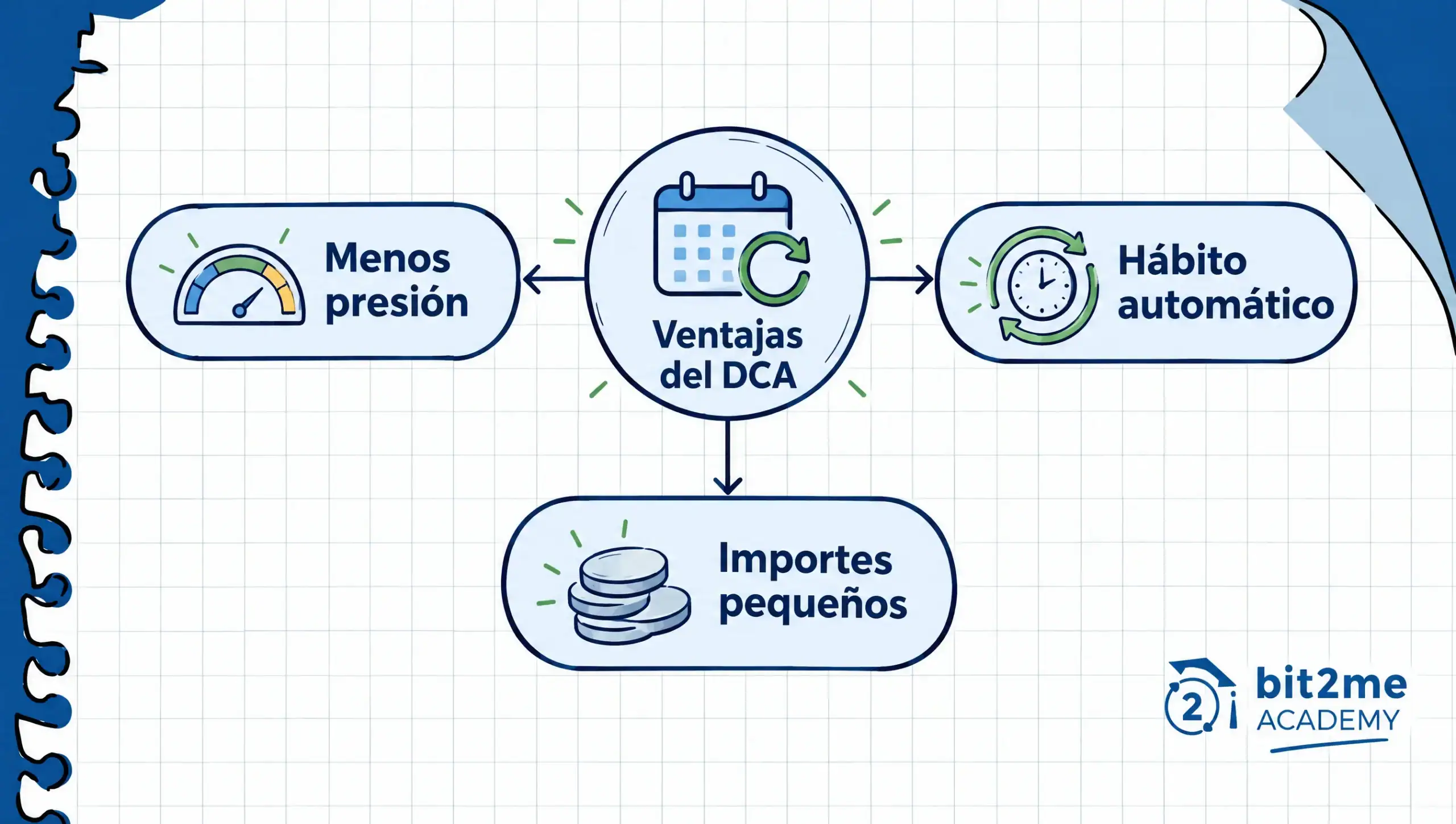
- It reduces the dependence on hitting the perfect moment to buy.
- Turn a difficult decision into an automatic habit, without mental friction each week.
- It allows you to start buying crypto assets with small and sustainable amounts over time.
The limitations of DCA: what this strategy does not guarantee
It's important to be honest about this point because there's a lot of misinformation circulating about it. Dollar-cost averaging (DCA) reduces the risk of buying everything at once at the wrong time, but it doesn't eliminate market risk or guarantee any results. If the price of a digital asset falls steadily for a long time, buying periodically will still accumulate unrealized losses, only spread across more trades instead of concentrated in one.
It's also not true that dollar-cost averaging (DCA) always performs better than a single purchase. In a market with a sustained and prolonged upward trend, a single purchase made at the beginning of the period could have yielded a better result than buying gradually, simply because all the capital would have been exposed to the upward trend from day one. The problem is that this upward trend can only be confirmed by looking back: it's impossible to know in advance whether the market will rise, fall, or move sideways over the next few months.
Therefore, dollar-cost averaging (DCA) should not be understood as a formula for guaranteed results, but rather as a way to manage uncertainty when that uncertainty is, precisely, the only certainty. It reduces the risk of buying everything at the worst possible time, but it cannot turn a bear market into a profitable one, nor can it guarantee that the final result will be better than any other way of buying. Any decision to acquire crypto assets should be based on this premise and not on the expectation of a guaranteed outcome.
How to automate DCA within the app of Bit2Me?
Automating DCA means scheduling the recurring purchase once and letting it run automatically from then on. Within the app of Bit2MeThe automated periodic purchase function allows you to define the digital asset, the fixed amount in euros and the frequency with which the operation will be repeated, without having to manually confirm each purchase.
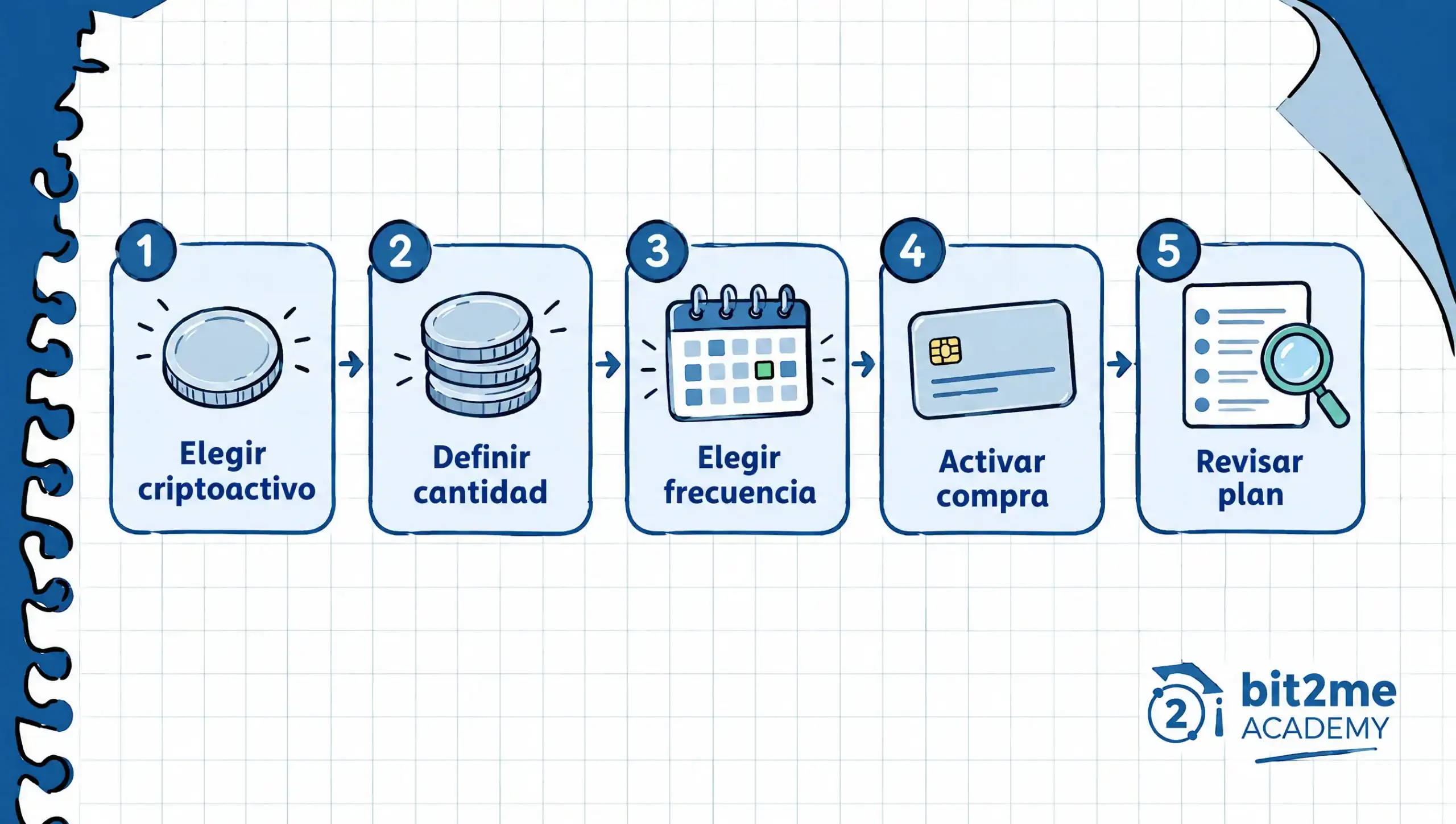
The usual process follows these steps:
- Access the recurring purchase section in the app of Bit2Me and select the cryptocurrency you want to buy regularly.
- Define the fixed amount in euros that will be allocated to each purchase, adjusted to what you can sustainably maintain.
- Choose the frequency: weekly, bi-weekly, or monthly, according to your preference and your income cycle.
- Confirm the payment method and activate recurring purchase so that it runs automatically on each scheduled date.
- Review your plan periodically, without needing to modify it every time the market moves.
Once set up, recurring purchases continue to work without you having to open the app each week to decide if it's a good time to buy. If you ever want to adjust the amount, frequency, or pause the plan, you can do so from the same section where you initially set it up. If you'd like to start trying it out, you can configure your DCA directly from the app and adapt it to your own savings pace.
If you're still getting to grips with the basics of buying and holding cryptocurrencies, it might help to review the general guide first. Bit2Me Academy about What is an exchange and how to choose one?, where the fundamentals on which any periodic purchase strategy is based are explained.
DCA in cryptocurrencies and regular contributions to funds: the same principle, two different frameworks
Anyone already familiar with the world of traditional investing will immediately recognize this logic: crypto DCA is mathematically identical to the mechanism we described in the guide. Bit2Me Academy Regarding periodic contributions to funds, applied to index funds or ETFs. In both cases, a fixed amount is distributed in successive purchases over time to average the entry price, instead of concentrating all the capital in a single transaction.
It's important to be precise here because the parallel is conceptual, not regulatory. Regularly buying crypto assets is governed by MiCA (the European Union's Markets in Crypto Assets Regulation), which is why this article always refers to "buying" or "acquiring" digital assets, never to "investing." Regular contributions to funds or ETFs, on the other hand, fall under securities market regulations. supervised by the CNMVwhere the verb "invest" is correct.
They are not the same product, nor do they share the same legal framework, although the underlying mathematical principle—averaging the price paid by spreading the purchase over time—is practically the same. For those already practicing dollar-cost averaging (DCA) with cryptocurrencies, understanding why equivalent strategies exist for other financial products is usually simple: only the asset, the correct verb, and the accompanying regulatory framework change.
How much to buy and how often: how to design your DCA plan?
There is no single number or frequency that works for everyone, because it depends on the saving capacity It depends on each person and their tolerance for seeing their portfolio value fluctuate. What is important to understand is that a small but sustainable amount held for months usually works better in practice than a larger amount that is abandoned after a few months due to lack of margin.
Weekly frequency spreads the initial cost across more points in the market, while monthly frequency is usually better suited to those with a regular paycheck who prefer less frequent plan reviews. Both frequencies are valid, and the price averaging mechanism works with both. Before setting an amount, it makes sense to ask yourself how much you can allocate without compromising other expenses, how long you're willing to maintain consistency, and what level of fluctuation you're comfortable with without being tempted to cancel the plan.
- Start with a modest and realistic amount instead of waiting until you can allocate a "significant" sum.
- Review your plan every few months, adjusting the amount if your income changes, instead of modifying it every time the price moves.
- Maintain the same frequency for as long as possible so that the average price has room to move.
Common mistakes when doing DCA in cryptocurrencies
The most common mistake is stopping recurring purchases just when the price drops sharply, precisely when the average price is most favorable. Pausing the plan during a price drop means missing out on acquiring units at a lower price, which is exactly what makes this mechanism more effective over time.
Another common mistake is switching assets too frequently, chasing the one that has risen the most in recent weeks. This practice breaks the logic of consistency upon which the entire system is based and usually results in buying high just when enthusiasm for that asset is at its peak. A third mistake is setting an overly ambitious amount from the outset, something that often leads to the plan being canceled at the first sign of a cash flow problem.
Being aware of these mistakes doesn't guarantee any specific result, but it does help to understand why two people who start with similar amounts can end up with very different portfolios if one of them stays the course and the other interrupts their DCA every time the market gets nervous.
Current status: DCA in cryptocurrencies under MiCA
Since the full implementation of MiCA Regulation In the European Union (as of December 2024), communications regarding the purchase of crypto assets, including periodic purchase strategies, must be clear, non-misleading, and warn of the inherent risks of this type of trading. This means that no regulated platform can present dollar-cost averaging (DCA) as a formula that guarantees results, and all commercial communications about this strategy must be accompanied by the corresponding risk warning.
For those who buy crypto assets in the European Union, this regulatory transparency is an additional guarantee that the information they receive about strategies like DCA is subject to a framework for protecting the retail buyer, and not to unsupported commercial promises.
Consistency is ultimately the true driving force behind dollar-cost averaging (DCA) in cryptocurrencies: it doesn't depend on accurately predicting market trends, but rather on maintaining a simple habit over months or years. Automating that periodic purchase from the app... Bit2Me It transforms a decision that many people postpone indefinitely into a process that works on its own, leaving the focus where it really matters, which is consistency and not one-off success.
Frequently Asked Questions about DCA in Cryptocurrencies
What does DCA mean in cryptocurrencies?
DCA stands for Dollar Cost Averaging, a strategy that involves buying a fixed amount of a cryptocurrency on a recurring basis, regardless of its price that day. In Spanish, it's commonly known as periodic or recurring crypto purchases.
How exactly does the DCA entry price average work?
By always buying the same amount, when the price is low, that fixed quantity buys more units, and when the price is high, it buys fewer. Over time, this automatic adjustment spreads the average price paid across different market conditions, instead of depending on a single entry point.
How can I set up a recurring cryptocurrency purchase?
From the app Bit2Me You can access the recurring purchase section, choose the cryptocurrency, define the fixed amount, and select the frequency: weekly, bi-weekly, or monthly. Once activated, the purchase will be executed automatically on each scheduled date without you having to confirm it manually.
What do I need before I start doing DCA in cryptocurrencies?
You need a verified account on an exchange, a linked payment method, and, most importantly, a balance you can maintain consistently for several months. You don't need a large initial amount to get started.
Does DCA eliminate the risk of losing money with cryptocurrencies?
No, dollar-cost averaging (DCA) reduces the risk of buying everything at once during a particularly bad period, but it doesn't eliminate market risk. If an asset's price falls steadily for a long time, continuing to buy periodically will also accumulate unrealized losses, albeit spread across more transactions.
What happens if I pause my DCA during a market downturn?
Pausing recurring purchases during a price drop means missing out on buying units at the lowest price during that period, which is precisely when the average price is most favorable. This is one of the most common mistakes among those starting out with this strategy.
Does DCA always perform better than buying everything at once?
Not necessarily. In a market with a sustained upward trend, a single purchase at the beginning of the period could have yielded a superior result, simply because all the capital would have been exposed to the rise from day one. The problem is that such a trend can only be confirmed by looking back, never beforehand.
How does cryptocurrency DCA differ from regular contributions to funds?
The mathematical principle is the same: spread a purchase over time to average the entry price. However, crypto DCA is governed by the MiCA framework and uses the verb "buy," while regular contributions to funds are governed by CNMV regulations and use the verb "invest."
How often should DCA purchases be scheduled?
Weekly renewals spread the initial cost across more points in the market, while monthly renewals are usually better suited to those who receive a salary and prefer to review their plan less frequently. Both are valid options, and the mechanism works with both.
What is the current state of DCA regulation in cryptocurrencies?
Since the full implementation of MiCA in December 2024, any communication regarding strategies for the periodic purchase of crypto assets in the European Union must be clear, not misleading, and warn of the inherent risks of this type of transaction. No regulated platform may present DCA as a guaranteed return.


«Investment in cryptoassets is not fully regulated, may not be suitable for retail investors due to high volatility and there is a risk of losing all invested amounts»
Share this article!Continue learning

Cómo elegir proveedor cripto B2B: checklist para tu RFP
Checklist objetivo para tu RFP: cómo evaluar un proveedor cripto empresas por licencia CASP, custodia, SLA, API, comisiones y trayectoria antes de firmar.
Cierre contable de fin de año con criptoactivos en balance
Cierre contable criptomonedas paso a paso: valoración, deterioro y documentación para el fin de ejercicio de tu empresa con criptoactivos en el balance.
Stablecoins para pagos internacionales B2B
Por qué las empresas usan stablecoins para pagos internacionales: liquidación rápida, menor volatilidad y la terminología MiCA EMT y ART explicada.
Cómo vender criptomonedas y retirar euros a tu banco
Aprende a vender criptomonedas paso a paso y retirar euros a tu cuenta bancaria: elige la orden de venta, solicita la retirada SEPA y controla los tiempos.