Stablecoins para pagos internacionales B2B
- A stablecoin is a crypto asset pegged to a fiat currency, designed to move quickly without the volatility of other digital assets.
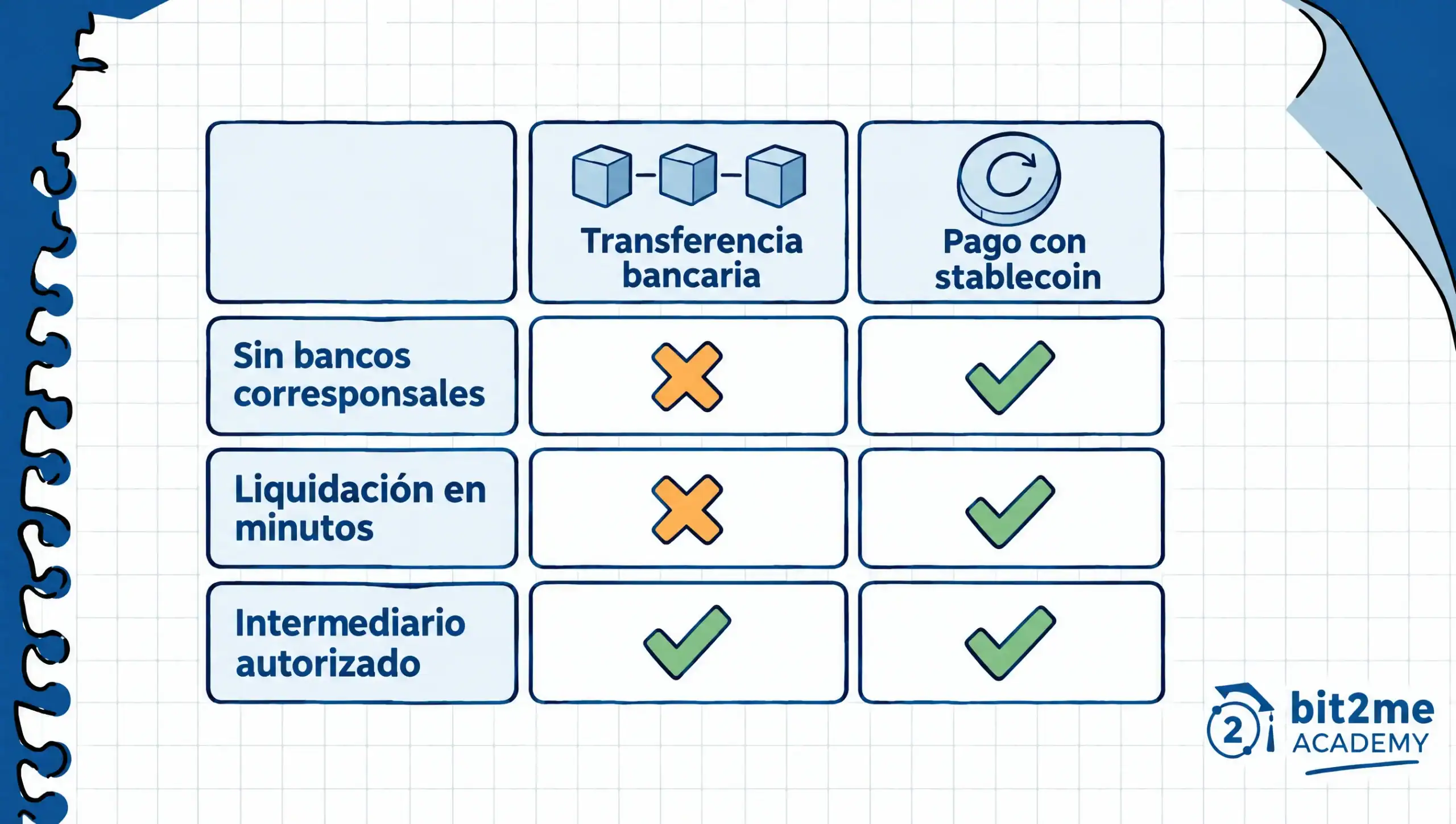
- It allows international payments between companies to be settled without depending on the correspondent bank chain of a traditional SWIFT transfer.
- MiCA distinguishes two key figures: the EMT, referenced to a single currency, and the ART, referenced to a more complex basket of assets.
- Neither speed nor reference to a currency eliminates the risk: the issuer, its reserves and the supplier's authorization remain the point that needs to be audited.
A stablecoin is a cryptocurrency whose value is pegged to a fiat currency, designed to reduce volatility in international payments between companies. This seemingly simple definition explains why finance departments already considering paying foreign suppliers in cryptocurrencies almost always end up focusing the conversation on a specific type of digital asset and not on the rest of the ecosystem.
This article complements the general guide of Bit2Me Academy This article covers paying international suppliers with cryptocurrencies, covering the accounting, tax, and counterparty risk considerations common to any business payment in digital assets. Here, we delve deeper into a more specific angle: why stablecoins, in particular, solve a problem that other cryptocurrencies don't address as effectively, and what regulatory terminology should be understood precisely before incorporating them into a company's payment policy.
Important noticeThis article is for educational and informational purposes only. Its content does not constitute financial, legal, tax, or accounting advice. Cryptocurrencies, including stablecoins, are risky assets whose value can be affected by the issuer's creditworthiness or the quality of its reserves. Before applying any of the considerations in this article to a real-world situation, the company should consult with its legal, tax, and accounting advisors in the relevant jurisdiction.
Main Cryptocurrencies Course
Basic levelBit2Me Academy We bring you a new course where you will learn everything you need to know about the most important cryptocurrencies that exist today.
Empezar ahora ›What do stablecoins offer that other cryptocurrencies don't in B2B payments?
When a finance department begins exploring international payments using cryptocurrencies, the first question is usually about speed: how long does it take to confirm a transaction compared to a traditional bank transfer? The second question, almost always overlooked at first, is which specific cryptocurrency is involved, because not all cryptocurrencies are equally well-suited for this purpose.
Bitcoin or Ethereum can be transferred between wallets in a matter of minutes, but their price can fluctuate significantly within that same timeframe, introducing an uncertainty that no company wants to manage when billing in euros or dollars. Stablecoins were created precisely to separate these two variables: they maintain the settlement speed of a blockchain network, but by being pegged to a fiat currency, they prevent the amount agreed upon with the supplier from changing significantly between the agreement and payment. This combination—the speed of the blockchain infrastructure without the price volatility of a generic cryptocurrency—is the specific reason why stablecoins, and not other digital assets, have become the preferred vehicle for international payments between companies.
This does not make stablecoins a neutral substitute for the euro or the dollar. They remain crypto assets, with their own infrastructure, operational risks, and, as explained later, a specific issuer behind each token. The difference compared to Bitcoin or Ethereum is not one of nature, but of design: while those assets aim to be a store of value or a unit of account in a decentralized network, stablecoins seek to replicate the behavior of an existing currency.
Settlement without correspondent banks: the real change in international payments
A traditional international transfer rarely travels in a straight line between the paying company's bank and the supplier's bank. In most cases, it passes through a chain of correspondent banks, each with its own schedule, compliance validation, and commission, which explains why a transaction can take anywhere from one to several business days to settle, especially when the two entities do not operate in the same time zone.
A stablecoin transaction circulates over a blockchain network public or permissioned, without the need for that correspondent chain. The amount is transferred directly between the paying company's wallet and the provider's wallet, with confirmation that, depending on the network used, can be completed in minutes instead of days. For a company with providers on several continents, this difference is not just a matter of convenience: it directly affects the treasury planning and the commercial relationship with the person who is waiting for payment.
This is precisely where stablecoins offer something a volatile cryptocurrency cannot with the same operational reliability. If a company had to convert euros to Bitcoin, send it, and wait for the supplier to convert it back to their own currency, the time this double conversion takes—and the price exposure during that time—would negate much of the speed advantage. By settling directly in an asset pegged to the billing currency, the company gains the speed of blockchain without adding an unnecessary layer of currency risk to the already agreed-upon amount.
It's important to clarify that "no correspondent banking" doesn't mean "no intermediaries at all." The company still needs a cryptocurrency platform or service provider to facilitate the conversion of fiat currency to stablecoin and the safekeeping of those funds—an intermediary of a different nature than a correspondent bank, but an intermediary nonetheless, with its own authorization requirements, which are detailed later in this article.
Reduced exposure to volatility: what does "currency-linked" mean?
The term "currency-pegged" describes the mechanism by which a stablecoin attempts to maintain its value: the issuer holds reserves, typically cash, deposits, or very short-term debt instruments, the value of which should equal the number of tokens in circulation. When a company settles a payment in a stablecoin referenced to the euroThe amount received by the supplier should remain very close to the agreed value, something that does not happen when the payment is made in a crypto asset whose price fluctuates according to market supply and demand.
This reduced exposure to volatility is why most international crypto payment transactions between companies consolidating in the market opt for a stablecoin instead of Bitcoin, Ethereum, or other volatile assets. The amount agreed upon in the invoice and the amount actually paid tend to match, which also simplifies the accounting of the transaction compared to a scenario where the value changes between the agreement and the payment.
Reduced does not mean eliminated. A stablecoin can lose its peg to the reference currency, a phenomenon known as depeg, if the market loses confidence in the issuer or if the reserves backing it are not as liquid as assumed. This nuance is what separates a company that evaluates stablecoins judiciously from one that mistakenly treats them as an exact and guaranteed equivalent of holding euros in a traditional bank account.
MiCA terminology that every company should master: EMT and ART
Within the regulatory framework of the European Union, the MiCA Regulation (Markets in Crypto-Assets) does not treat all stablecoins as a single category. It distinguishes two legal statuses depending on what the token actually represents, a distinction that a financial manager should handle with the same precision as they handle the rest of the contractual vocabulary with their suppliers.
EMT: Electronic Money Token, the stablecoin referenced to a single currency
An EMT (Electronic Money Token) is a stablecoin pegged to a single fiat currency, such as the euro or the dollar, with the aim of maintaining a value equivalent to that currency. MiCA requires EMT issuers to maintain sufficient and properly segregated reserves, as well as offering holders the right to redeem their tokens at the face value of the pegged currency. In practice, most international B2B payments settled in a stablecoin today use an EMT, precisely because invoice amounts are typically expressed in a single currency rather than a combination of assets.
ART: Asset-Referenced Token, the stablecoin referenced to a basket of assets
An ART (Asset-Referenced Token), on the other hand, references a basket that can combine various currencies, commodities, or other crypto assets. Because of this greater structural complexity, MiCA requires its issuers to meet stricter capital, governance, and transparency requirements regarding the exact composition of the basket. For a company that only needs to settle an invoice in euros or dollars, an ART adds a layer of valuation complexity that rarely provides additional benefit compared to a well-backed EMT.
Distinguishing between EMT and ART is not an academic exercise: it directly impacts the questions a company should ask before accepting a particular asset as payment. Asking whether the token proposed by the provider is an EMT or an ART, and what currency or basket it references exactly, should be part of the same due diligence process used today to verify any other payment terms with an international supplier.
Risks your company should assess before paying with stablecoins
Adopting stablecoins for international payments doesn't automatically eliminate risk for a company simply because they are designed to be stable. At least three aspects should be evaluated before making this practice standard practice in payment policies.
The first risk is that of the issuer: the solvency, management, and transparency of the entity issuing and administering the EMT or ART ultimately determine whether that asset can deliver the promised value at any given time. The second risk is that of the reserves: if the assets backing the stablecoin are not as liquid, secure, or auditable as assumed, the issuer's ability to honor the redemption may be compromised in a market stress scenario. The third risk is that of working with a crypto-asset service provider not authorized under MiCA, which leaves the company without the asset segregation and oversight guarantees that the regulation requires of authorized entities.
- Issuer risk includes everything from poor financial management to a lack of public communication about where and how reserves are held.
- The risk to reserves materializes when those assets lose value, become illiquid, or cannot be converted as quickly as a massive withdrawal by holders would require.
- Regulatory counterparty risk arises when the platform that converts fiat to stablecoin or holds the funds is not authorized as a crypto asset service provider (CSP).
None of these three risks makes stablecoins unsuitable for international payments, but they do explain why a company should treat them with the same rigorous counterparty analysis it would apply to any correspondent bank or traditional payment gateway. The difference is that, in this case, the analysis focuses on the token issuer and the provider facilitating the transaction, not on a central bank backing the currency.
How to verify that a stablecoin provider is authorized under MiCA
MiCA directly regulates EMT and ART issuers, as well as cryptocurrency service providers that facilitate their custody, conversion, or transfer, not the company that uses them to pay a third party. This places the responsibility on the paying company to verify, before making a transaction, that it is working with entities that are within that authorization perimeter.
An authorized EMT issuer must operate as a credit institution or electronic money institution, publish regular reports on the composition and liquidity of its reserves, and offer an exchange right at the face value of the referenced currency. An authorized crypto-asset service provider (CSP), for its part, must segregate your clients' assets of its own balance sheet and be supervised by the relevant competent authority, which in Spain is the National Securities Market Commission (CNMV)Verifying both records—that of the token issuer and that of the intermediary executing the transaction—should be a mandatory step before incorporating a specific stablecoin into the company's payment policy.
Outside the European Union, each jurisdiction applies its own authorization framework, and some relevant issuers in the global market still do not operate under a regime equivalent to MiCA. This does not automatically rule out its use, but it does require the company to more thoroughly assess the transparency of its reserves and its operating history before assuming the same level of trust it would place on an issuer supervised within the European Union.
Integrate stablecoins into the company's international payment process
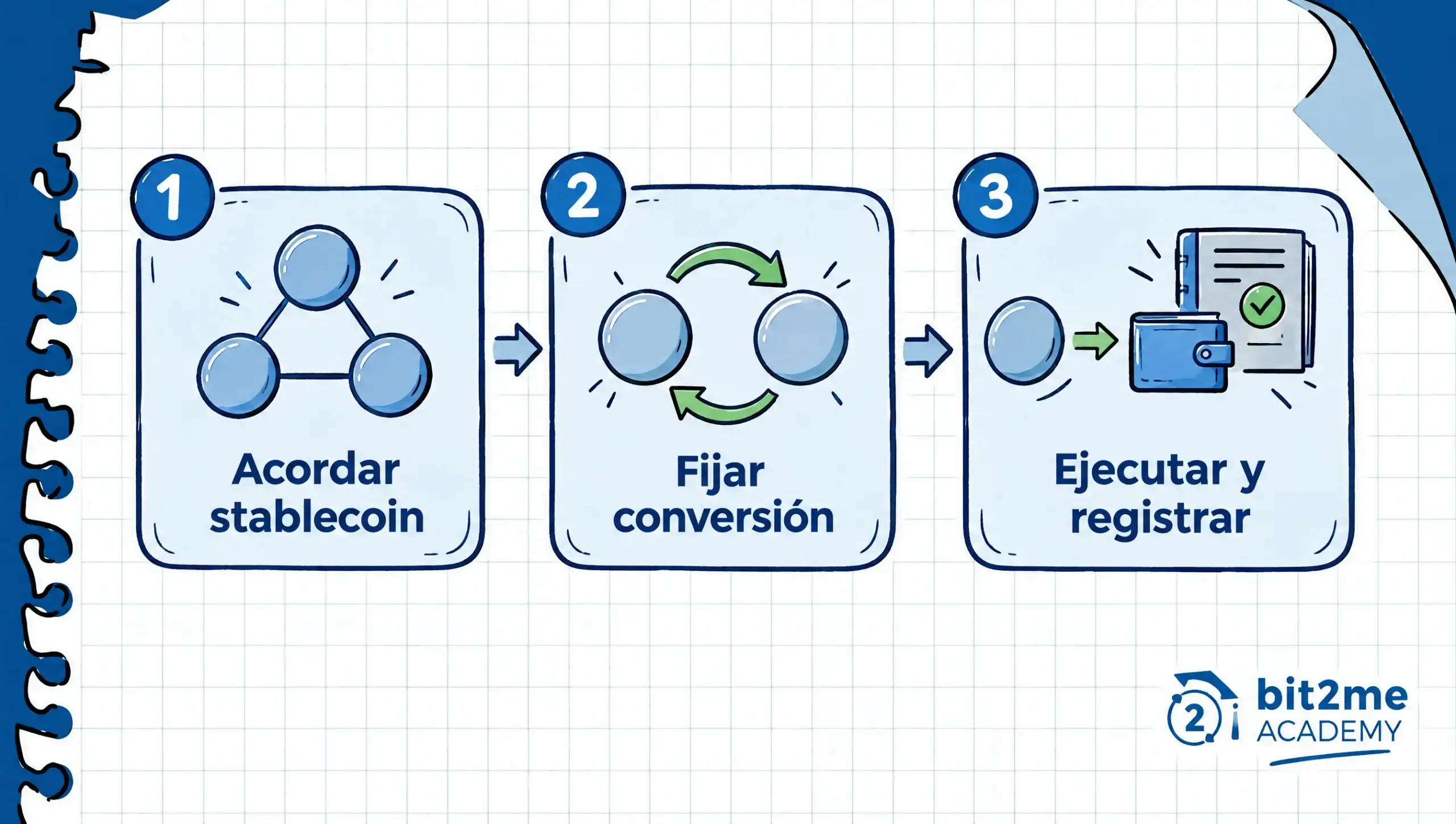
Once the due diligence process regarding the issuer and provider is complete, the operational integration follows a logic similar to that of any relevant international payment, with some nuances specific to the asset. The first step is to agree with the provider on which specific stablecoin will be used and on which blockchain network, since the same token can operate on several networks with different fees and confirmation times.
The second step is to set the conversion point for the agreed amount in the billing currency to the corresponding EMT (Equivalent Monetary Transaction). This is much less critical than with a variable-priced cryptocurrency, but it still warrants a clear procedure to record the exchange rate used in case of even a slight deviation from parity. The third step is execution and recording: sending the amount to the supplier's wallet, confirming the transaction on the relevant network, and updating the supplier management system or ERP with the complete details of the transaction, including the transaction hash for traceability.
For businesses with a recurring volume of international crypto payments and multiple providers, this manual process becomes inefficient as it grows, at which point it often makes sense to evaluate a more structured technical integration rather than managing each transaction individually. The guide from Bit2Me Academy about What are stablecoins? It delves into the backup mechanisms and the EMT/ART classification with more conceptual detail, useful as a preliminary reference for any team starting to evaluate this transition.
Current status: EMT and ART in B2B payments under MiCA until December 2026
As of the publication date of this article, December 2026, most EMT issuers operating significantly in the European Union are already authorized under MiCA, and the crypto-asset service provider regime has completed its transition period in almost all Member States. This has considerably reduced the uncertainty surrounding which stablecoins can be used for B2B payments within the European framework with supervisory guarantees equivalent to those of other regulated financial instruments.
The ART market remains comparatively much smaller, with fewer authorized issuers and still marginal use in business payment operations compared to its role in other use cases within the crypto ecosystem. The European Banking Authority (EBA) continues to publish additional interpretative criteria on certain technical aspects of the supervision of EMT and ART issuers, so this section will be updated if relevant changes occur in that regulatory framework.
For a finance department currently evaluating the integration of stablecoins into its international payments policy, the practical message is that the regulatory framework now offers an objective verification criterion—issuer authorization, PSC authorization, EMT or ART classification—that didn't exist just a couple of years ago. This criterion doesn't replace the company's own risk analysis, but it does significantly reduce the uncertainty surrounding who it's dealing with.
Adopting stablecoins for international payments is, at its core, a treasury decision that combines a real operational advantage—faster settlement and reduced exposure to volatility—with due diligence on the issuer and provider that shouldn't be treated as a minor formality. If your company is evaluating this transition and needs to resolve specific questions about which EMT or ART best suits its transaction volume, jurisdiction, or integration with its existing ERP, speak with the B2B team of Bit2Me It is a reasonable step before modifying the policy of payments to international suppliers.
Legal notice regarding the risk of crypto assets
Investing in cryptocurrencies is not fully regulated, may not be suitable for retail investors due to its high volatility, and carries the risk of losing all invested funds. It is important to read and understand the risks of this investment, which are explained in detail at: https://up.bit2me.com/legalbit2me
Frequently asked questions about stablecoins for international payments
What are stablecoins and why are they used in international payments?
They are cryptocurrencies pegged to a fiat currency, designed to maintain a stable value against assets like Bitcoin or Ethereum. They are used in international payments because they combine the settlement speed of a blockchain network with much lower exposure to price volatility.
How does paying with stablecoins work for businesses compared to a bank transfer?
The company converts the agreed-upon amount into a stablecoin and sends it directly to the provider's wallet via a blockchain network, bypassing the correspondent bank chain of a SWIFT transfer. Confirmation is typically completed in minutes, compared to the several business days a traditional international transfer can take.
What is the difference between an EMT and an ART according to MiCA?
An EMT (electronic money token) is pegged to a single fiat currency, while an ART (asset-referenced token) can reference a basket of various assets, including currencies, commodities, or other crypto assets. Most B2B payments use EMT because invoices are typically denominated in a single currency.
Do stablecoins completely eliminate the risk of volatility in international payments?
No, they significantly reduce it compared to a floating-priced cryptocurrency, but they don't eliminate it entirely. A stablecoin can lose its peg to the reference currency if the market loses confidence in the issuer or the quality of its reserves.
What should a company verify before accepting a specific stablecoin from a provider?
You should verify that the token issuer is authorized under MiCA as a credit institution or electronic money institution, that it publishes verifiable reserve reports, and that the crypto asset service provider facilitating the transaction is authorized as a PSC. It is also advisable to identify whether it is an EMT or an ART.
What issuer risks should a company consider when paying with stablecoins?
Issuer risk refers to the solvency, management, and transparency of the entity that issues and manages the stablecoin—factors that determine whether it can honor the redemption right at any given time. This risk exists regardless of whether the asset functions correctly on a daily basis.
How does reserve risk differ from issuer risk?
Issuer risk relates to the issuer's overall management and solvency, while reserve risk focuses specifically on whether the assets backing the stablecoin are sufficiently liquid, secure, and auditable. Both risks are related, but it's advisable to assess them separately when analyzing a specific issuer.
Why are stablecoins preferable to Bitcoin or Ethereum for B2B payments?
Bitcoin and Ethereum offer the same settlement speed, but their price can fluctuate significantly between the agreement with the provider and the time of payment, altering the actual cost of the transaction. Stablecoins maintain this speed while reducing this exposure by being pegged to the same currency in which billing takes place.
Is it mandatory to work with a MiCA-authorized provider to pay with stablecoins?
MiCA regulates the token issuer and the crypto-asset service provider, not directly the company making payments to a third party. Therefore, there is no explicit prohibition against using an unauthorized provider. However, doing so leaves the company without the asset segregation and oversight safeguards required by the regulation—a risk best avoided for recurring payments of significant volume.
What is the current state of MiCA regulation for stablecoins in B2B payments?
By December 2026, most relevant EMT issuers in the European Union are authorized under MiCA, and the crypto-asset service provider regime has completed its transition in almost all Member States. The ART market remains comparatively small, with fewer authorized issuers and still marginal use in business payments.


«Investment in cryptoassets is not fully regulated, may not be suitable for retail investors due to high volatility and there is a risk of losing all invested amounts»
Share this article!Continue learning
DCA: qué es la compra periódica de criptomonedas y cómo automatizarla
Descubre qué es el DCA en criptomonedas: cómo funciona la compra periódica, qué límites reales tiene y cómo automatizarla paso a paso en la app de Bit2Me.

Cómo elegir proveedor cripto B2B: checklist para tu RFP
Checklist objetivo para tu RFP: cómo evaluar un proveedor cripto empresas por licencia CASP, custodia, SLA, API, comisiones y trayectoria antes de firmar.

Cierre contable de fin de año con criptoactivos en balance
Cierre contable criptomonedas paso a paso: valoración, deterioro y documentación para el fin de ejercicio de tu empresa con criptoactivos en el balance.

Cómo vender criptomonedas y retirar euros a tu banco
Aprende a vender criptomonedas paso a paso y retirar euros a tu cuenta bancaria: elige la orden de venta, solicita la retirada SEPA y controla los tiempos.