Cómo vender criptomonedas y retirar euros a tu banco
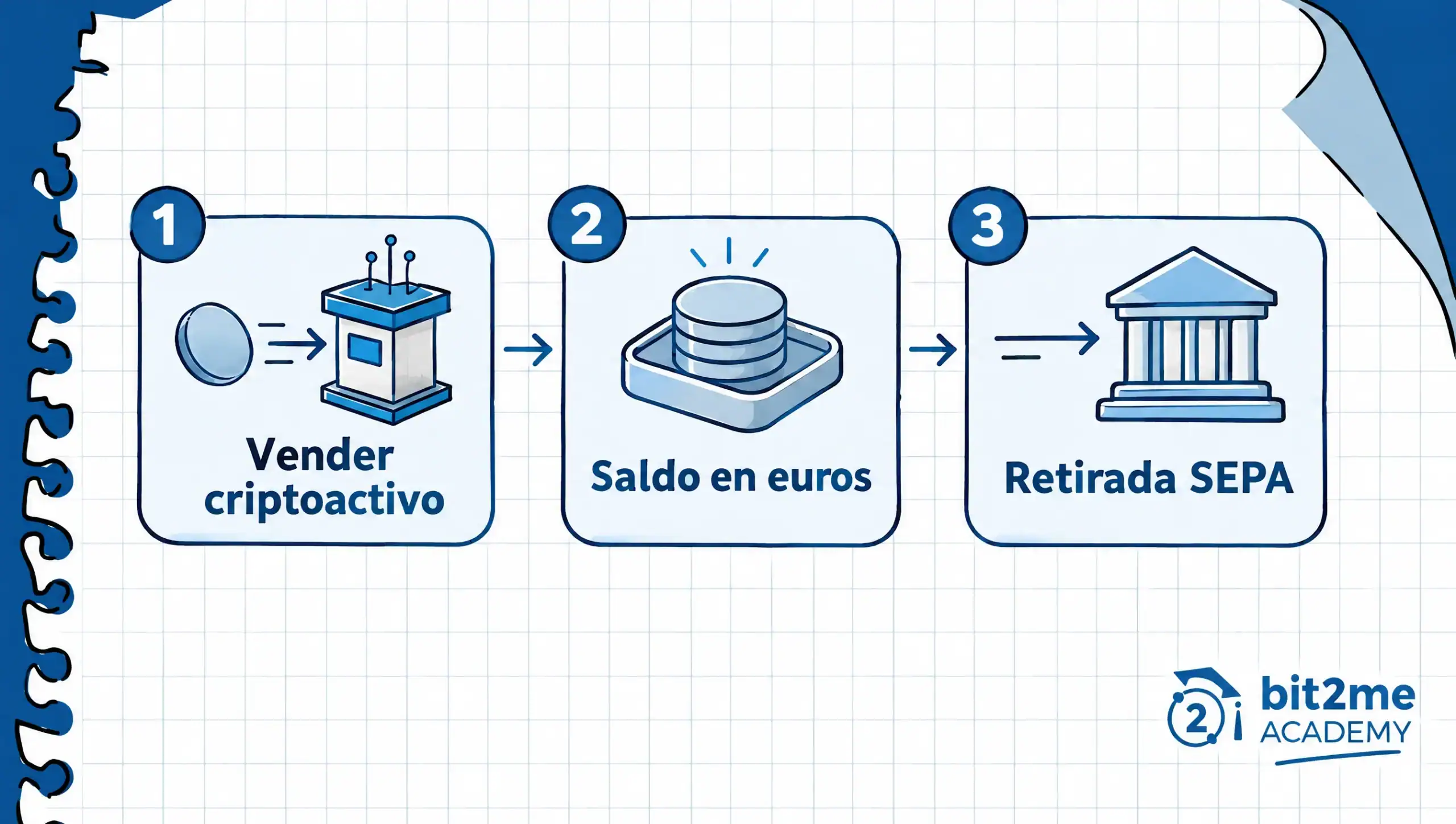
- Selling your crypto assets and converting crypto to euros in your bank account is a regulated process that combines a sell order and a SEPA withdrawal.
- The exchange converts your crypto asset to euros at the market price or at the price you set, depending on the type of order you choose.
- It serves to convert into euros what you previously acquired in crypto assets, whether to spend it, save it, or simply close a position.
- Selling generates a capital gain or loss for income tax purposes, so it's advisable to keep track from the first euro you withdraw.
More and more people, after having bought cryptocurrencies for months or years, are now considering the opposite step for the first time: converting part of that portfolio into euros and seeing it reflected in their regular bank account. This is a different moment than the initial purchase, because it involves new decisions—what sell order to choose, how long it takes for the money to arrive, what to report for tax purposes—that aren't always as clear as the initial acquisition process.
This guide covers how to sell cryptocurrencies step-by-step on a regulated platform, how to request a withdrawal to your bank account via SEPA transfer, how long it typically takes for the funds to be credited, and the basic tax implications to keep in mind before taking the plunge. The goal is for you to understand the entire process by the end of this article, from deciding to sell to receiving the funds in your bank account.
Important noticeThis article is for educational and informational purposes only. The content does not constitute financial, legal, or tax advice. Cryptocurrencies are high-risk assets and their value can fluctuate significantly. Consult a qualified professional before making any purchase, sale, or participation decisions.
Main Cryptocurrencies Course
Basic levelBit2Me Academy We bring you a new course where you will learn everything you need to know about the most important cryptocurrencies that exist today.
Empezar ahora ›What does it mean to sell cryptocurrencies and convert crypto to euros?
Selling cryptocurrencies involves exchanging the digital asset you have in your wallet for its equivalent in euros within a exchange platformand then withdraw that balance to a traditional bank account. It's the reverse of buying: while acquiring cryptocurrencies involves giving euros in exchange for Bitcoin, Ethereum, or another asset, selling involves giving the cryptocurrency in exchange for euros, which are initially available in your user account on the exchange.
The distinction between "selling" and "withdrawing" is key to understanding the entire process, as they are two separate steps and neither replaces the other. Selling converts your cryptocurrency into a euro balance within the platform; withdrawing moves that balance from the platform to your personal bank account via a SEPA transfer. You can sell and leave the euros in your user account without withdrawing them immediately, for example, if you plan to use them for another transaction within the same platform.
Before selling for the first time, it is advisable to operate on a platform authorized as a Crypto Asset Service Provider (CASP/PSC) under the MiCA RegulationJust as we recommend when buying. This authorization is what obliges the platform to keep user funds separate, offer a clear withdrawal process, and comply with minimum standards common throughout the European Union, both for buying and selling crypto assets.
Prerequisites before selling crypto assets
Before you can withdraw cryptocurrencies to a bank account, you need to meet a couple of conditions that most regulated platforms require by law, not by choice. The first is to have your account verified through the KYC (Know Your Customer) process, the same identity verification procedure you presumably completed when you first purchased your crypto assets.
The second requirement is to have a linked and verified bank account within the platform, usually in your own name. This requirement complies with regulations. money laundering prevention Applicable to any authorized cryptocurrency service provider in the European Union, this policy prevents withdrawing funds to a third-party bank account. Linking the account is usually done by providing the IBAN and, in some cases, uploading a brief document confirming ownership, such as a bank statement or certificate of ownership.
It's best to complete this process carefully before your first sale, because trying to sell and withdraw without a verified bank account only adds an extra step when you want your money available as soon as possible. Once linked, the account is saved for future withdrawals, and the process becomes significantly faster.
How to sell your crypto assets step by step
With a verified account and a linked bank account, the process of selling cryptocurrencies and withdrawing the amount in euros follows a clear sequence on any regulated platform. These are the standard steps to complete the transaction from start to finish.
- Access the trading or selling section of the platform and select the cryptocurrency you want to sell, for example Bitcoin or Ethereum.
- Choose the type of sell order: market order to sell at the current price immediately, or limit order to set a specific price at which you want to sell.
- Enter the amount of cryptocurrency you want to sell or the amount in euros you want to receive, and check the fee before continuing.
- Confirm the sale transaction and check that the balance in euros is reflected in your user account within the platform.
- Request a SEPA withdrawal of the amount to your verified bank account, indicating the amount you want to transfer.
- Confirm the withdrawal request, in some cases with a second verification (2FA, two-factor authentication), and wait for the credit to be deposited into your bank account.
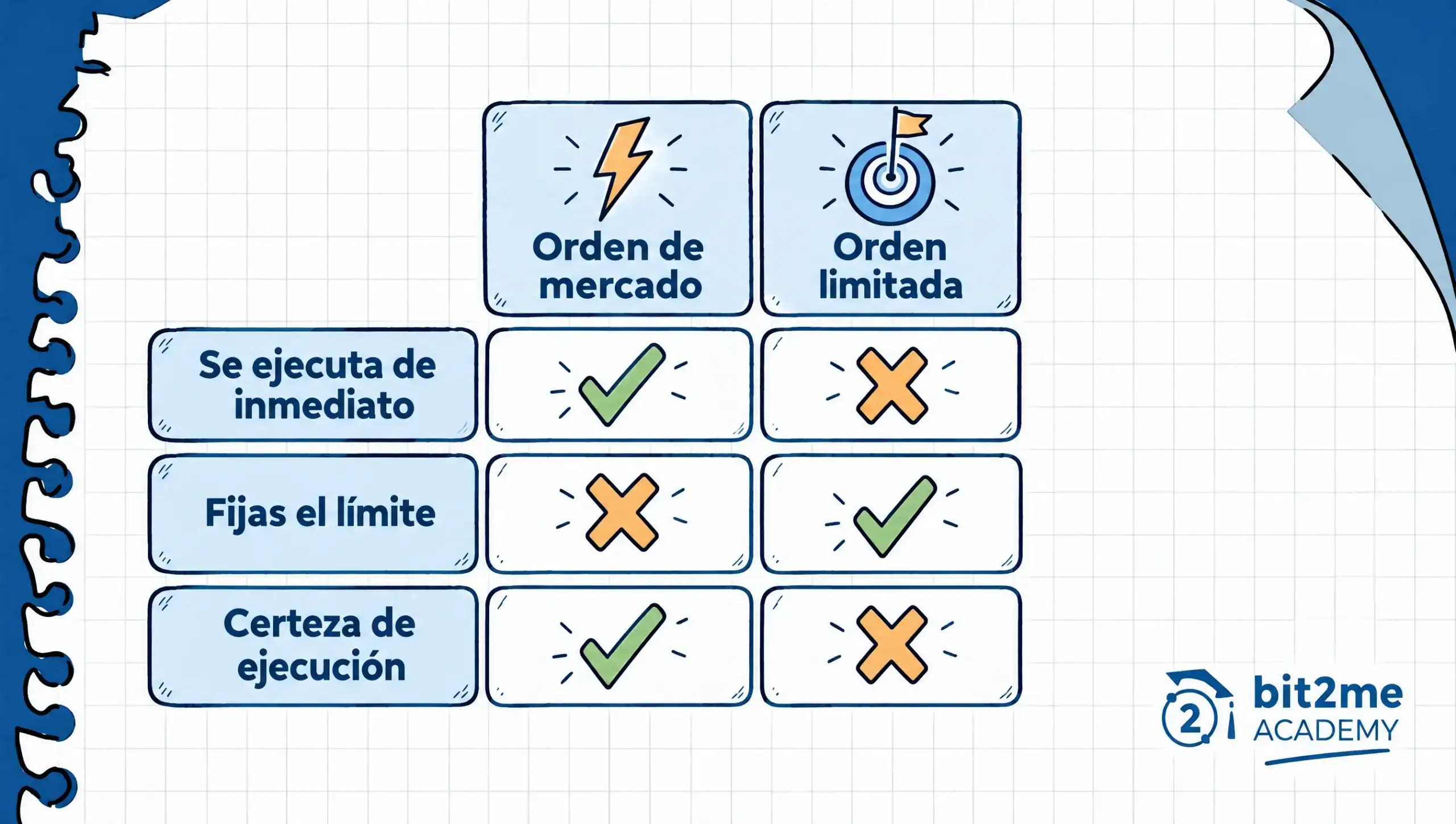
Step 2 deserves special attention because it determines how and when your sale is executed. A market order prioritizes immediacy: you sell at the best available price at that moment, with no guarantee that it will be exactly the price you saw seconds before due to natural market fluctuations. A limit order, on the other hand, prioritizes price: the trade is not executed until the market reaches the level you have set, which can take minutes, hours, or not be completed at all if the price never reaches it.
Market order or limit order: which to choose when selling
Choosing between a market order and a limit order It depends on what matters most to you when selling your crypto assets: speed or the exact price. If your goal is to have your euro balance available as soon as possible to initiate the withdrawal, a market order is the most direct option, as it is executed immediately against the best available buy offer at that moment.
If, on the other hand, you prefer to wait for the cryptocurrency to reach a specific price before selling it, a limit order allows you to set that level and leave the trade pending until the market reaches it. This option makes sense when you're not in a hurry to withdraw your funds and prefer to control the selling price more precisely, although it means accepting that the trade may take some time to complete or may not even be executed if the price moves away from your target.
Neither selling method is inherently better: market orders favor certainty of execution, while limit orders favor price certainty. Reviewing the cryptocurrency's recent history before deciding, rather than choosing out of habit, helps determine the most appropriate order type for each specific situation.
How to request a SEPA withdrawal to your bank account
Once you've sold the cryptocurrency and the euro balance is available in your user account, the next step is to withdraw the cryptocurrency to your bank account via a SEPA transfer. SEPA (Single Euro Payments Area) is the euro transfer system common to the entire European area, and it's the standard mechanism used by [unclear - possibly "bank transfer companies"]. regulated crypto asset platforms to send funds to their users' bank accounts.
To request a withdrawal, access the corresponding section of the platform, select the previously linked bank account, and indicate the amount in euros you wish to transfer. Most platforms clearly display any withdrawal fees and the exact net amount you will receive; it's advisable to review this information before confirming, especially if it's your first withdrawal.
After confirmation, some platforms require a second verification using 2FA (two-factor authentication) as an additional security measure, since this involves transferring funds out of the account. This layer of protection reduces the risk of someone withdrawing funds without your consent should they gain unauthorized access to your account.
Typical processing times at your bank
One of the most frequently asked questions when selling cryptocurrencies for the first time is how long it takes for the money to actually appear in your bank account. Unlike card purchases, which typically credit the cryptocurrency within minutes, withdrawing euros via SEPA follows the traditional banking system's processing times, which are inherently slower.
Under normal circumstances, a SEPA withdrawal requested on a business day is usually credited within several hours to one or two business days, depending on the sending platform and the receiving bank. Requests made on weekends or public holidays are usually processed on the next business day, as the traditional banking system does not operate outside of these days in most SEPA countries.
If your withdrawal is taking longer than usual, it's most likely because the request is still undergoing internal validation by the platform or is in transit to the bank, not because there's a problem with the transaction itself. Checking the status of your request in your account history before trying again will prevent confusion, and if the processing time is unusually long, contacting the platform's support team will usually resolve the issue.
| Appearance | Sell the crypto asset | Withdraw to bank account (SEPA) |
|---|---|---|
| What happen | The cryptocurrency is converted into a euro balance within the platform | The euro balance is transferred from the platform to the bank |
| Usual time | Almost immediate with market order | From several hours to 1-2 business days |
| Depends on | The type of order chosen and market liquidity | The receiving bank and whether the request is on a working day |
| Prerequisite | Verified account (KYC) | Bank account linked to your name |
What to check before confirming each transaction
Before confirming either the sale or the withdrawal, it's worth taking a moment to review a couple of details that prevent common mistakes, especially in your first transactions. Checking these points takes only a few seconds and significantly reduces the likelihood of needing to contact support later.
- Before confirming the sale, check that the net amount you will receive, after fees, matches your expectations.
- Verify that the IBAN of the linked bank account is correct and still active before requesting the withdrawal.
- Confirm the order type chosen (market or limit) to avoid selling at a different price than you had in mind.
None of these steps replace the information the platform itself displays on screen before each confirmation, but they serve as a reminder of what to look for when you don't yet have the automated process memorized. Over time, reviewing these details becomes a quick habit rather than an extra step that slows down the operation.
The sale and its effect on income tax: what should be recorded
Selling cryptocurrencies is not just a technical operation within a platform: it also has tax consequences that should be considered from the very first sale. In Spain, the sale of a cryptocurrency generates a capital gain or loss for the purposes of IRPF (Personal Income Tax), calculated as the difference between the acquisition value and the transfer value of that crypto asset.
This means that every time you sell, you should record at least the transaction date, the original purchase price in euros, and the final sale price in euros. Keeping this record from the beginning, rather than trying to reconstruct it months later when filing your tax return, saves considerable time and reduces the margin of error.
This article does not delve into the tax details of each scenario, because the specifics vary depending on each person's transaction history, and it is advisable to consult with a qualified professional. To automate this record-keeping, Bit2Me TAX It allows you to calculate the capital gain or loss generated by your cryptocurrency trading transactions, and if you want to better understand the general framework before going into detail, the tax cluster of Bit2Me Academy It also includes other articles specifically focused on the taxation of crypto assets.
Common mistakes when selling cryptocurrencies for the first time
Many of the problems that arise when selling cryptocurrencies and withdrawing euros for the first time are related to overlooked preliminary steps rather than the transaction itself. Knowing these steps beforehand helps avoid them without having to learn them through experience.
One of the most common mistakes is trying to withdraw funds to a bank account that isn't yet linked or verified on the platform, forcing you to complete that process right when you need the money. Another frequent error is confusing the type of sell order, for example, placing a limit order at an unrealistic price and being surprised when the trade doesn't execute for days.
It's also common to underestimate the applicable commission for both sales and withdrawals, only to discover later that the net amount received is somewhat less than expected. Carefully reviewing each screen before confirming, as discussed in the previous section, is the simplest way to avoid these three mistakes in practice.
Selling without having bought first: why order matters
The entire process described in this guide assumes you already have crypto assets in your account, acquired previously. If you haven't yet taken that first step and want to understand how acquisition works before considering a future sale, this guide will help you understand how the acquisition process works. Bit2Me Academy about how to buy bitcoin It explains in detail the purchase process, its requirements, and the aspects you should know before acquiring your first crypto asset.
A thorough understanding of the buying process also simplifies the selling process, as many concepts are common to both: identity verification, the order types available on the platform, and the importance of always operating with a provider authorized under MiCA. Those who have already made purchases at their own pace often find selling a more intuitive process than they anticipated, precisely because they are already familiar with the interface and the general operation of the account.
You can create an account at Bit2Me To see firsthand how the sales, SEPA withdrawal, and verification steps we've covered in this guide are applied, whether you already own crypto assets or are still deciding on your first purchase.
What to do if the price isn't what you expected
It's common to hesitate about the exact moment to sell, especially if the cryptocurrency's price has fluctuated in the preceding hours or days. No platform or educational article can tell you the right time to sell, because cryptocurrency prices depend on multiple market factors that cannot be predicted with certainty.
What you can control is the process: calmly deciding which type of order best suits your situation, checking the net amount before confirming, and linking your bank account in advance so that withdrawals don't depend on last-minute procedures. This control over the process itself is, in practice, the most reassuring aspect when market prices are beyond your control.
Selling cryptocurrencies and seeing the amount reflected in your bank account closes a cycle that began with the purchase, but it doesn't have to be a final decision or a complete end to your relationship with crypto assets. You can sell some and keep the rest, repeat the process later, or simply familiarize yourself with it for when you need it, knowing that every transaction you make should be recorded for your next tax return.
Legal notice regarding the risk of crypto assets
Investing in cryptocurrencies is not fully regulated, may not be suitable for retail investors due to its high volatility, and carries the risk of losing all invested funds. It is important to read and understand the risks of this investment, which are explained in detail at: https://up.bit2me.com/legalbit2me
Frequently asked questions about selling cryptocurrencies
What do I need to sell cryptocurrencies and withdraw euros to my bank?
You need to have your account verified through KYC and a bank account linked in your name on the platform. Once both requirements are met, you can sell the cryptocurrency and request a SEPA withdrawal without any further steps.
How do I choose between a market order and a limit order when selling?
A market order executes the sale immediately at the best available price, while a limit order waits for the market to reach the price you set. Choose a market order if speed is your priority, and a limit order if you prioritize controlling the exact selling price.
How long does it take for the money to arrive in my bank account?
A SEPA withdrawal requested on a weekday is usually credited within several hours to one or two business days. Requests made on weekends or holidays are usually processed on the next business day.
Can I withdraw money to someone else's bank account?
No, regulated platforms require that the destination bank account be in your own name and verified within your profile. This restriction is in accordance with anti-money laundering regulations applicable in the European Union.
Is there a fee for selling cryptocurrencies or withdrawing euros?
It depends on the platform: sales usually incur a commission on the transaction amount, and SEPA withdrawals can be low or free depending on the provider. It's advisable to review both fees on screen before confirming each step.
What happens if I sell and don't withdraw the money immediately?
The euro balance remains available in your user account on the platform until you decide to withdraw it or use it for another transaction. There is no obligation to withdraw immediately after selling.
Is it safe to sell cryptocurrencies on an exchange?
On a platform authorized as a cryptocurrency service provider under MiCA, sales and withdrawals follow regulated verification and fund segregation processes. No measure completely eliminates the risk associated with cryptocurrency volatility, so it's advisable to be well-informed before trading.
Does selling crypto assets have tax consequences?
Yes, the sale generates a capital gain or loss for income tax purposes, calculated as the difference between the purchase price and the sale price. Tools such as Bit2Me TAX helps calculate that result based on your transaction history.
What is the difference between selling with a market order and selling with a limit order?
A market order prioritizes immediate execution, even if the final price may vary slightly, while a limit order prioritizes a fixed price, even if the trade takes longer to complete or isn't executed at all. The choice depends on whether you value speed or price accuracy more.
What is the current status of the sales and withdrawal process on regulated platforms?
Since the implementation of the MiCA Regulation, authorized platforms such as CASP/PSCs in the European Union must maintain clear processes for identity verification, segregation of client funds, and withdrawals via standard banking systems like SEPA. These requirements generally make the process of selling and withdrawing euros uniform across regulated platforms operating in Spain.


«Investment in cryptoassets is not fully regulated, may not be suitable for retail investors due to high volatility and there is a risk of losing all invested amounts»
Share this article!Continue learning
DCA: qué es la compra periódica de criptomonedas y cómo automatizarla
Descubre qué es el DCA en criptomonedas: cómo funciona la compra periódica, qué límites reales tiene y cómo automatizarla paso a paso en la app de Bit2Me.

Cómo elegir proveedor cripto B2B: checklist para tu RFP
Checklist objetivo para tu RFP: cómo evaluar un proveedor cripto empresas por licencia CASP, custodia, SLA, API, comisiones y trayectoria antes de firmar.
Cierre contable de fin de año con criptoactivos en balance
Cierre contable criptomonedas paso a paso: valoración, deterioro y documentación para el fin de ejercicio de tu empresa con criptoactivos en el balance.
Stablecoins para pagos internacionales B2B
Por qué las empresas usan stablecoins para pagos internacionales: liquidación rápida, menor volatilidad y la terminología MiCA EMT y ART explicada.