Cryptocurrencies in Ireland: buying guide 2026
- Currency
- EUR
- Legal status
- Legal and regulated (MiCA)
- Supervisor
- Central Bank of Ireland

 Ireland
Overview in Ireland
Buying cryptocurrencies in Ireland is legal, mainstream and increasingly shaped by European rules — yet reliable guidance in plain English for Irish residency remains uneven. Global blogs ignore Revenue CGT deadlines, SEPA quirks with AIB or Bank of Ireland, and the fact that Dublin hosts major MiCA licensing hubs while most residents simply want a safe euro on-ramp. If you need a guide written for the Irish market — regulator, currency and tax obligations included — this hub gathers what matters before you explore each crypto-asset in depth.
Ireland implements the Markets in Crypto-Assets Regulation (MiCA, Regulation EU 2023/1114) as an EU member state. Title V rules for crypto-asset service providers (CASPs) have applied in full since 30 December 2024. The Central Bank of Ireland authorises and supervises CASPs — including EU-passported entities contracting through Irish legal vehicles. Legacy virtual-asset service providers registered under the pre-MiCA AML regime may continue until 1 July 2026 while applying for authorisation; after that date, serving Irish residents without a MiCA licence is prohibited. For you as a user, the practical takeaway is to prefer MiCA-licensed platforms with segregated client custody before you transfer euros from your Irish current account.
Operationally, Ireland uses the euro and SEPA, so funding a MiCA platform is straightforward: SEPA from AIB, Bank of Ireland, PTSB or digital banks, or card and mobile wallet top-ups for first purchases. Tax is handled by Revenue: disposals — including crypto-to-crypto swaps — can trigger Capital Gains Tax at 33% after the €1,270 annual exemption (2026). The sections below unpack regulation, market context, tax, security and the step-by-step buying process.
Key facts
- Currency
- EUR
- Legal status
- Legal and regulated (MiCA)
- Supervisor
- Central Bank of Ireland
- Tax authority
- Revenue Commissioners
Crypto regulation in Ireland: MiCA and Central Bank supervision
The legal baseline for crypto-assets in Ireland is Regulation (EU) 2023/1114 (MiCA). Approved by the European Union and applicable across all twenty-seven member states, MiCA creates a single framework for token issuers, stablecoins and crypto-asset service providers. Its goal is not to ban innovation but to require authorisation, minimum capital, conflict-of-interest policies, segregated client custody and clear risk disclosure to retail investors. A platform operating in Ireland without the corresponding CASP licence falls outside the regulated perimeter once the transition period ends.
In Ireland, supervision of authorised entities rests with the Central Bank of Ireland, which publishes MiCA guidance, maintains registers of authorised CASPs and can warn the public about unauthorised firms. Ireland's role as an EU licensing hub means several global brands contract with Irish legal entities under CBI supervision — Payward Europe (Kraken) is a public example — but retail users should still verify which legal entity holds their funds and whether that entity appears on the official register. Passporting allows a CASP authorised in another member state to serve Irish residents if it notifies under MiCA rules.
For retail investors, MiCA introduces tangible changes: white papers for certain tokens must meet EU standards; significant stablecoins face stricter reserve and liquidity rules; and providers must separate client funds, undergo audits and maintain operational resilience plans. Title V CASP rules have applied since 30 December 2024. Providers registered only under Ireland's pre-MiCA virtual-asset service provider regime may continue until 1 July 2026 while seeking full authorisation; after that deadline, unlicensed service to residents is unlawful. This does not eliminate market risk — Bitcoin can still fall twenty per cent in a week — but it reduces counterparty risk.
Consumer-facing advertising must not understate volatility or imply guaranteed returns, in line with CBI conduct expectations and EU investor-protection standards. Before depositing euros, check MiCA authorisation status on the Central Bank website, read custody terms and enable two-factor authentication. Educational best practice — not legal advice — is to use MiCA-licensed CASPs, never share recovery phrases and avoid platforms that solicit remote access to your device. Operating through an unlicensed offshore venue may leave you without an effective EU supervisor if a dispute arises.
The Irish crypto market: euro, multinationals and SEPA rails
Ireland combines a domestic population of roughly five million with one of Europe's largest multinational workforces: tech, pharma and financial-services employees in Dublin, Cork and Galway often encounter crypto through US-parent payroll, stock compensation or peer networks. Unlike inflation-hit economies where stablecoins replace a weak currency, Ireland's euro provides monetary stability and the main declared motives tend to be portfolio diversification, access to global digital assets and curiosity — not replacing euro cash at the till.
The dominant investor profile skews medium-to-long term: recurring euro purchases, accumulation on regulated platforms and less high-frequency day trading than in some Asian or US retail markets. Universal online banking — nearly everyone has a current account and debit card — simplifies onboarding: verify identity, send a SEPA transfer from AIB or Bank of Ireland and hold Bitcoin in custody within hours. Because Ireland uses the euro, MiCA platforms quote natively in EUR without FX friction on deposits.
SEPA from Irish banks, credit unions or Revolut Ireland is the workhorse funding rail; cards, Apple Pay and Google Pay suit quick first buys. Bitcoin and Ethereum concentrate search interest and volume, followed by stablecoins such as USDT and USDC — useful for moving value without volatility exposure — and a long tail of altcoins tied to DeFi, layer-2 or sector narratives. Irish law does not ban specific tokens on authorised venues; listing policy is each CASP's compliance choice. Public debate sometimes conflates Ireland's CASP licensing cluster with everyday retail investing — related topics, but distinct experiences for most buyers.
Availability of more than four hundred crypto-assets on European CASPs such as Bit2Me reflects diversified demand without opening accounts in multiple offshore jurisdictions. The spoke pages linked from this hub go deeper on local angles: Bitcoin as long-term euro diversification, Ethereum via Dublin's fintech corridor, USDT for dollar-linked liquidity in an FDI-heavy economy, XRP for cross-border settlement narratives and Cardano for proof-of-stake holdings aligned with ESG-aware portfolios. Each asset page repeats only what is unique to that token; regulation, Revenue CGT at 33% and SEPA funding stay here.
Taxation of crypto in Ireland: Revenue, CGT at 33% and myAccount
Revenue treats crypto-assets as chargeable assets — not legal tender in Ireland, but generating tax obligations when your asset composition changes. The most common case is selling crypto for euros: the difference between acquisition cost (including fees) and disposal proceeds is a chargeable gain within Capital Gains Tax (CGT) at 33%. An annual exemption of €1,270 (2026) may reduce net gains. Simply holding without disposing does not by itself trigger CGT, though other rules may apply to income-like rewards.
Swaps — exchanging Ethereum for USDT, Bitcoin for Cardano, etc. — also constitute disposals: you are treated as selling the origin asset and acquiring the destination, calculating gain or loss in euro at the moment of exchange. Paying for goods or services directly with crypto follows the same logic when a chargeable gain arises. Many users believe they "only pay tax when cash hits the bank"; that is incorrect for crypto-to-crypto trades. Keep a chronological log: date, asset, quantity, euro price, fees.
Report disposals through Revenue Online Service (myAccount) or Form CG1 by the relevant deadline (typically 15 December for disposals in the first eleven months of the year, 31 January for December disposals), attaching a calculation schedule. Staking, lending, earn or airdrop rewards may create additional taxable events when received, depending on product structure. Revenue and EU data-sharing frameworks mean exchange reporting is increasing — voluntary compliance remains cheaper than later corrections with interest and penalties.
Capital losses on crypto disposals can offset chargeable gains in the same tax year, but loss utilisation follows Revenue rules — keeping records of losing trades matters as much as winning ones. Moving crypto between your own wallets without a change of beneficial ownership does not typically trigger CGT by itself, but using different platforms can complicate cost-base tracking if you do not export histories. Revenue has increased use of exchange data and blockchain analytics in compliance programmes; this does not make holding crypto illegal, but raises the cost of under-reporting.
If you make few trades per year, a spreadsheet may suffice; frequent traders should export CSV histories and consider crypto-tax tooling or professional advice. This section is educational and does not replace Revenue's official guidance or a qualified tax professional. Consult revenue.ie before filing.
This information is educational and does not replace professional tax advice. Always consult your tax authority before filing.
Security and custody: protecting crypto as an Irish resident
Security in crypto has two dimensions: market risk (volatility, scams, failed projects) and operational risk (hacks, phishing, lost keys). No MiCA licence removes the first, but it mitigates the second when you choose a provider subject to custody, cybersecurity and audit requirements. In Ireland, operating with a CASP authorised by the Central Bank of Ireland or passported under MiCA implies segregated client funds, incident-response plans and pre-contract risk disclosure.
Bit2Me, as a reference European platform, has operated since 2014 without custody security incidents in that period (per its public record), complements custody with insurance on qualifying balances, and supports two-factor authentication plus fraud monitoring. That is not a bank deposit guarantee: crypto remains a risky asset class and insurance covers defined custody events, not market losses. For larger holdings, many users combine exchange custody for daily use with periodic transfers to a hardware wallet they control.
Personal hygiene remains universal: enable app-based 2FA instead of SMS where possible, never share seed phrases, verify URLs before login and hang up on "support" calls requesting remote access. English-language support on an EU CASP reduces friction when a first SEPA from an Irish bank is delayed — a factor often underestimated versus global exchanges with ticket-only support in US time zones.
The Central Bank of Ireland regularly warns about unauthorised investment firms and social-media crypto scams targeting Irish residents. Legitimate CASPs never guarantee returns or ask you to install remote-access software. If an offer sounds too good to be true — fixed weekly yields, "recovery" services after a loss, or pressure to act within hours — treat it as fraud and report suspicious activity through official CBI channels rather than sending more funds.
Ready to buy in Ireland?
Create your free account, choose a method available for your market, and get started in minutes.
- SEPA transfer
- Card
- Apple Pay
- Google Pay
How to buy cryptocurrencies in Ireland
Three steps to get started with your local currency on a regulated platform.
Step 1
Open an account and complete KYC
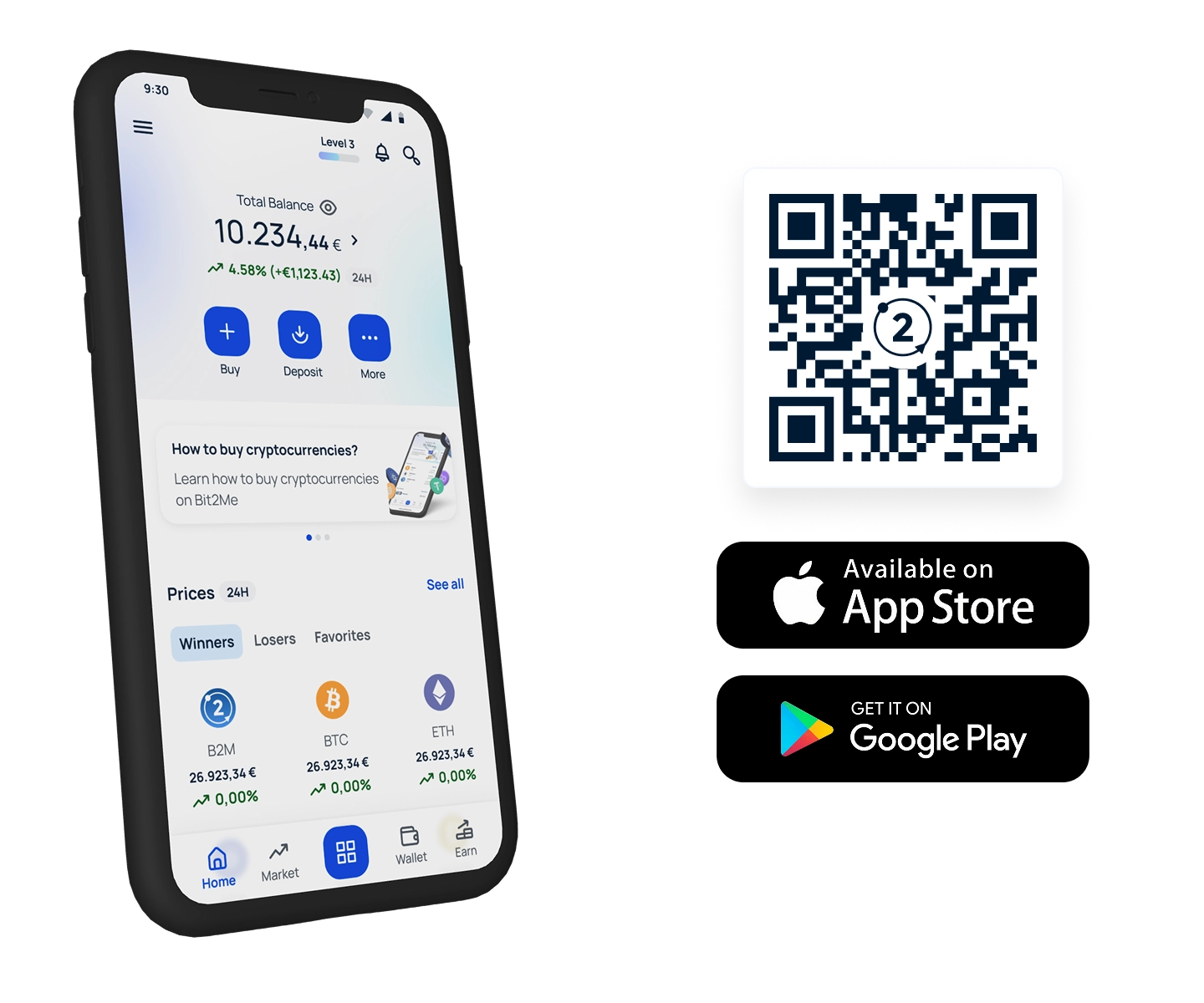
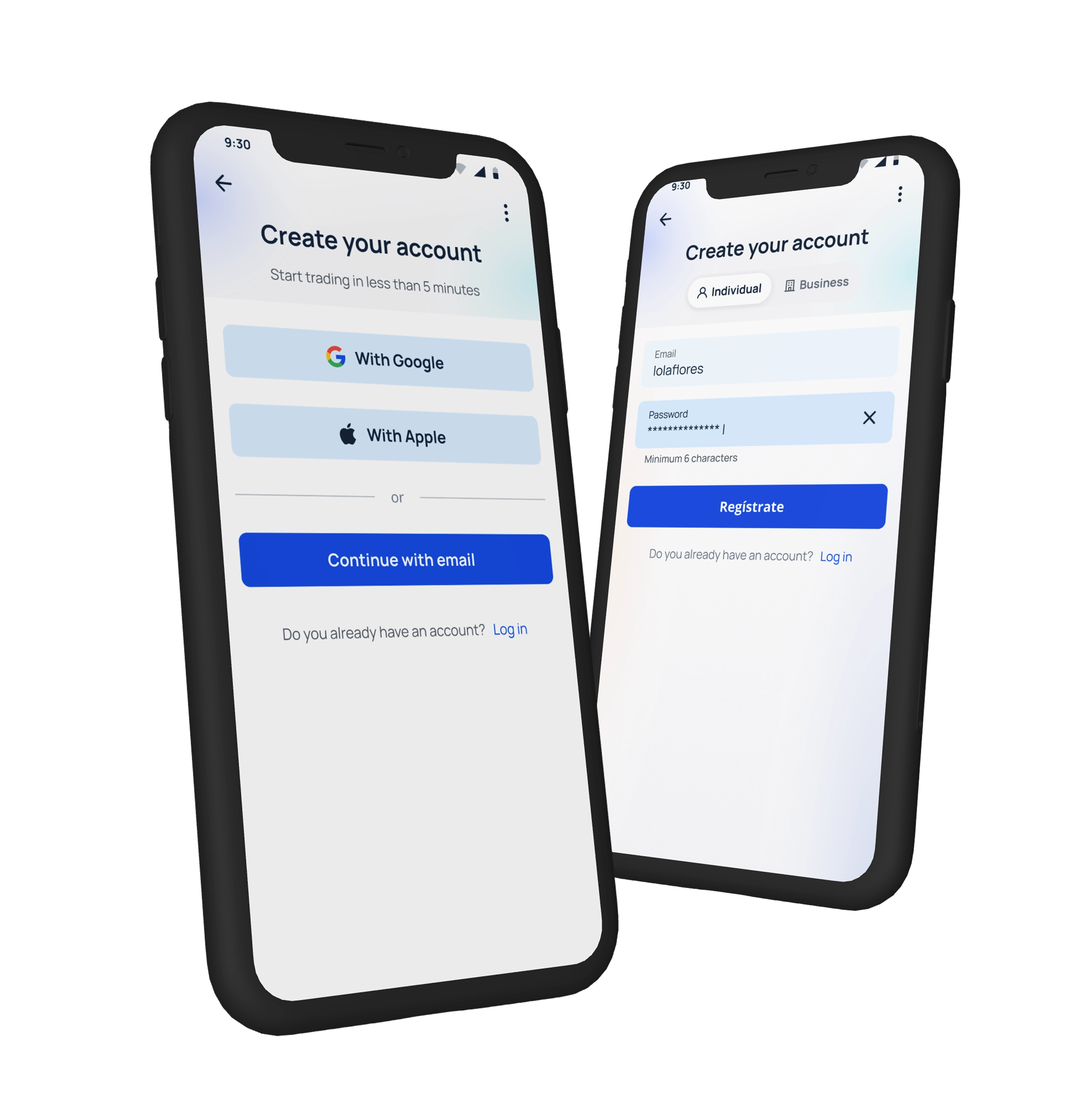
Register on a MiCA-licensed CASP such as Bit2Me with your email and a strong password. Complete identity verification (KYC): passport, Irish driving licence or Public Services Card, selfie and sometimes proof of address. This is a legal anti-money-laundering requirement for all authorised providers; without KYC you cannot deposit euros or withdraw funds to your Irish bank.
Step 2
Fund in euros via SEPA or card
Choose your local payment method. A SEPA credit transfer from AIB, Bank of Ireland, PTSB or your credit union is usually low-cost and arrives within one business day. Debit or credit card, Apple Pay and Google Pay are faster for small first purchases but may carry a percentage fee. Check minimum and maximum deposit limits before sending funds; if your bank queries an unfamiliar IBAN, contact both the bank and the exchange support team — SEPA to a MiCA-licensed CASP is the standard compliant route.
Step 3
Buy your chosen crypto-asset
Navigate to the market or converter, select the asset (Bitcoin, Ethereum, USDT, XRP, Cardano or another from 400+ listings), and enter a euro amount or crypto quantity. Review the exchange rate, spread and trading fees before confirming. You can make a one-off purchase or configure recurring buys if the platform supports DCA — a common strategy among Irish investors who average entry price over time rather than timing the market.

Step 4
Keep custody on-platform or in your wallet
After purchase, your crypto sits in custodial balance on the exchange, ready to sell, convert or withdraw. For self-custody, generate a withdrawal to your personal wallet address — verify the blockchain network and destination character by character; errors are irreversible. Many Irish users keep an operational portion on a regulated exchange for trading and move larger long-term holdings to cold storage with a hardware wallet they control.
Bit2Me products available in Ireland
Services
10 of 10 products available in Ireland
10
Available
0
Not available
- Available
Deposit with credit, debit, or prepaid card
- Available
Instant purchase with Card
- Available
Deposit with bank transfer
- Available
Transfers between own wallets
- Available
Deposits with cryptocurrencies
- Available
Transfers between Bit2Me users
- Available
Withdrawal with bank transfer
- Available
Exchange between cryptocurrencies
- Available
Cryptocurrency withdrawals
- Available
Crypto Mastercard debit card







Payment methods in Ireland
With Bit2Me, you can buy and sell crypto using the methods available for this market, depending on the operations enabled in your country.
Local bank transfers
Credit and debit cards
Digital wallets and mobile pay
How to invest in cryptocurrencies in Ireland?
Investing in crypto in Ireland is easier than you think
Register, verify your account and choose how much to invest to buy Bitcoin, Ethereum and other cryptocurrencies from any device on a MiCA-regulated European platform.
Why Bit2Me lets you sleep at night
If you buy crypto from Ireland, doing it through a MiCA-licensed European CASP matters: native euro SEPA funding, EEA supervision, insurance on qualifying custodial balances, and a track record since 2014 without custody security incidents. Bit2Me brings those pieces together without offshore uncertainty.
Crypto that doesn't stain you
Bit2Me complies with KYC/AML and is registered with the Bank of Spain: your operations don't mix with illicit-origin funds on a supervised platform.
Headquartered in Spain, not a tax haven
Bitcoinforme S.L. operates under European law with the CNMV as its direct supervisor.
Free, automatic tax report
Download it from the app or web for every tax year you've traded, at no extra cost. It generates itself from your activity.
No security incidents since 2014
Five consecutive independent audits back our operational soundness.
Human support in your language
24/7 support in your language, with a phone line (+34 910 91 37 88) and people — not bots — answering from Spain.
A platform that doesn't go down
Multi-region high availability, 24/7, 365 days a year, with ~100 ms average response.
Your funds, when you decide
Withdraw to your own wallet at any time. No lock-in, no penalty.
$150M insurance on custody
Assets in Bit2Me Custody are insured for $150M (USD), with segregated cold storage and multisig + HSM FIPS 140-2.
Trust and compliance
Bit2Me operates under European supervision with recognised security certifications.
Operational since 2014
First Spanish Fintech to obtain the MiCA License


Operational since 2014
First Spanish Fintech to obtain the MiCA License
Crypto guides in other countries
Explore crypto guides tailored to other markets.



Get started in Ireland with Bit2Me
Free account, buying methods available for your market, and 400+ cryptocurrencies under European supervision.
Frequently asked questions
Sources
- Central Bank of Ireland — MiCA
centralbank.ie
- European Commission — Crypto-assets / MiCA
finance.ec.europa.eu
- Revenue — Cryptocurrency and CGT
revenue.ie
Educational information; not financial or tax advice. Always verify with official sources.